Reunion 2023 – Vào Hạ

CHƯƠNG TRÌNH HỌP MẶT 2023

Louisiana – Florida

New Orleans

Day 1 – Saturday: 

1. Arrival:

Lái xe từ Houston, Dallas – Texas. Khởi hành bằng máy bay từ California, Canada và những nơi xa khác đến phi trường Louis Armstrong New Orleans International Airport. Ra phi trường đón bạn từ xa về.

 2. Oak Alley Plantation:

Cách phi trường MSY 40 miles, đồn điền trồng mía Oak Alley Plantation được nhiều người biết đến bởi vẻ đẹp của hàng cây sồi đại thụ được trồng từ thế kỷ 18. Open 8:30AM–5PM

https://www.oakalleyplantation.org/

3. Swamp Tour:

Thăm khu đầm lầy, rừng ngập nước đa dạng, kỳ vĩ được ví như “bảo tàng” thiên nhiên khổng lồ, mang nét nguyên sơ, huyễn hoặc tựa cõi mộng. 14 miles from airport. Open 9AM–4PM.

https://www.cajunprideswamptours.com/tours/swamp-tours

 4. New Orleans’ levees – Great Wall of Louisiana:

Ngắm hoàng hôn bên bờ hồ Pontchartrain.

Leo lên con đê đoạn bên bờ hồ Pontchartrain và cây cầu Causeway. Ngay dưới chân đê là những xóm nhà không bị ngập lụt vì bão Ida vừa qua nhờ hệ thống chống bão lụt quy mô cho New Orleans được xây dựng sau khi cơn bão Katrina đã gây thiệt hại về nhân mạng, tài sản rất lớn, làm đình trệ nền kinh tế của New Orleans và Louisiana trong nhiều năm trời.
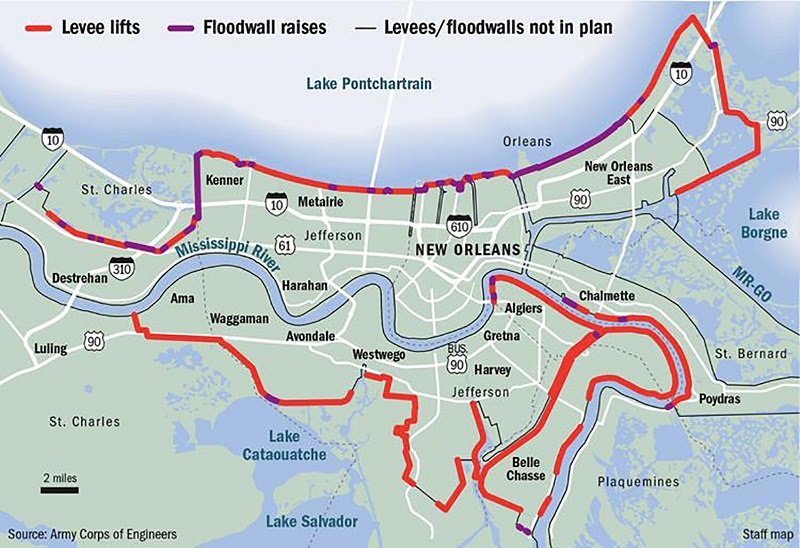
Sau cơn bão Katrina đổ vào New Orleans hồi cuối tháng 8 năm 2005, công binh Hoa Kỳ đã được giao nhiệm vụ xây dựng một hệ thống phòng chống lũ lụt tại đây với ngân sách hàng chục tỉ đô la. Hệ thống phòng thủ này bao gồm những máy bơm, hệ thống đê và tường chống lũ lụt có khả năng chống chọi với những “cơn bão thế kỷ”, được thiết kế và tính toán dựa trên cơn bão dữ có sức công phá dữ dội nhất như Katrina.

5. Uống cà phê nghe nhạc Jazz:

https://www.cafebeignet.com/

    311 Bourbon Street + 8am-9:30pm Daily + Live Jazz Daily 10am-Close

6. New Orleans by Night:

Ăn tối xong, đi dạo French Quarter vào buổi tối, xem khung cảnh nhộn nhịp của nơi này.

Cả thế giới không đâu có. Chỉ một con phố nhỏ Bourbon, mỗi buổi tối, nhất là vào cuối tuần, cả ngàn người tản bộ hoặc vào các quán nhâm nhi một vài ly rượu cho ấm áp lòng người cô quạnh, rồi ngắm các người đẹp đi vài đường lả lướt trên sàn nhẩy thật mát mắt. Nếu du khách quan niệm “nghệ thuật vị nghệ thuật” thì những màn biểu diễn của những người đẹp miền Nam Hoa Kỳ, cũng xin được nhìn với con mắt bao dung của nghệ thuật. Xin nhớ điểm đặc thù của New Orleans là rượu pha cocktail brandy là nghệ thuật tuyệt vời của giới ăn chơi sành điệu. Đại lộ Canal với những hàng cột điện cổ kính trên hai trăm năm chiếu ánh quang huy hoàng giữa lòng trung tâm thành phố, khiến các sử gia khoác cho một danh xưng đầy quyến rũ: “Con đường sáng nhất thế giới”. Mọi thứ ở New Orleans dường như chỉ bắt đầu khi thành phố lên đèn.

Day 2 – Sunday:

1. Jackson Square:

Đậu xe sau quán Café Du Monde uống cà phê sáng rồi đi thăm những nơi gần quán Café

Jackson Square

2. Uptown & Garden District:

Đến trạm xe điện phía sau Café Du Monde mua vé one-day pass $3 đi thăm thành phố. Xuống trạm Audubon Park. Ghé thăm 2 trường Tulane và Layola Universities đối diện công viên.

Uptown and Garden District.

3. Bourbon Street:

Xe điện (Streetcars) sẻ trở về và dừng lại đầu đường Bourbon. Đi dạo trên đường Bourbon và những con đường quanh đó để thấy French Quarter lúc ban ngày.

4. Theresa Seafood 

Lạc trôi về vùng miệt thứ Louisiana diện kiến dung nhan “Nữ tướng Tôm Tươi” mà đài VOA đã từng lặn lội đến đây làm phóng sự về tấm gương tần tảo làm việc nuôi 10 người con khôn lớn và tạo dựng nên cơ ngơi ngày nay.

Mua tôm tươi mới từ tàu chở vào vựa hải sản.

Florida

Lên đường đi Florida là tiểu bang được mệnh danh là thiên đường của biển, là nơi quanh năm ấm áp và ngập tràn nắng.

Từ New Orleans tới Florida phải đi qua 3 tiểu bang : Louisiana, Mississipi và Alabama.

Tiểu bang Alabama được biết qua tác phẩm nổi tiếng “Giết con chim nhại – To Kill a Mockingbird”. Đoạn băng ngang thành phố Mobile của tiểu bang Alabama, chui xuống một đường hầm dưới lòng sông đi thêm 52 miles là đến ranh giới bang Florida.

5. Destin:

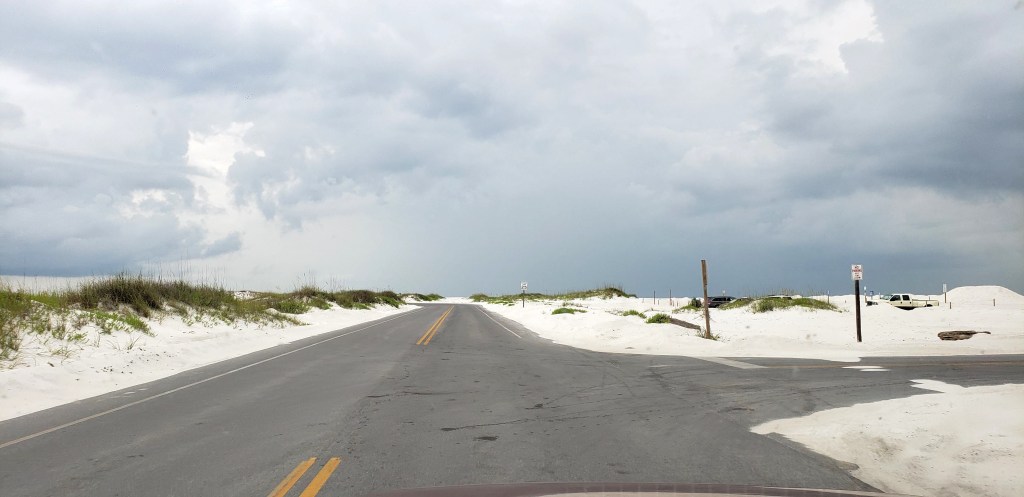
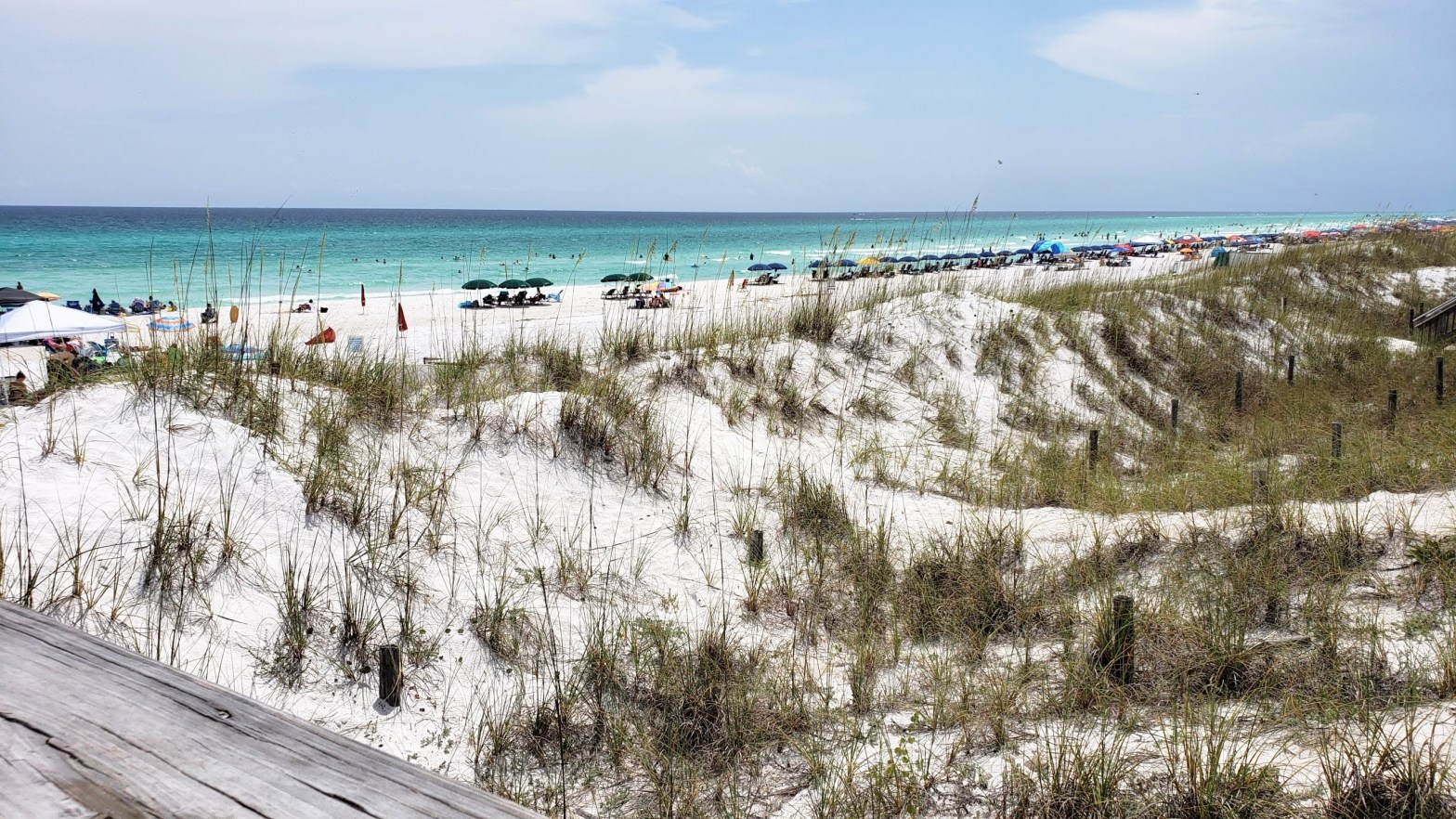
Vùng biển Destin thường được gọi là Emerald Coast biển xanh như ngọc, cát trắng chói mắt, sóng cũng vừa phải.
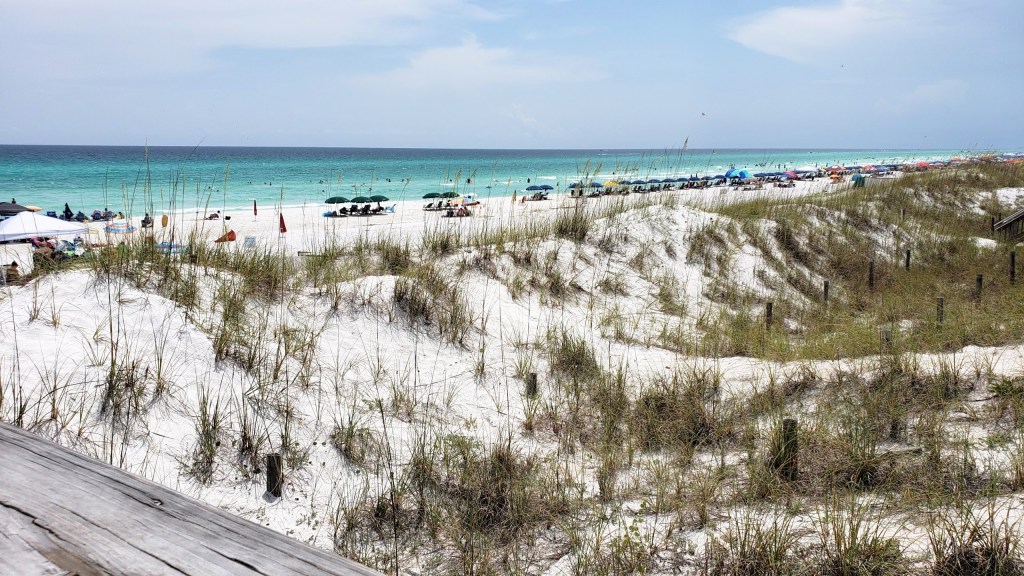
Đến Destin bằng con đường ven biển 98, hai bên đường có nhiều đụn cát trắng, phía tay phải là biển, bên tay trái là cái đầm rộng lớn, có một cái cù lao tên là Crab Island nhưng không thấy cái đảo nhỏ nầy nhô lên khỏi mặt nước, nhiều thuyền nhỏ và những người lội nước khoảng tới ngực đi chơi ở đó. Ở đó có nhiều trò chơi cho đủ mọi lứa tuổi, có thuyền bán thức ăn ….Tất cả sinh hoạt đều ở trên mặt nước như một khu chợ nổi.

Lái xe dọc theo đường ven biển Scenic Gulf Dr, nhà cửa và các căn condo to lớn đã gần như lấp đầy, che hẳn tấm mắt của người đi trên đường. Nhiều bãi tắm nối tiếp nhau, để tìm được một chổ đậu xe thật trần ai, nhất là vào ngày lễ.

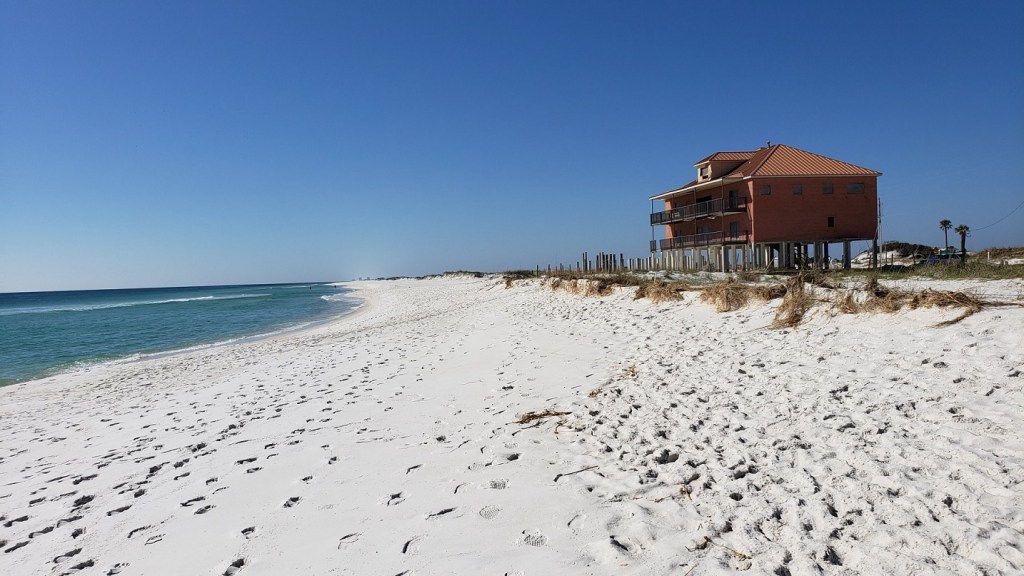
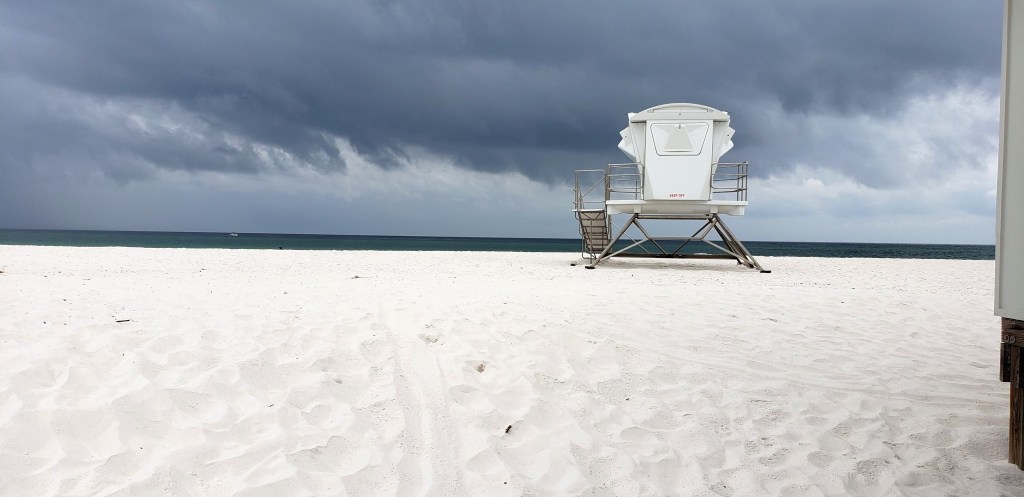
Ra biển, cát trắng ngoài sức tưởng tượng, như đang đi trên một tấm thảm nhung.

Day 3 – Monday:

🌊 CRAB ISLAND

Nếu các bạn có dip đi Destin nên trải nghiệm tới Crab Island nha. Zui lắm các bạn ơi :)) Chắc mình sẽ đi mỗi năm quá. Canh ngày trời nắng thì nhìn nước sẽ đẹp hơn. Các bạn có thể liên lạc với anh Tony Phạm để mướn pontoon chở các bạn ra Crab Island chơi nha, ảnh vừa ” đẹp trai, 6 múi, da ngăm” mà còn nhiệt tình , zui tính nữa. Đây sdt của ảnh nè các bạn 850-376-5034

🌊 FORT WALTON BEACH :

Ghé thăm Air Force Armament Museum kế bên Eglin Air Force Base.
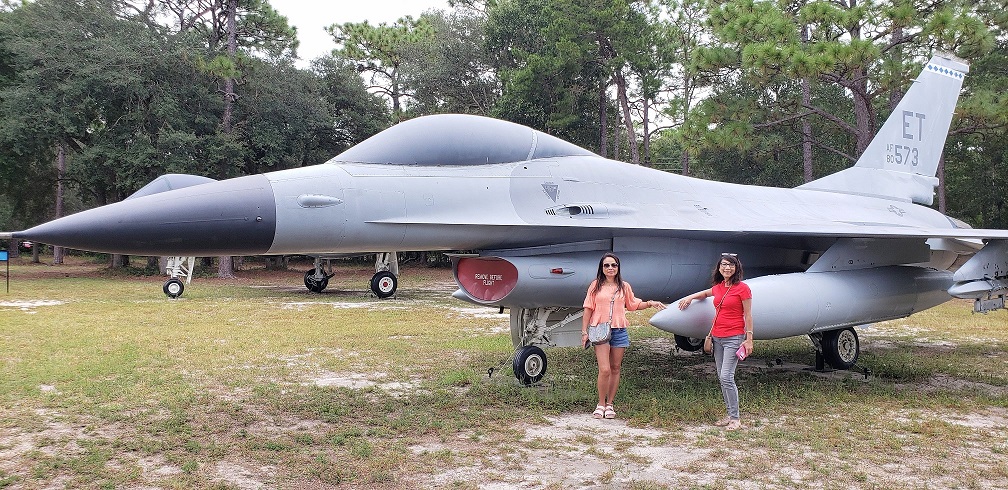
Là căn cứ không quân lớn nhất Hoa Kỳ, Eglin Air Force Base là trung tâm thử nghiệm các loại vũ khí phi hạt nhân của lực lượng không quân. Viện bảo tàng vũ khí không quân trưng bày nhiều phi cơ chiến đấu và các loại bom.

Thành phố Fort Walton Beach

🌊 OKALOOSA ISLAND

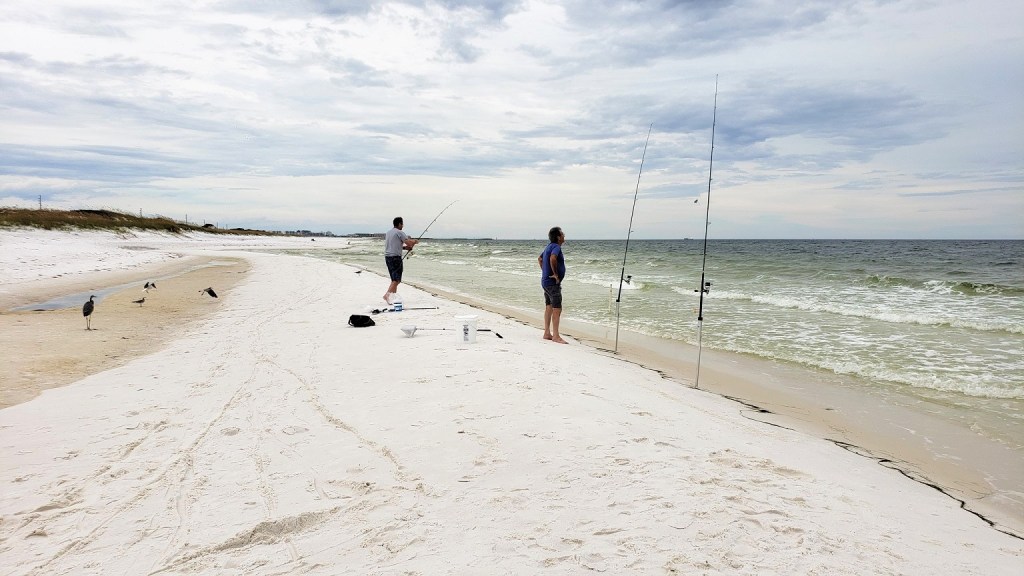
Cho những ai thích vùng biển vắng, hoang sơ. Những đàn chim hải âu, bồ nông, cò, vạc bay về đậu trên những cồn cát.
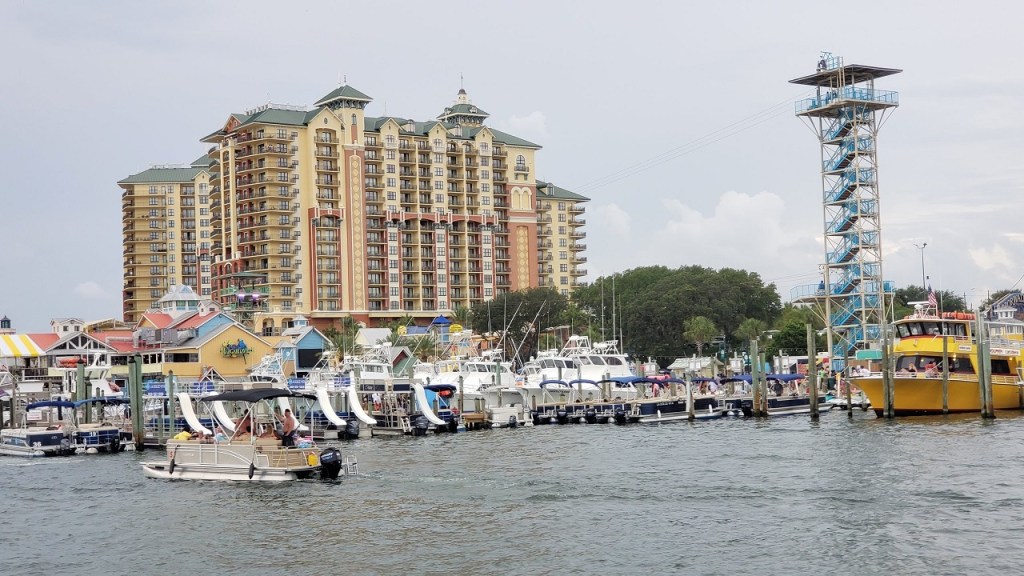
🌊 HABORWALK VILLAGE

Khu phố đi bộ HaborWalk Village ngay bến cảng khá dễ thương. Cảnh sông nước với thuyền bè tưng bừng ngược xuôi, hàng quán sinh hoạt và người qua lại ồn ào, náo nhiệt.
Day 4 – Tuesday

Northwest Florida Beaches Tour

Đi thăm một số ngôi làng và thành phố vùng Tây Bắc Florida với những phố biển xanh ngát trời mây, ru mình trên những con sóng hồn nhiên.

Nét chung của những phố miền biển nơi đây là một bên là biển xanh sóng vỗ rì rào, một bên là các dãy khách sạn, khu resort, condo hướng mình đón gió biển. Phóng tầm nhìn ra xa một chút sẽ thấy một màu xanh đại dương tươi mát hòa với màu trời trong vắt như ngọc. Khách lãng du chỉ cần lái xe một quãng ngắn, tìm chỗ đậu xe xong đi bộ một chút là ra tới bãi biển.

Phố biển gió mây lồng lộng, chạy dài nối tiếp nhau nhưng mỗi nơi cũng có đặc trưng riêng.

🌊 MIRAMAR BEACH :

Những condo vươn cao, mặt trước là biển, mặt sau gần vịnh, bên hông là hồ. Màu xanh của sân golf hợp với cái màu lóng lánh của mặt nước trong lành buổi sáng sớm.

🌊 SEASIDE :

Seaside đơn giản chỉ là một làng nhỏ ven biển.

Vẫn giữ được nét yên bình, sạch sẽ và trong lành của một vùng quê.

Trường làng đúng là “cây xanh lá vây quanh” . Đứng dưới những tàng lá xanh thấy học trò sinh hoạt trong sân trường. Những lớp học xây tách rời nhau vây quanh hành lang như những vệ tinh quanh một quỹ đạo.
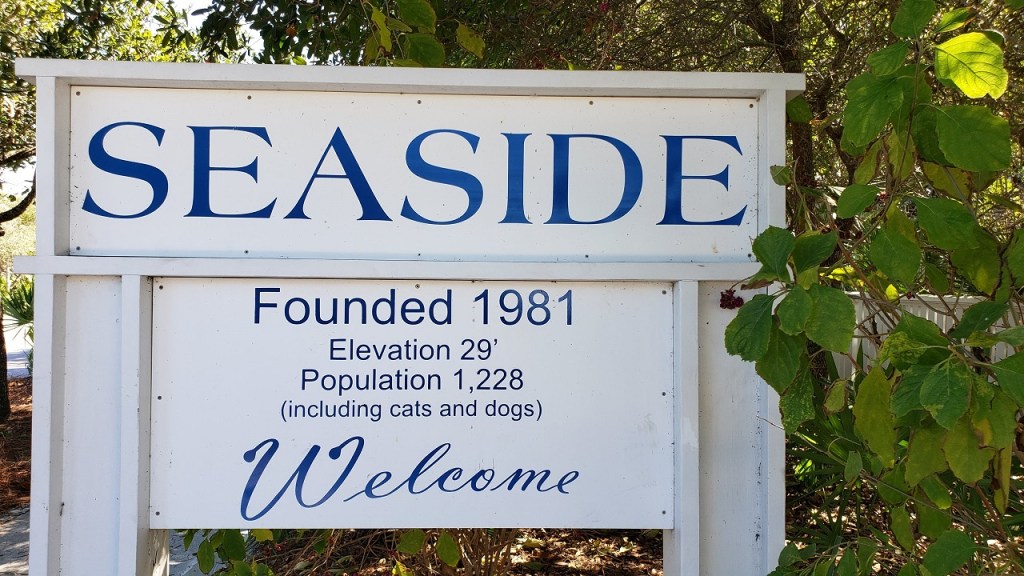
Làng Seaside với những con đường lát đá, những ngôi nhà trổ gác cao để sáng uống cà phê khẽ ngắm mặt trời lên trên biển.

Đi thăm những ngôi nhà trong làng khiến người ta hát khe khẻ bài Sắc Màu:
Một màu xanh xanh, chấm thêm vàng vàng
Một màu nâu nâu, một màu tím tím
Màu nâu tím mắt em tôi ôi đẹp dịu dàng
Một màu xanh lam, chấm thêm màu chàm …

🌊 ROSEMARY BEACH

Con đường đi vào phố biển có công viên nằm giữa 2 làn xe với những hàng cây rợp bóng. Cư dân và du khách di chuyển bằng xe đạp trên những con đường nhỏ như lạc vào một khu phố ở châu Âu.

🌊 PANAMA CITY BEACH

Vùng biển này kéo dài 27 miles và bình dân hơn nên những bãi biển khá ồn ào, náo nhiệt, nơi đây là của tuổi trẻ, các sinh viên Đại Học khắp nơi thường tụ tập về đây quậy dịp nghĩ spring break.

Day 5 – Wednesday

🌊 Pensacola:

Ghé tiệm Six Kids Store Super Deli để mua mực và cá còn nguyên con. Tiệm của anh Long cách Làng Quảng Pensacola khoảng 3 miles. Anh Long cũng là “Lý trưởng” của làng, lúc trước cư ngụ tại làng An Hải bên kia sông Hàn , Đà Nẳng. Qua Mỹ năm 1980 lúc 13 tuổi.

Biển ở đây không có cá chuồn, cá đù, cá hố như bên mình, nhưng cá ngân, cá ngừ, cá mú, cá hanh thì nhiều vô kể. Đồ biển tiệm anh chỉ để trong tủ lạnh vài ngày là có hàng mới.
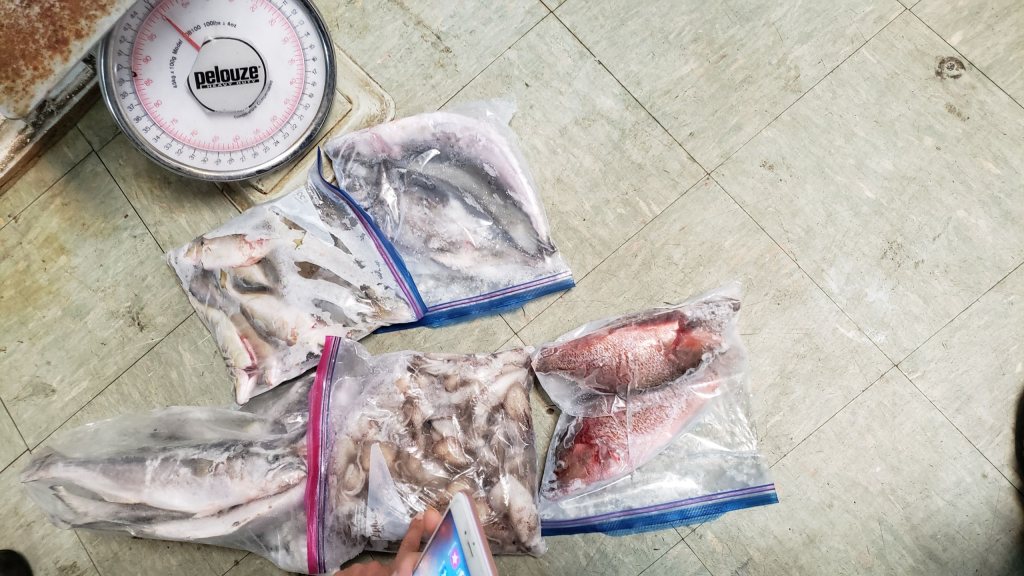
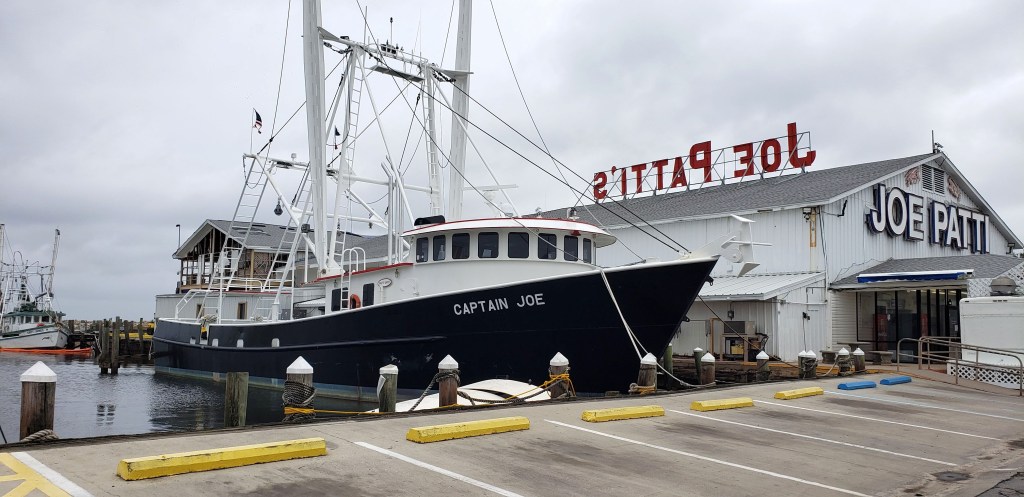
Thăm chợ hải sản lớn nhất Florida là Joe Patti rồi qua chợ Biển Đông mua những thứ cần thiết.

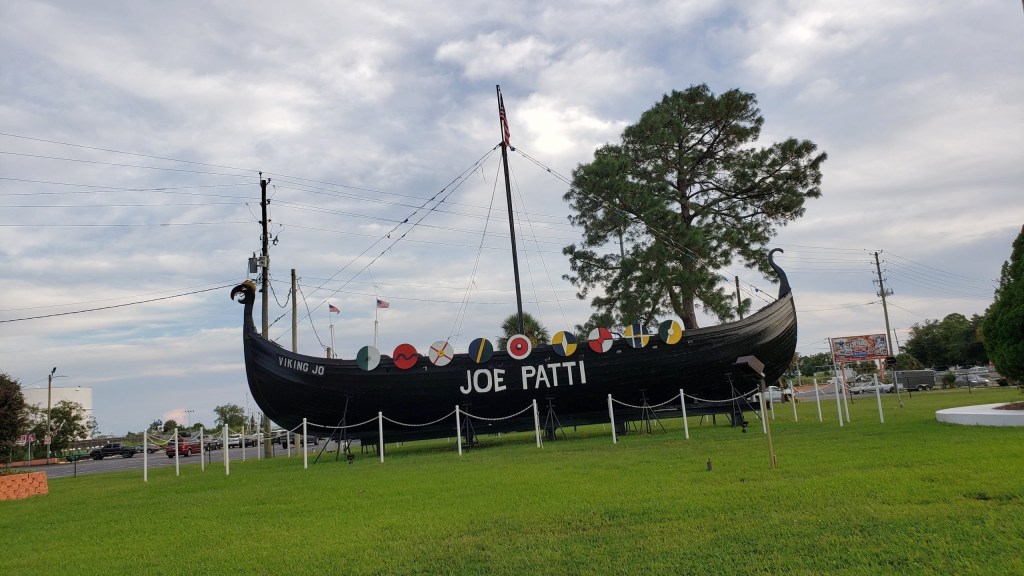
Không hổ danh là Đệ nhất Seafood của khu vực, Joe Patti trang trí cửa tiệm với 2 con tàu lớn. Tàu Viking ở bãi cỏ trước tiệm và tàu sắt đậu bên hông. Hàng ngày tàu đánh cá, đánh tôm từ vịnh Mexico cập ngay sau lưng tiệm không phải chờ đợi mất thời gian và hải sản được tiếp nhận kịp thời để chất lượng vẫn đảm bảo tươi tốt.

Tiệm Joe Patti hình như lúc nào cũng đông khách. Du khách phương xa cũng ghé đến nhiều.

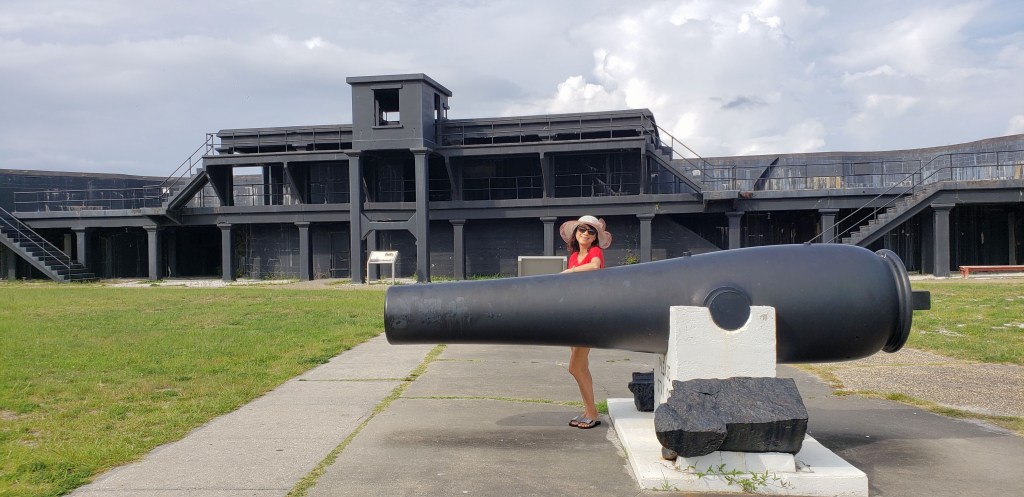
Ghé thăm Fort Pickens.

Thành phố Pensacola – Florida

Từ Fort Pickens đi theo con đường ven biển State Highway 399 đến Navarre Beach
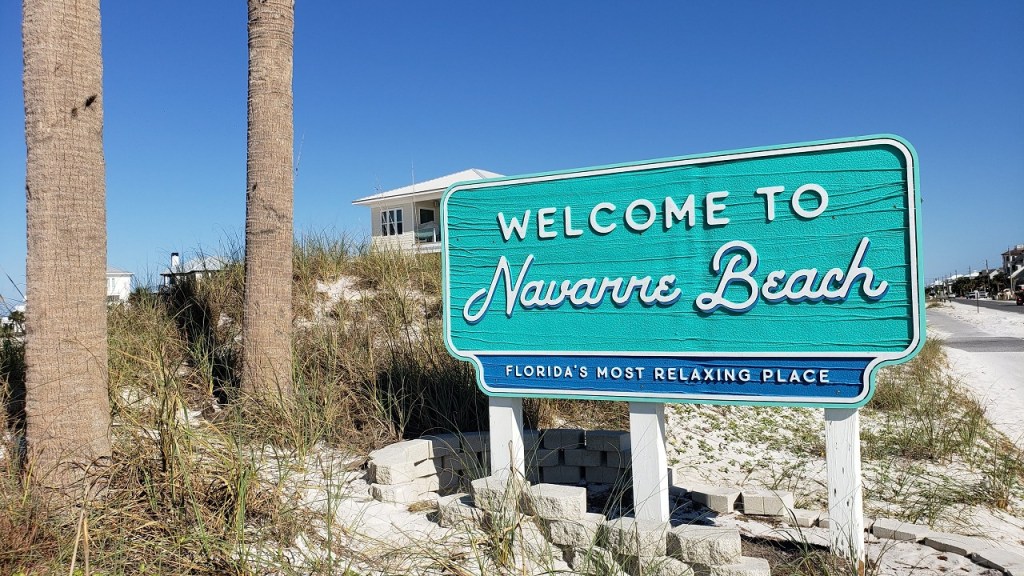
Bãi biển Navarre là một sự lựa chọn hoàn hảo cho việc tìm kiếm sự rung cảm với thiên nhiên.

Bốn trong số sáu loài rùa biển ở Hoa Kỳ được tìm thấy tại bãi biển này. Rùa biển đến bãi biển Navarre vì sự yên tĩnh và bóng tối, người ta giúp bảo vệ rùa bằng cách giữ cho các bãi biển không có vật thể và ánh sáng nhân tạo. Mùa làm tổ của chúng là từ đầu tháng 5 đến cuối tháng 10, trong thời gian đó bạn có thể thấy rùa đẻ trứng trên các bãi biển, miễn là bạn tuân theo các quy tắc tham quan.

Khi bão nhiệt đới Sally tràn qua Florida và rút đi vào tháng 9, để lại những con sao biển nằm la liệt trên bờ cát ở bãi biển Navarre.

Những vỏ ốc đầy màu sắc, lớn nhỏ khác nhau trôi dạt từ trong lòng biển tụ về đấy. Giẫm lên những xác vỏ ốc đã vỡ ra thành triệu triệu mảnh nhỏ, bắt đầu đi tìm những vỏ ốc biển của mình.

Lang thang dọc biển nhặt vỏ sò, vỏ ốc và thỉnh thoảng thích thú tìm được một vỏ sò đẹp. Khi đưa tay chạm vào một vỏ ốc đang nằm trên bãi, dường như sóng vừa cuộn đưa vỏ ốc ấy lên trước mặt.

Mong tìm được một vỏ ốc sand-dollar nguyên vẹn, nhưng tìm mãi không được. Chắc là phải nhặt những mảnh sand-dollar nhỏ để ráp lại thành một sand-dollar lớn.

Bãi biển Navarre thực sự được biết đến nhiều nhất với phim Jaws của đạo diển Steven Spielberg’s, khi phần lớn bộ phim được quay ở đây.

Một đặc điểm đáng chú ý khác của bãi biển này là nơi đây có cầu tàu (Fishing Pier) dài nhất ở Vịnh Mexico, là một địa điểm nổi tiếng để câu cá và ngắm cá heo.🐳🐳

Day 6 – Thursday

🌊 CAMP HELEN STATE PARK

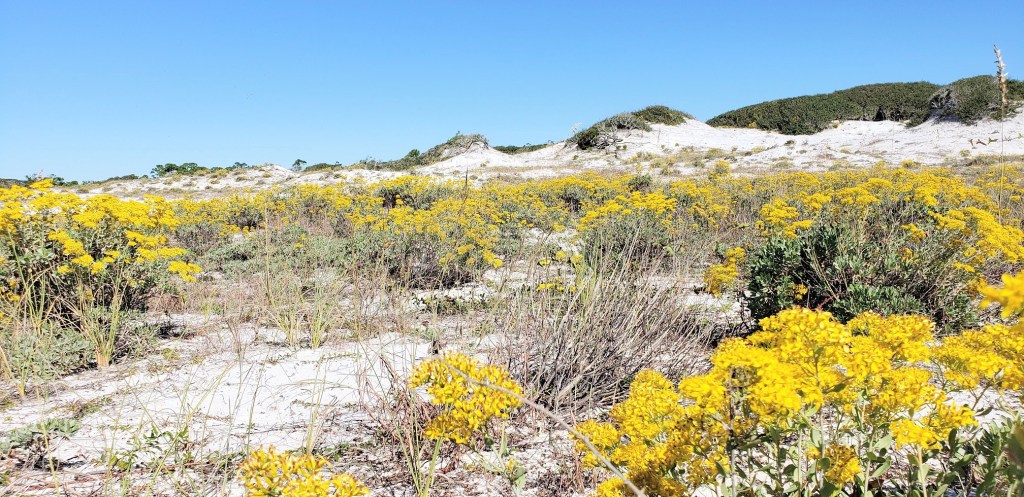
Con đường cát trắng ra biển có hàng cây thông cát (sand pine) dẫn lối với bao nhiêu là hoa vàng bên biển xanh. 🌼🌼

Công viên Camp Helen ba mặt giáp nước với Vịnh Mexico và Hồ Powell. Sự kết hợp độc đáo khiến nó trở thành một kỳ quan sinh thái. Hồ Powell bao quanh phía bắc và phía đông của công viên, và là một trong những hồ cồn cát ven biển (coastal dune lake) hiếm hoi lớn nhất chỉ được tìm thấy ở một vài nơi trên thế giới.

Các cồn cát ven hồ là hệ sinh thái nước ngọt rất quý hiếm. Những hồ này chỉ được tìm thấy ở một số địa điểm trên thế giới như là New Zealand, Úc, Madagascar và ở Hoa Kỳ dọc theo bờ biển Oregon, Nam Carolina và Tây Bắc Florida.

Nước trong hồ có màu nâu. Chất hữu cơ tự nhiên từ lá cây rơi xuống hồ và các khoáng chất khác nhau tạo ra màu nâu, được gọi là tannin. Điều kiện này là hoàn toàn tự nhiên. Hãy coi nó như lá trà được ngâm trong nước!
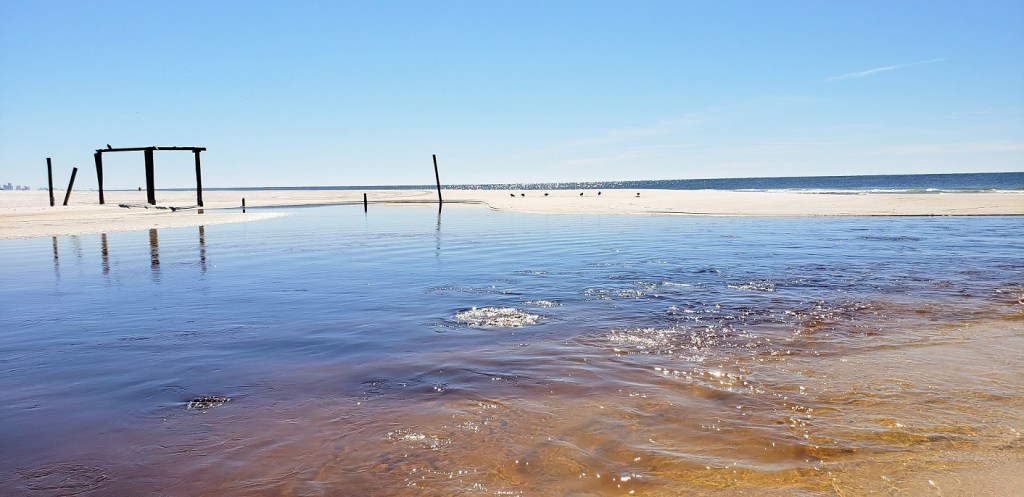
Màu vàng của hoa, màu nâu của nước hồ theo con kênh chảy ra biển, màu trắng của cát, màu xanh của cây cỏ và đại dương và những hàng trụ gỗ còn sót lại của chiếc cầu tàu khiến người ta có cảm giác chơi vơi và khác lạ với biển.

🌊 SANDESTIN:

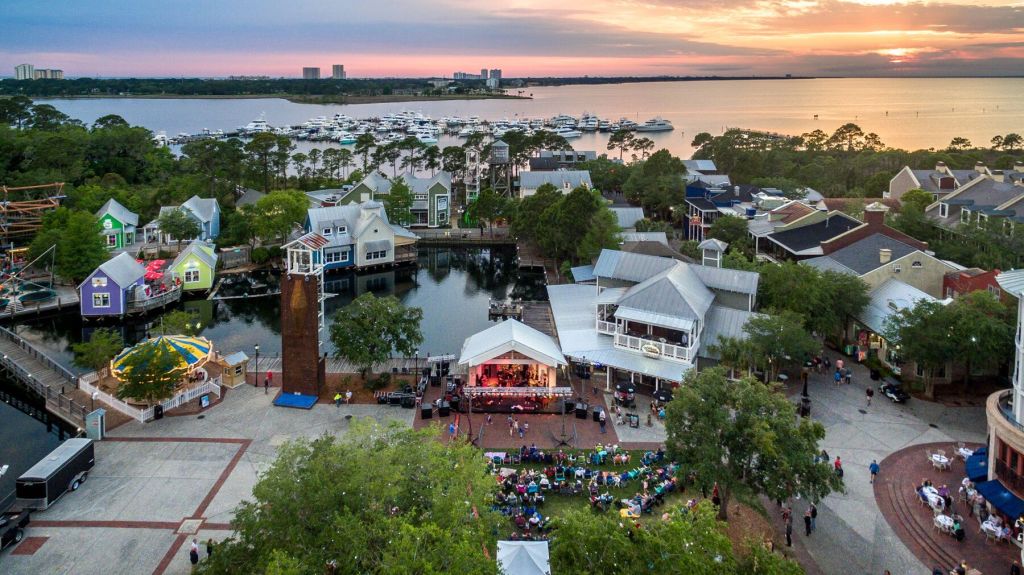
Ngôi làng Baytowne Wharf lẩn khuất giữa những lùm cây xanh mát. Trong làng có những quán ăn và khu trò chơi cho trẻ em. Mùa hè đông đúc thì tối có ca nhạc ngoài trời. Phía sau làng là bến thuyền và chỗ thả du thuyền xuống lòng vịnh Choctawhatchee rộng mênh mông.

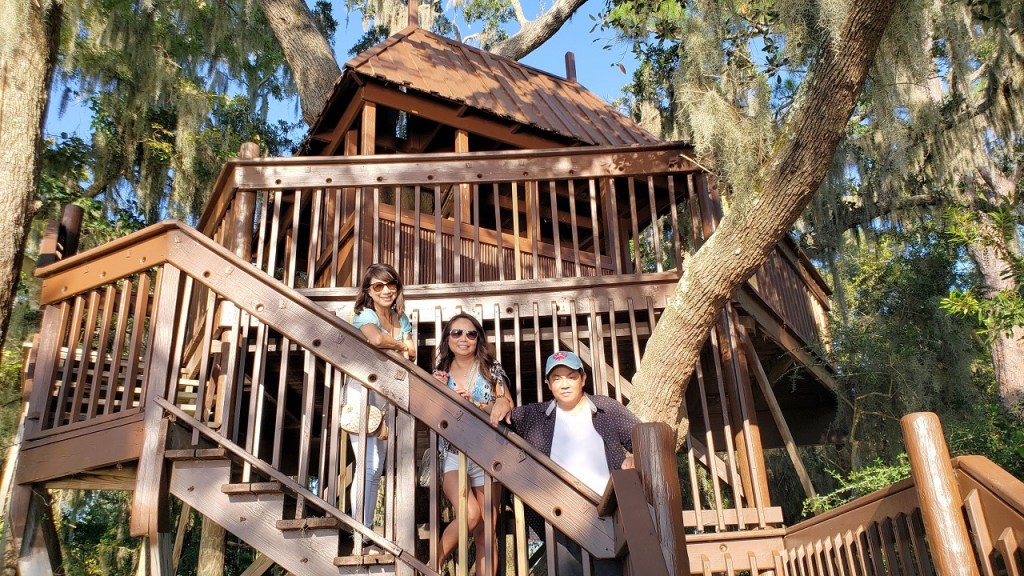
Chụp hình kỷ niệm với Treehouse ở bến thuyền.
🌊 Dinner

🌊 About Sand

Cát dọc theo bờ biển Tây Bắc Florida là một trong những bãi cát trắng nhất, sạch nhất và mềm mại nhất trên thế giới! Điều bạn có thể không biết, đó là khi đi bộ trên các bãi biển ở đây, bạn thực sự đang đi bộ trên dãy núi Appalachian.

Dãy núi Appalachian chạy song song với bờ Đông nước Mỹ, bắt đầu từ cực Bắc là Canada xuống đến tiểu bang Alabama ở cực Nam, tổng cộng dài khoảng 2000 miles (3200 km).

Cát được tạo thành chủ yếu từ những mảnh tinh thể thạch anh rất nhỏ đã được những con sông rửa sạch từ trên núi.

Từ những ngọn núi, tinh thể thạch anh sau đó được đưa xuống Vịnh Mexico qua các con sông chảy vào vịnh, chẳng hạn như sông Apalachicola ở phía đông Destin. Từ Vịnh, nó trôi dạt vào các bãi biển khi thủy triều cuốn nó vào bờ, tập trung vào các bãi biển nguyên sơ ngày nay, và được làm trắng hơn nhờ sức nóng của mặt trời.

Du khách say mê và gọi là “những bãi biển trắng như đường” của Tây Bắc Florida. Cát tích tụ tạo ra các dải cát dọc theo con sông uốn khúc và các dòng suối trên hành trình dài của nó xuôi về phía nam đến các rìa của vùng nước màu ngọc lục bảo của Vịnh Mexico. Cát trắng giúp các bãi biển nơi đây không nóng lên vào mùa hè, đi chân trần trên cát vẫn mát. Sugar White Sand là sự bổ sung hoàn hảo cho Vùng nước xanh ngọc lục bảo của Vịnh Mexico.

Một trong những điều thú vị là quá trình này là nó vẫn đang diễn ra ngày hôm nay! Đó là lý do tại sao cát trắng đã không biến mất vì xói mòn mặc dù nhiều cơn bão đã đi qua khu vực trong những năm qua; Sông Apalachicola liên tục cung cấp thạch anh nghiền thàng bột cát mới vào bờ để giữ cho các bãi biển trắng như tuyết.
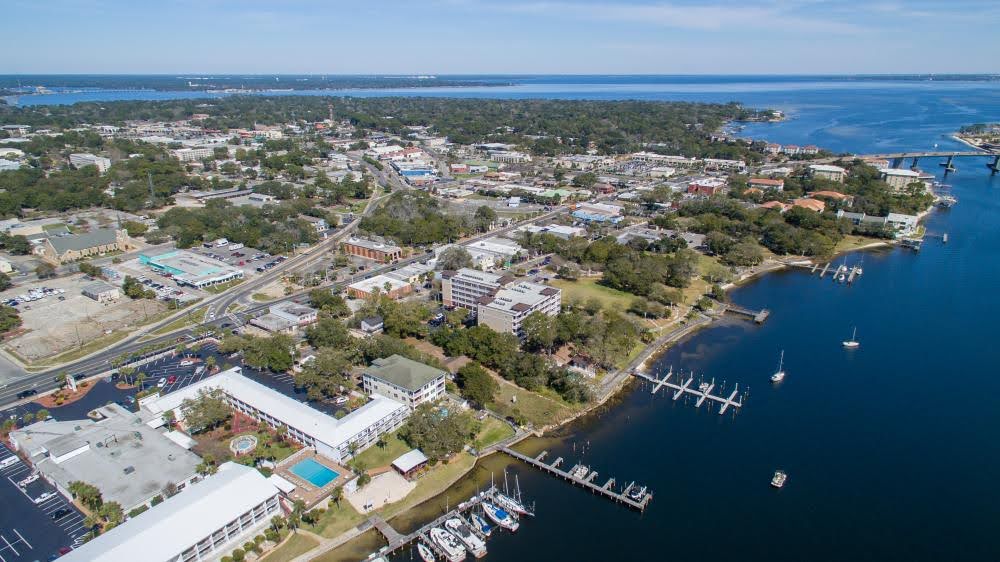
Fort Walton Beach – Florida

Cũng là một thành phố nhỏ ngay bên cạnh Destin, Fort Walton Beach là cửa ngỏ đi vào căn cứ không quân rộng nhất thế giới. Eglin Air Force Base có diện tích 464,000 mẫu (724 square miles) trải dài qua 3 quận hạt Santa Rosa, Okaloosa, và Walton.

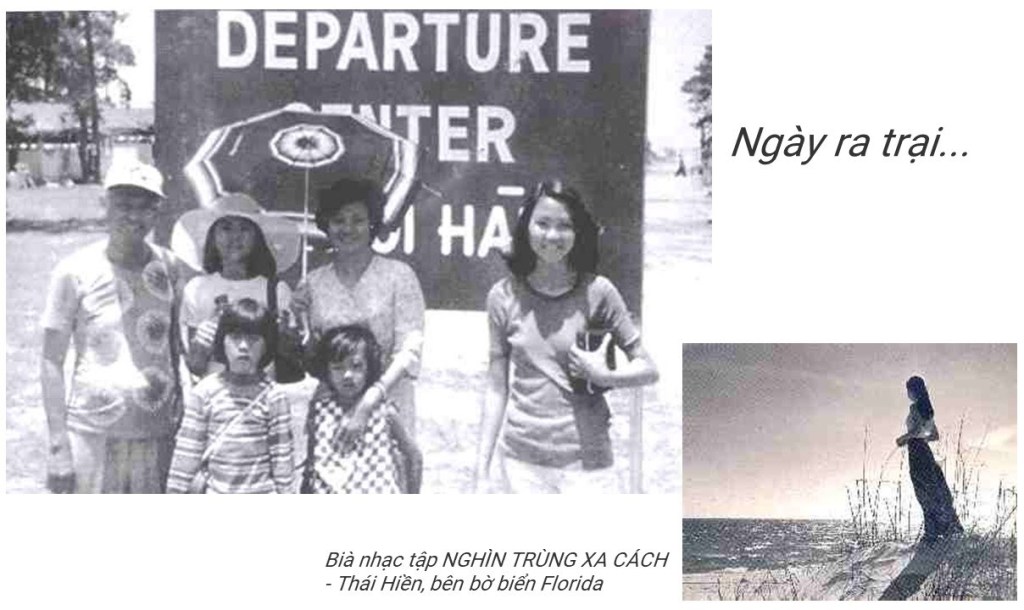
Năm 1975 trong Chiến Dịch Chào Đón Những Người Mới Tới (Operation New Arrivals) , một chiến dịch không vận mang tính nhân đạo lớn nhất trong lịch sử Hoa Kỳ, trại tạm cư được cấp tốc mở ra để giúp đỡ cho người Việt Nam.

Nhưng Camp Pendleton (California) chẳng mấy lúc đã đầy nghẹt. Phải chọn thêm trại. Tại Bộ Quốc phòng, trại Fort Chaffee (Arkansas) và Eglin Air Force Base (Florida) được chọn ngay vì khá rộng và có phương tiện tương đối tốt.

Từ đảo Guam những người tị nạn Việt Nam được không vận đến. Cuộc hành trình dài, với hai trạm ngừng cho máy bay lấy thêm xăng nhớt. Khi máy bay đáp xuống phi trường Eglin hay Tallahassee, phi cơ đã bay hơn 20 tiếng đồng hồ từ khi bắt đầu. Nếu đến thủ đô thì xe buýt màu xanh da trời cổ điển của Không Quân Mỹ chở bà con về Căn Cứ Không Quân Eglin Air Force Base, cách đó hai giờ xe (Eglin nằm về hướng Tây thủ đô Tallahassee cách 120 dậm).

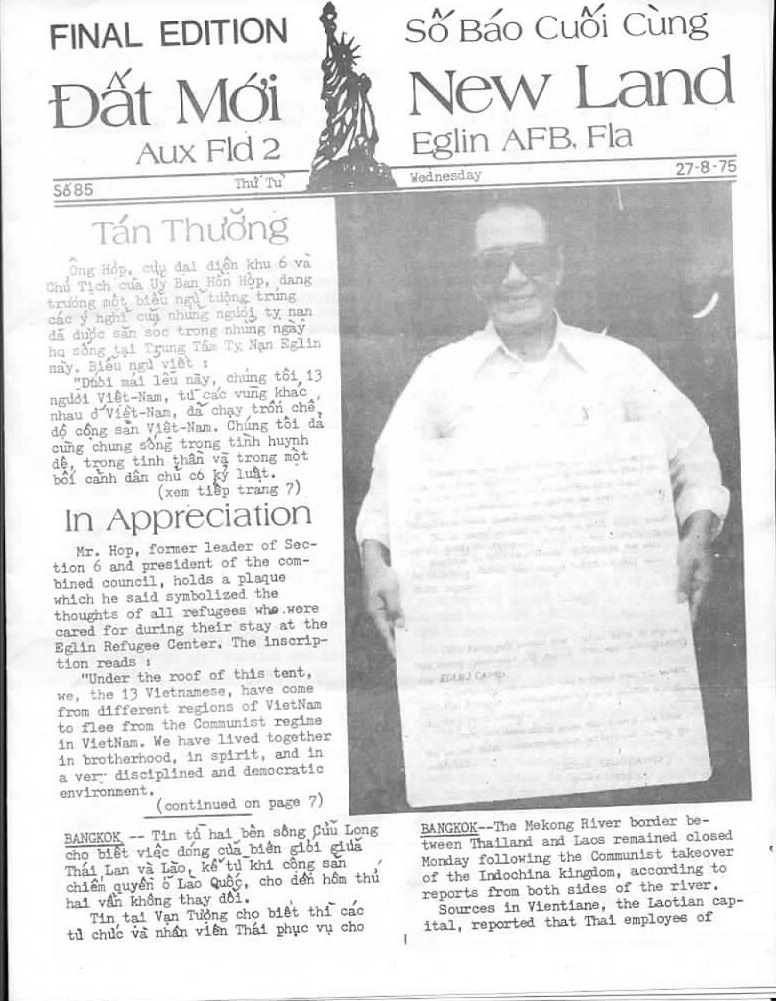
📰 Bản tin song ngữ Đất Mới (New Land) phát hành ở trại Eglin trong ấn bàn cuối cùng trước khi trại đóng cửa vào tháng 9/1975 cho biết tổng số người Việt đã đến trại tạm cư là 10082. Trong thời gian ở đây người tạm cư cũng được bus tour chở đi du ngoạn Fort Walton Beach và bán tranh vẽ cho du khách.
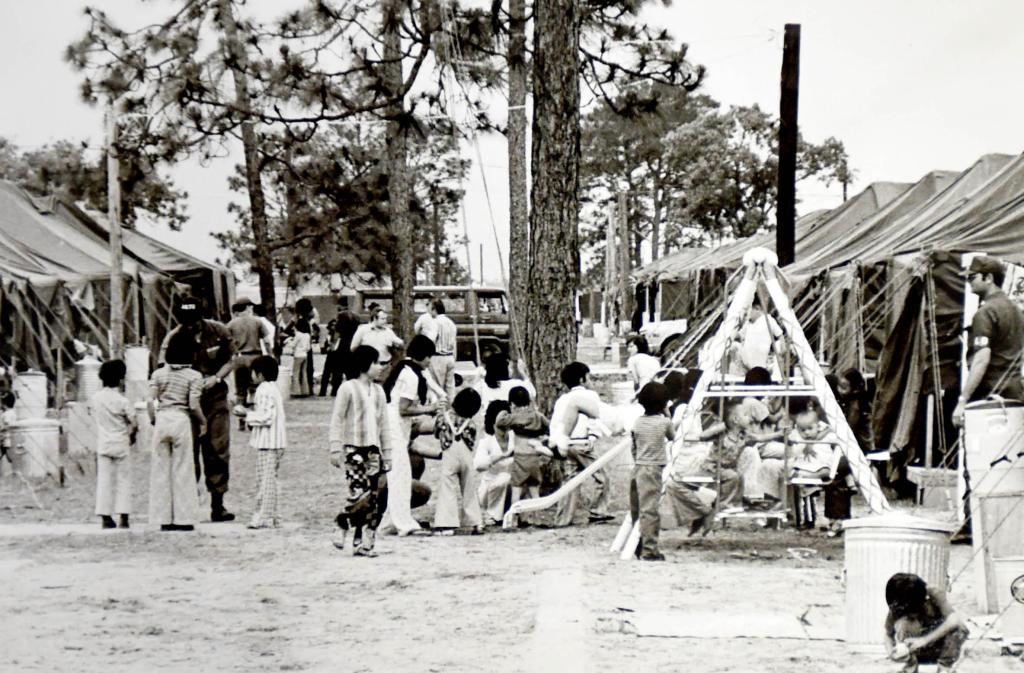
Đối với nhiều người, trại Eglin AFB còn là nơi ghi dấu chứng tích lịch sử biểu trưng cho những bước khởi đầu của những công dân Mỹ gốc Việt, khơi gợi trong ký ức họ những kỷ niệm đáng nhớ về những hy sinh gian khổ và những phấn đấu để mở đường cho những thế hệ tương lai một cuộc sống tự do và những cơ hội thành đạt ngày nay.

Giáo sư Nguyễn Ngọc Bích khi gặp lại nhạc sĩ Phạm Duy trong trại Eglin đã viết:

Từ vực thẳm của những ngày xa xứ đó, ông đứng dậy. Ông xua đuổi ý tưởng tìm cách trở về để được đoàn tụ với các con. Ông nhận ra trại với một người bạn Mỹ đứng tên xì-pông-xo cho gia đình ông. Và ông nhất quyết dựng lại cuộc đời ở tuổi 50 hơn. Ông nhìn lại: từ một gia đình quây quần hạnh phúc, trai gái đầy đủ, ông chỉ còn lại có Thái Hằng và mấy người con gái còn ở tuổi choai choai. Mặc dầu vậy, ngay từ đầu ông không muốn phải dựa lâu vào người xì-pông-xo Mỹ, ngay từ những ngày sớm sủa đó ông đã nhất quyết tự-lập – bằng mọi giá. Ông đứng dậy bằng con đường cầm ca, cái nghiệp của ông, với sự tiếp tay của Thái Hằng, người vợ hiền từ dù như đã giải nghệ từ lâu, và của cô con gái lớn trong gia đình, Thái Hiền, lúc bấy giờ mới chừng 15-16 tuổi, còn đang học trung học. Phải mấy năm sau, ban nhạc “Gia Đình Phạm Duy” mới có thêm Thái Thảo.

Trong cuốn hồi ký, nhạc sĩ Phạm Duy đã kể lại khoảng thời gian hơn 2 năm sống ở Fort Walton Beach:

✔️ Ban nhạc của học sinh High School trong thành phố Fort Walton Beach (cách xa trại 17 cây số) tới biểu diễn. Ông giáo sư âm nhạc của trường này xin tôi chép cho bài The Rain On The Leaves (Giọt mưa trên lá) để ban nhạc học sinh trình bày.
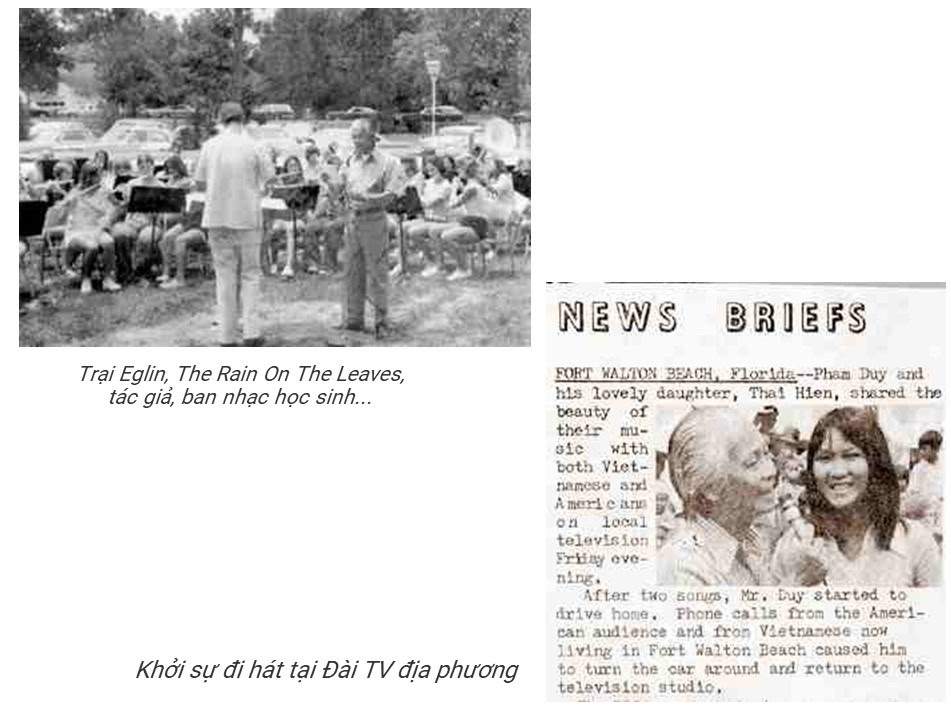
Vũ Thành nhạc sĩ hàng đầu của Việt Nam bỏ về lều, thốt ra lời cay đắng : — Suốt đời mình, không bao giờ có trong tay một ban nhạc với đầy đủ nhạc cụ như lũ nhoắt con học sinh tỉnh nhỏ kia !

✔️ Sau hơn mười ngày ở trong trại, khi có vợ chồng cựu Trung Tá Không Quân là Jon và Joyce Carle (đã từng ở Việt Nam vài ba năm và quen biết tôi qua mấy người bạn chung) tới thăm và ngỏ ý mời về ở gia đình họ trong thành phố Fort Walton Beach thì tôi nhận lời ngay. Chúng tôi đã quá ngán cuộc sống nửa vời ở trong lều vải của trại Eglin này rồi… 🏠

✔️ Gia đình họ Carle ở con đường mang tên một tiểu bang khác : Nebraska Avenue. Nhà Mỹ thường chỉ có ba phòng ngủ, cựu trung tá Jon và vợ là Joyce với con gái Kelly đã chiếm hai phòng rồi. Bốn con trai của gia đình Carle (được đặt tên theo vần K, cũng như tên con gái út) là Kit, Kriss, Kurt, Klay đã thoát ly gia đình từ lâu. Hiền, Thảo ở một phòng, Đức, Hạnh ở chung phòng Kelly, còn vợ chồng tôi, a lê, xuống garage. 🛌 🛌 🏠

✔️ Để có tiền tiêu vặt, Thái Hiền phải đi làm trong một tiệm chuyên bán các loại trứng chiên từ 11 giờ đêm tới 4 giờ sáng. 🥚 🍳

✔️ Tôi mua một xe Volkswagen nhỏ để, trước hết, đi tới làng chài của người tị nạn mua tôm đem về luộc ăn. Fort Walton Beach và những thị trấn phụ cận là vùng đánh cá nên dân chài Việt Nam tới sinh sống khá đông. Trong số hơn 100,000 người Việt di dân qua Mỹ, người đánh cá là lớp người thành công nhanh nhất. Chẳng cần phải học nghề hay học chữ, tới định cư ở thành phố biển nào là mua tầu ra khơi hành nghề ngay.

🛶 🚤 ⚓️ 🦈 🐋

✔️ Vợ chồng Carle giúp tôi đứng dậy nghĩa là trước tiên họ giới thiệu tôi và Thái Hiền đi hát tại vài ba nơi ở chung quanh Fort Walton Beach.

🎹 🎼 🎤 🎧.

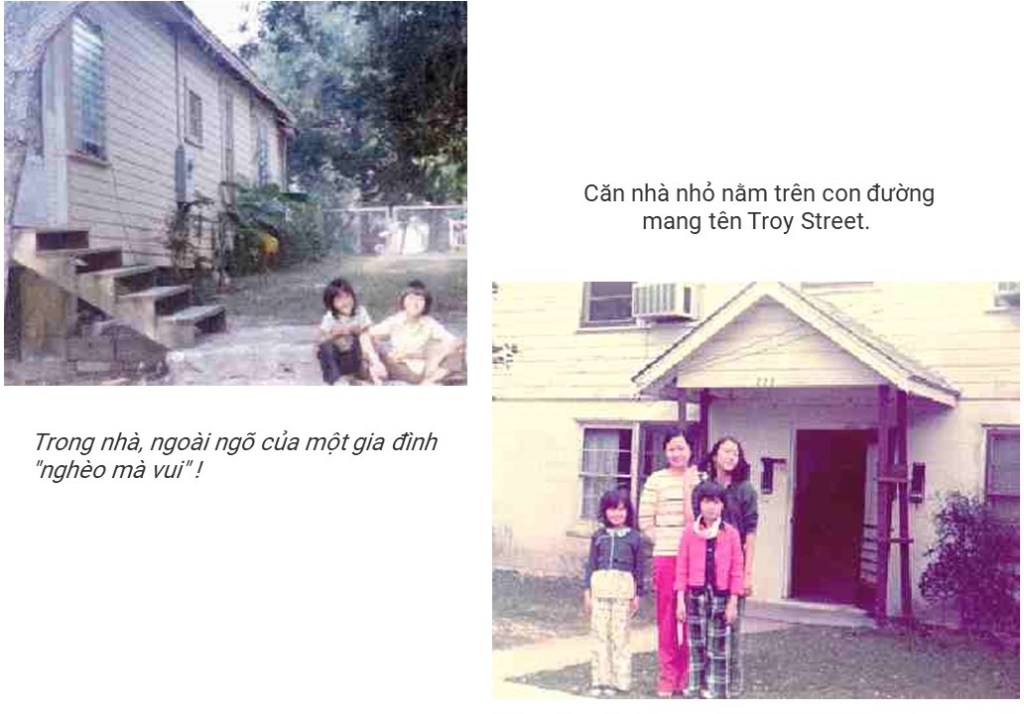
✔️ Sau gần hai năm ở chung, chúng tôi muốn có tự do nên từ giã vợ chồng họ Carle ra ở trong căn nhà nhỏ nằm trên con đường mang tên Troy Street. Tôi mua một căn nhà nhỏ nằm trên đường Troy Street này, với giá 19.000$, chỉ cần trả trước bốn ngàn đôn. Đây là loại nhà được xây cất để bán cho người nghèo, lâu ngày đã trở thành ọp ẹp. Vách nhà được chủ cũ sơn mầu loè loẹt làm chối mắt kẻ yêu mỹ thuật là tôi. Không phải nhà gạch mà là nhà gỗ, nhà bìa, vào những đêm mưa, nơi tôi nằm phải căng một mảnh nylon dưới trần nhà thì mới ngủ được. Nhà dựng trên đất cát như một thứ nhà sàn nên vào những ngày giông tố là có gió lùa từ dưới đất lên. Bàn ghế, giường nằm, divan là đồ cũ rích và hôi rình, do nhà thờ tặng… Nhưng đó là căn nhà đầu tiên trên đất Mỹ của tôi nên tôi yêu nó lắm !

✔️ Trong gian nhà gỗ ở Fort Walton Beach, những khi rảnh rang, tôi giở bản thảo của Tổ Khúc Bầy Chim Bỏ Xứ ra coi, với ý định hoàn tất nó. Nằm dài trên divan cạnh lò sưởi, trời Florida không lạnh nhưng cũng đốt củi cho có vẻ lãng mạn, ôm đàn vào lòng, tôi đáp ứng một khắc khoải trong tôi là : sáng tác.

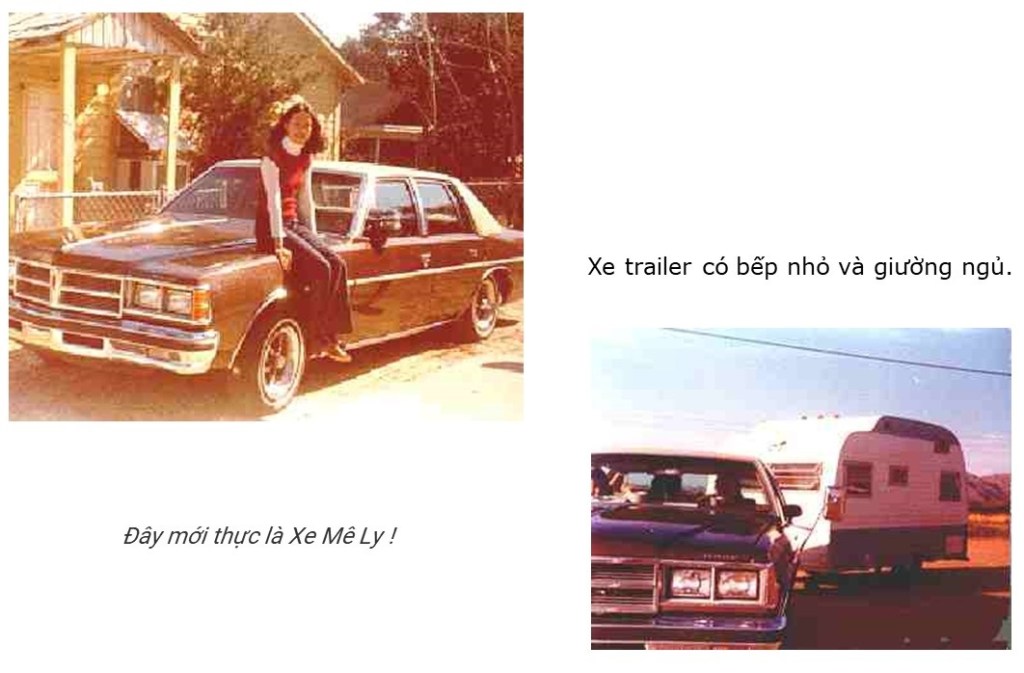
✔️ Bán căn nhà sơn mầu xanh lá cây rồi mua một xe trailer có bếp nhỏ và giường ngủ, mùa Hạ 1977, hai vợ chồng tôi và bốn đứa con nhỏ giã từ Fort Walton Beach, cứ theo xa lộ số 10 xuyên ngang nước Mỹ mà đi. Giống như những người đi lập nghiệp ở nước này trong thế kỷ trước, chúng tôi làm cuộc ”tiến về viễn Tây”. Người xưa làm cuộc di dân từ cựu lục địa qua đây rồi đi tìm đất đai và tìm vàng ở phía mặt trời lặn. Nay lưu dân tôi đi về miền Tây để tìm lại mình.

Phạm Duy đến California một ngày hè 1977 với chiếc xe hơi méo mó và chiếc trailer sứt mẻ. Dừng chân thành phố mang tên Thị Trấn Giữa Đàng (Midway City) nằm gần Little Saigon cho đến gần cuối đời. Trong thời gian ơ Fort Walton Beach, nhạc sĩ Phạn Duy phát hành băng nhạc, bán băng và sách dạy nhạc, đi lưu diễn nhiều nơi trên nước Mỹ.

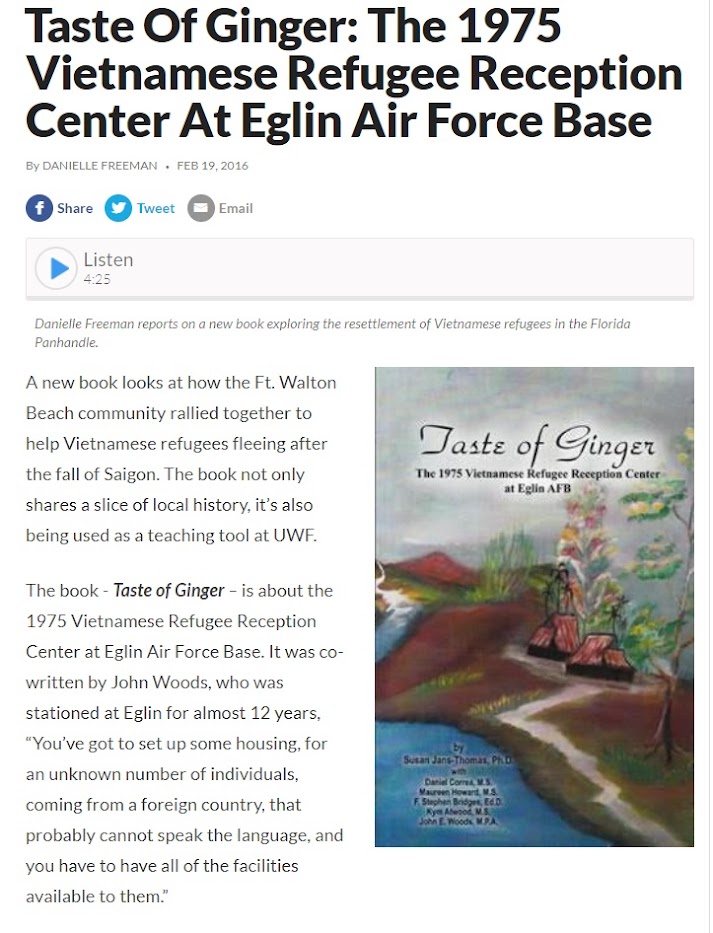
Gần đây một cuốn sách với tựa đề “Taste of Ginger” đã được xuất bản nói về những nổ lực của cộng đồng dân sự và quân nhân Fort Walton Beach chung tay chào đón người tị nạn Việt đến một miền đất mới hoàn toàn xa lạ. Cuốn sách cũng được dùng làm tài liệu giảng dạy tại đại học West Florida.

Đến Fort Walton Beach 45 năm sau khi trại Eglin đóng cửa, thành phố nay có một tiệm ăn Việt Nam nhưng hơn 10 tiệm Thái chứng tỏ cộng đồng Thái Lan khá đông.

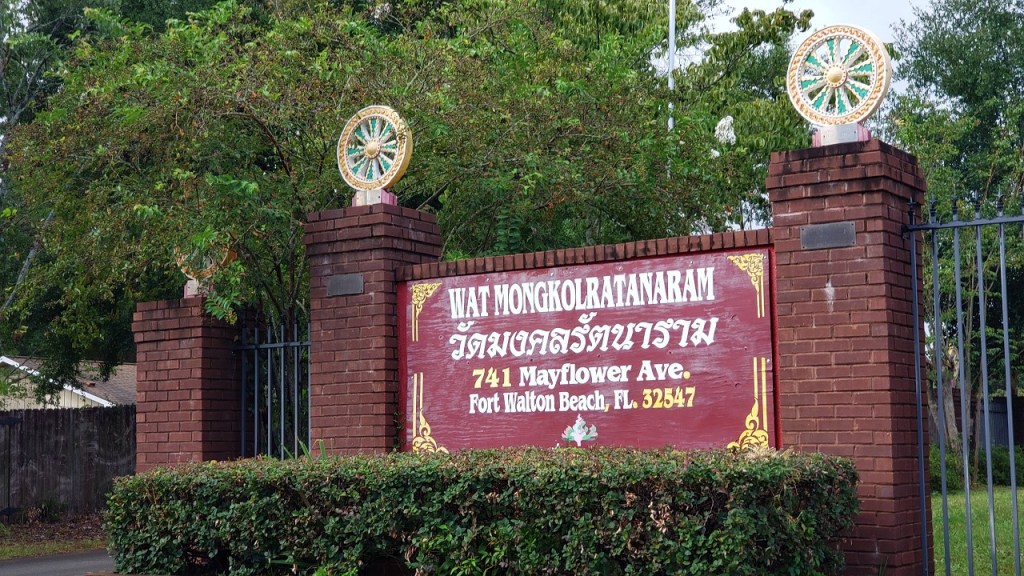
Ngoài vài ngôi chợ Thái, Á Châu, Philippine tại đây có ngôi chùa Thái tên khá dài là Wat Mongkolratanaram Temple. Mỗi chủ nhật hàng tuần nơi nầy có Chợ Trời, bán trái cây, rau cải.

Tại chợ Trời nơi chùa Thái, họ bán nào rau xanh như rau muống, bồ ngót, đọt cơm nguội, ớt, cải làng, rau nhúc, rau càng cua, một vài thứ rau để ăn với bánh xèo, trái cây có chuối, măng cụt, mãn cầu ta, cây Mãng cầu xiêm nhỏ có trái đem về trồng … Nói chung rau, trái cây cũng không nhiều.

Tại đây có nhiều quầy bán thức ăn với những bàn dài cho thực khách ngồi dưới tàn cây sau chùa. Phở, Pad Thai, gỏi cuốn, gỏi đu đủ, gà chiên, xâu thịt nướng, xôi xoài, chuối chiên, trà Thái… Muốn ăn phải mua vé loại 5 đô và 1 đô. Mua thức ăn trả tiền bằng vé nầy. Vì các quầy thức ăn là của chùa do Phật tử làm công quả nấu nướng, đứng bán. Tiền thu được là của chùa, trả bằng vé, chùa không cần kiểm soát.

Tiệm hải sản ở đây có lẻ người gốc Á nhiều nên ngoài cua còn bán cả đầu cá hồng lớn nặng cả kilo. 🦀 🐳

Pensacola – Florida

Pensacola, thành phố nhỏ dễ thương nằm bên bờ vịnh Mexico nổi tiếng thơ mộng.

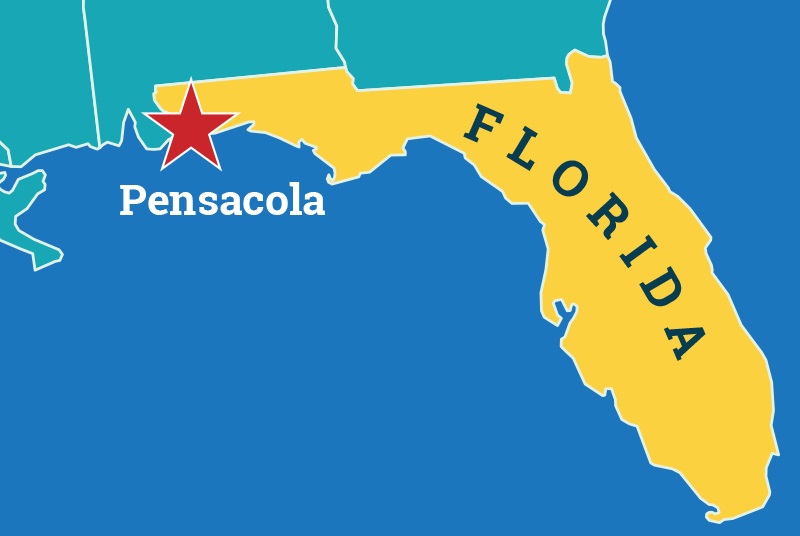
Thành phố biển Pensacola thuộc tiểu bang Florida, nằm sát biên giới bang Alabama. Là một trong những thành phố nằm trong Gulf of Mexico, duyên hải vịnh Mexico. Vùng duyên hải này bao gồm nhiều tiểu bang của Mỹ như Florida, Alabama, Mississippi, Louisiana và Texas.

P-Cola, như người dân địa phương hay gọi nằm ngay cuối cán chảo của bờ Tây Florida ( Panhandle & West Florida Beaches), một rẻo đất nhỏ so với địa hình của toàn tiểu bang. Tất cả những bãi biển ở khu vực này rất đẹp, biển xanh, cát trắng muốt, mịn như bột mì được gọi là powdered sugar sand.

Nếu nhìn toàn tiểu bang Florida như một chiếc giày ống đặt ngược, thì bạn có thể tưởng tượng vùng Key West, Miami nằm ở điểm cao ống giày, khoảng giữa ống giày là Orlando, gót giày là Jacksonville, giữa bàn chân là thủ đô Tallahassee, và mũi giày là thành phố Pensacola.

Pensacola cũng nổi tiếng với một biệt danh khác là thành phố 5 màu cờ “The City of Five Flags”, vì 5 thế lực khác nhau cai trị thành phố này trong hơn 450 năm qua. Đó là : Tây Ban Nha, Pháp, Anh, The Confederacy- Miền Nam nước Mỹ thời nội chiến, và Hiệp chủng quốc Hoa Kỳ ngày nay..

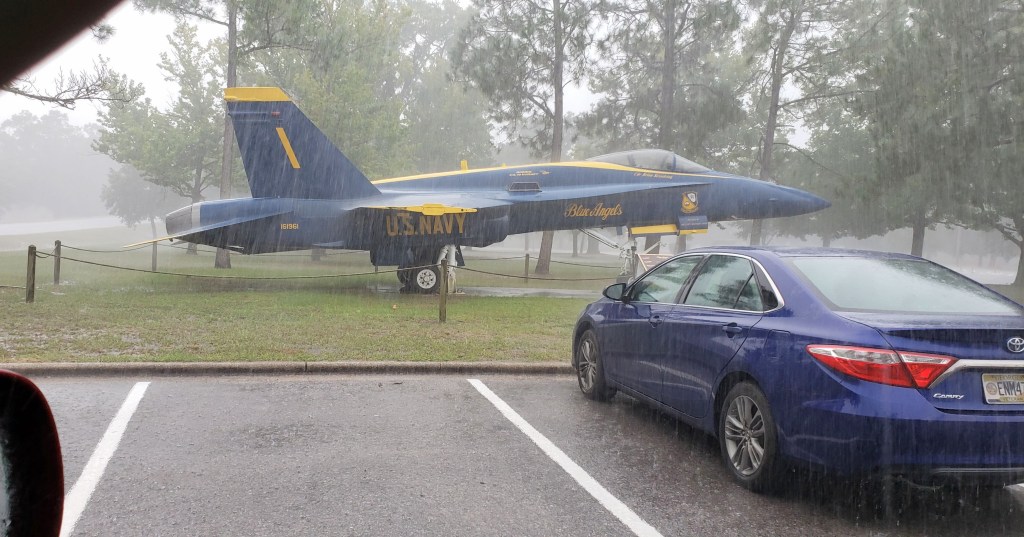
Thành phố này có căn cứ hàng không Hải Quân đầu tiên của quân lực Hoa Kỳ (Naval Air Station), hay còn gọi là cái nôi của ngành hàng không Hải Quân Hoa Kỳ (the cradle of navy aviation). Đây là cũng home base của đội bay biểu diễn của Navy, the Blue Angels.

Trường Phi Hành Hải Quân Hoa Kỳ Pensacola (U.S. Naval Air School Pensacola) ở đây từng đào tạo nhiều phi công Việt Nam.

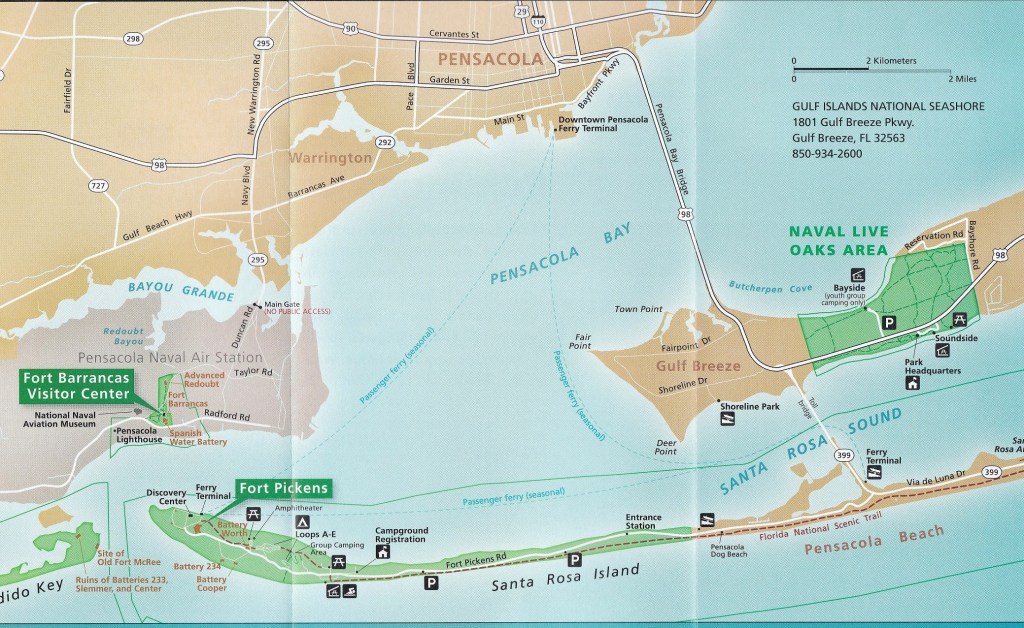
Pháo đài Barrancas nằm ở bên trong căn cứ, gần đó có ngọn hải đăng và National Naval Aviation Museum là bảo tàng hàng không hải quân lớn nhất thế giới.

Fort Pickens mở cửa cho khách tham quan. Giá vào cửa là $25 cho mỗi đầu xe, du khách được ra vào trong national park này trong 7 ngày để thăm viếng, cắm trại, câu cá, tắm biển.

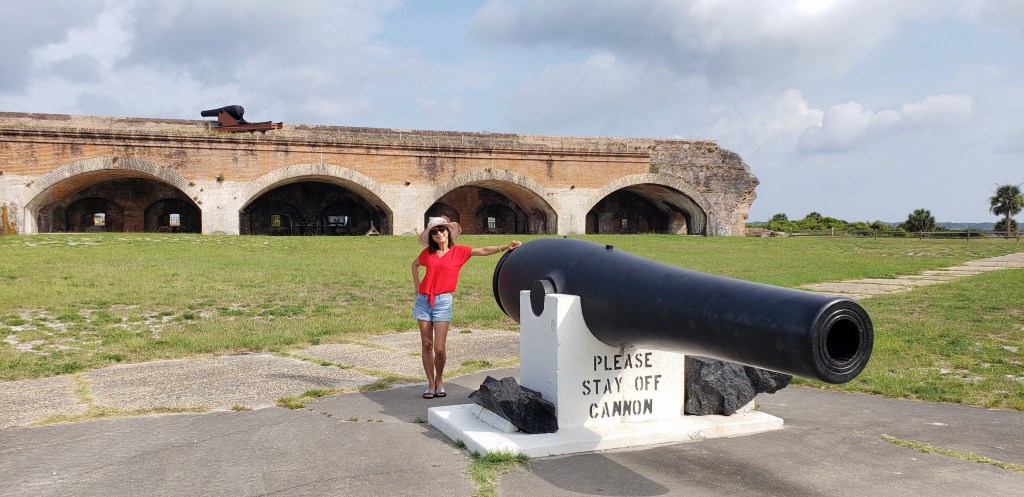
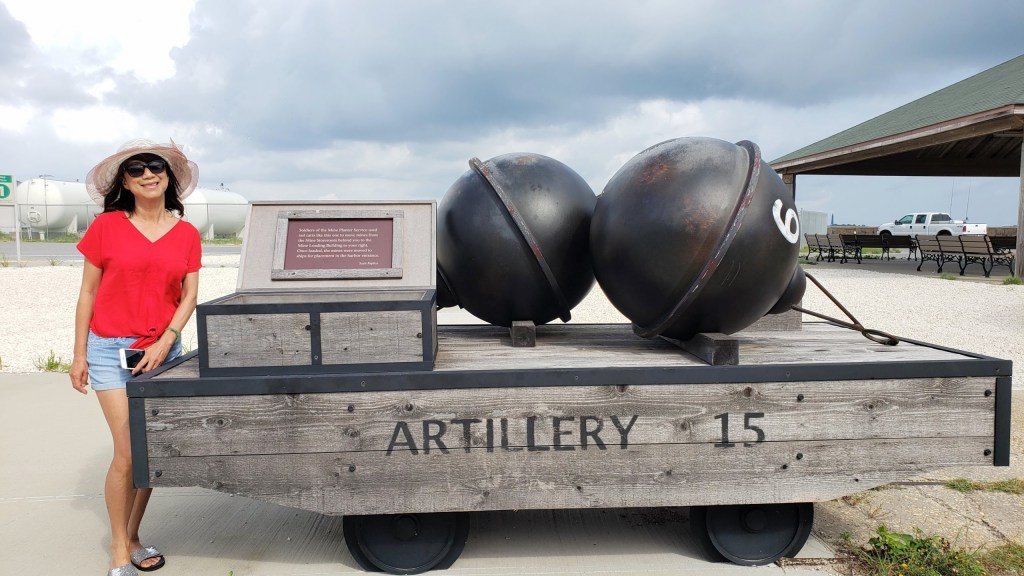
Pháo đài Pickens được hoàn thành vào năm 1834 sau khi Mỹ quyết định củng cố tất cả các cảng lớn của mình nhằm phòng vệ bờ biển nên còn lại khá nhiều khẩu đại bác và những quả mìn để phong tỏa cửa biển khi tàu địch kéo đến. Có một giai đoạn nơi này làm nơi giam giữ vị tù trưởng nổi tiếng người da đỏ bộ lạc Apache, Geronimo. Pháo đài là chứng tích quan trọng của lịch sử Hoa Kỳ từ thời Nội Chiến đến Thế Chiến 2.

Bây giờ bạn có thể đi giữa đống đổ nát của pháo đài và cảm nhận cuộc sống của người lính hồi đó như thế nào khi nhìn ra những bãi biển và đại dương.

Những bãi tắm trong đây rất hoang sơ so với những bãi bên ngoài vì không có tiệm ăn, khách sạn, condo vây quanh. Tiện nghi đầy đủ với bãi đậu xe rộng rãi, nước ngọt để xả, nhà ăn với lò nướng cho những ai muốn xài và tránh nắng, cùng nhà vệ sinh thoải mái, tất cả đều free.

Mua seafood tươi sống thì vào Joe Patti, họ có thể nấu luôn cho mình nếu mình yêu cầu. Người Việt ở đây có thể mua của các ghe đánh cá của đồng hương, họ đánh qua đêm, sáng tàu vào bến thành ra tôm cá rất tươi.

Người Việt ở nơi đây chiếm một số lượng tương đối, tuy không thể so sánh với Orlando, Tampa.

Thức ăn Việt Nam thì có khoảng 4-5 cái chợ VN, trong đó có hai chợ chính là chợ Biển Đông và chợ SaiGon Oriental Market & Deli.

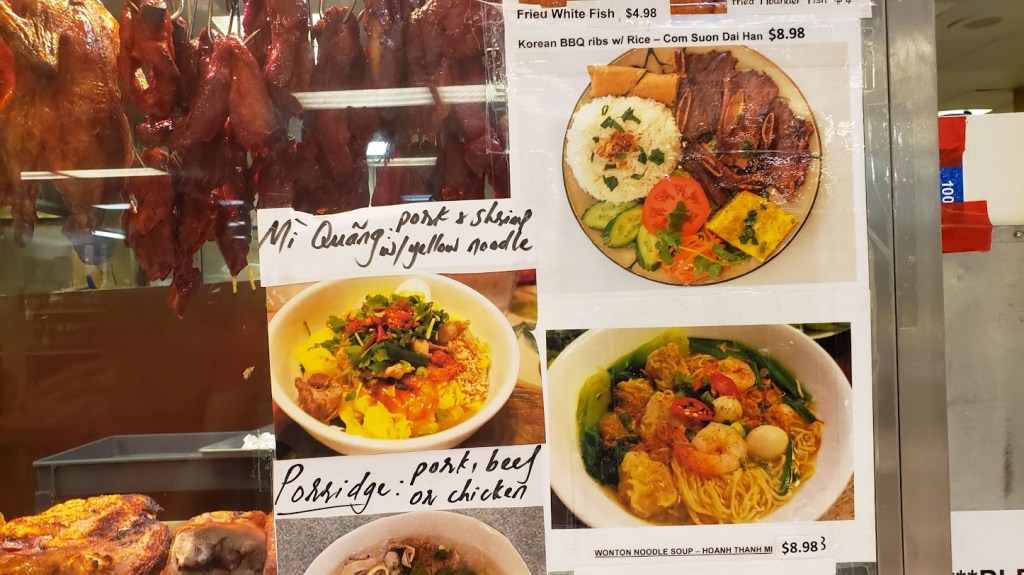
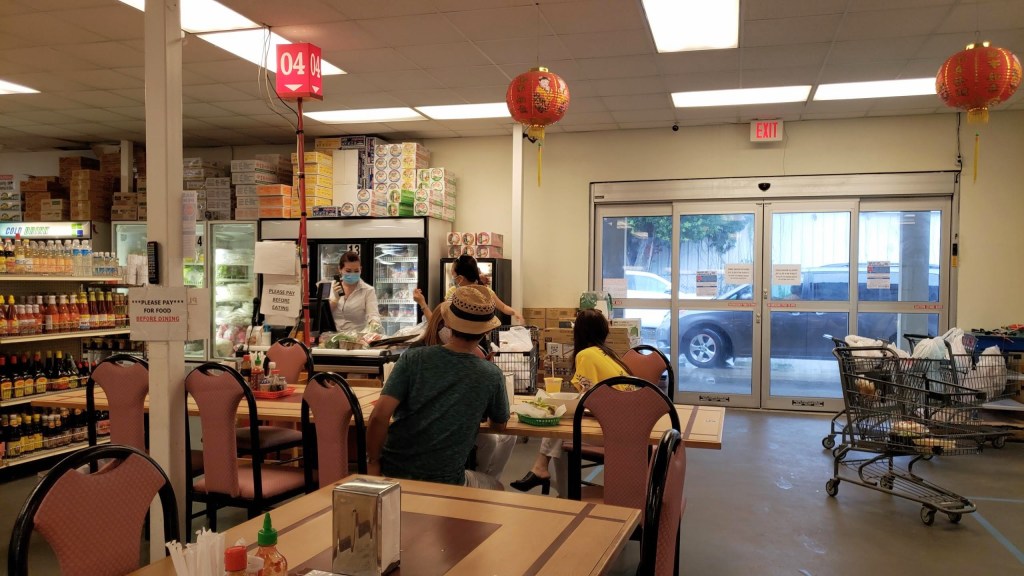
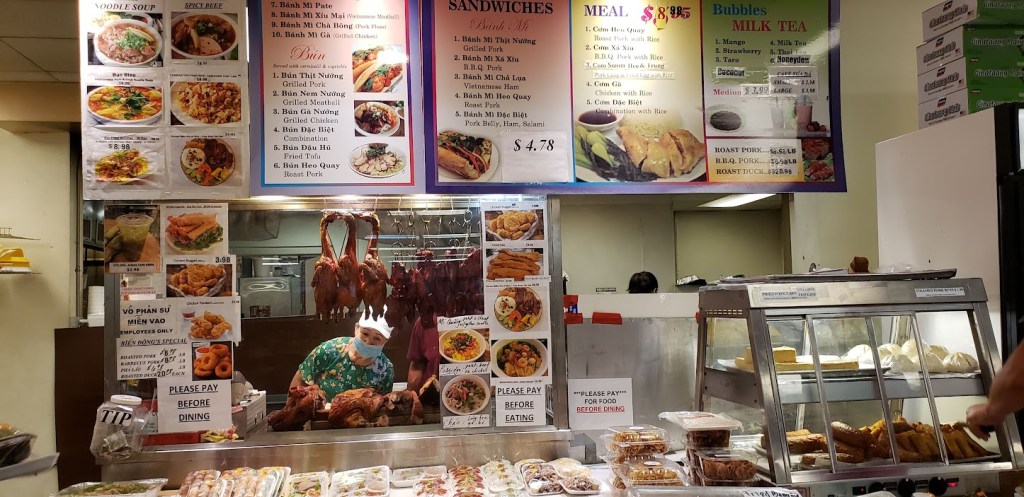
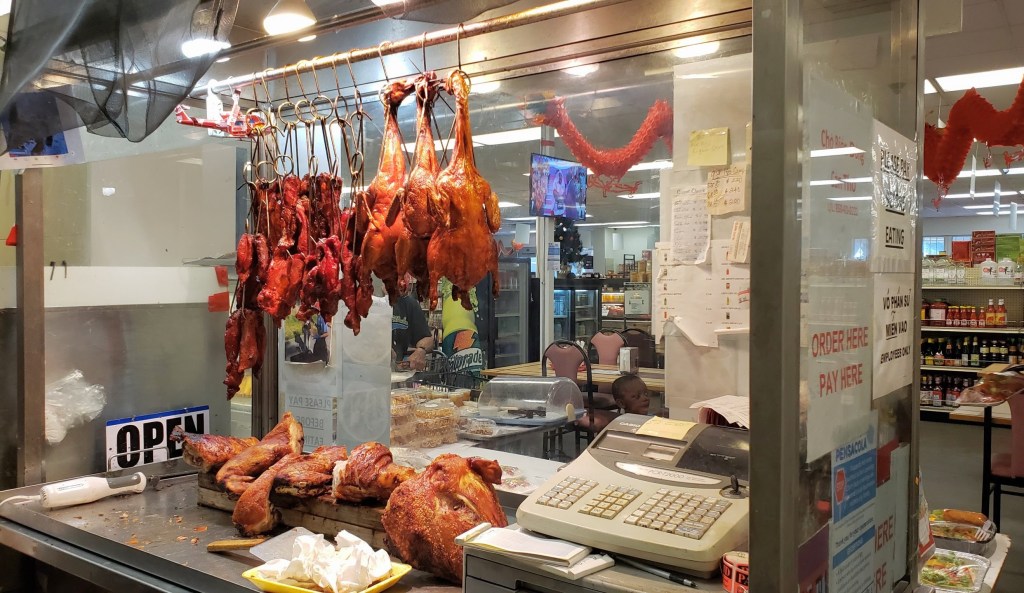
Ghé chợ Biển Đông, bên trong có một tiệm ăn nhỏ có cả món Mì Quảng và quầy heo quay, vịt quay, xá xíu.

Ở quầy tính tiền, cô thu ngân (có lẻ cũng là chủ nhân quán ăn) thấy đồng hương từ xa đến đã bớt 10%.

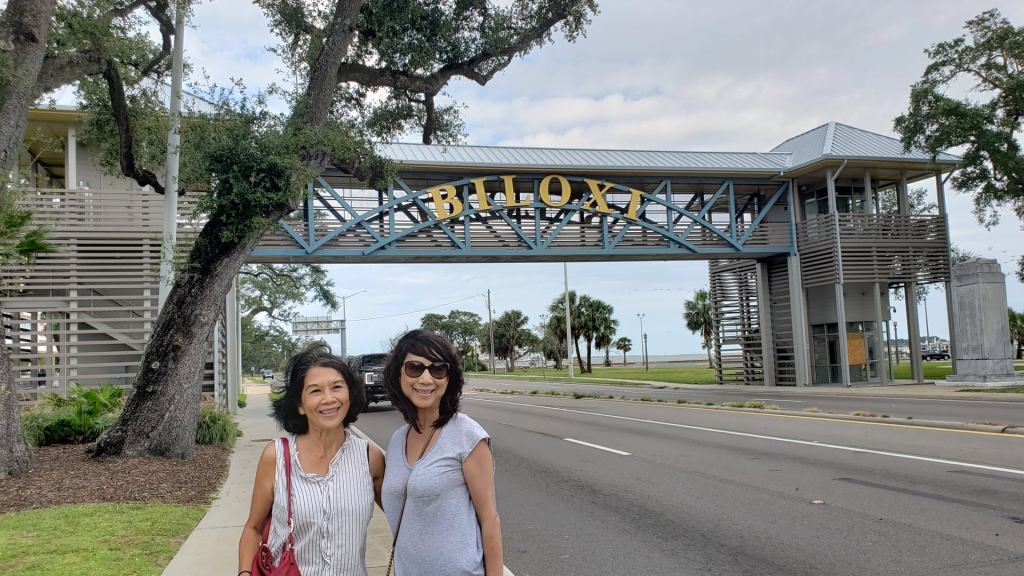
Biloxi -Mississippi

Ghé thăm thành phố nhỏ Biloxi nằm trong vịnh Mexico thuộc tiểu bang Mississippi.
⚓️ ⚓️ ⚓️


Vùng duyên hải Vịnh Mexico của Hoa Kỳ bao gồm các tiểu bang giáp ranh Vịnh Mexico. Gulf States – Texas, Louisiana, Mississippi, Alabama, và Florida được biết đến là các tiểu bang Vịnh miền Nam Hoa Kỳ. Nơi đây có nguồn lợi tôm tự nhiên rất lớn, do vậy mà có rất nhiều ngư dân Việt Nam khai thác nguồn lợi hải sản này.
🌊🌊🌊


Nghề đánh tôm ở vùng vịnh Mexico có thể phân biệt làm hai loại, Đánh tôm Guft và đánh tôm Bay:


✔️ Đánh Tôm trong vịnh: Đánh tôm ở Guft cần phải có tàu lớn – thường là dài trên tám mươi feet. Phải trang bị đầy đủ hải cụ, gồm cả rada và các phòng lạnh, bếp sinh hoạt, nhà vệ sinh, phòng khách, phòng điều khiển,…để có thể làm việc nhiều ngày trên biển mà vẫn giữ cho tôm tươi tốt. Tôm Guft có thể đánh được quanh năm, không bị luật lệ giới hạn. Tôm Guft to nhưng không ngon bằng tôm Bay vì thịt cứng và hơi tanh.


✔️ Đánh tôm ở “Bay”: là các hồ giao tiếp giữa biển cả và sông ngòi nên vị nước hơi lợ. Không mặn mà cũng không ngọt. Có rất nhiều hồ tiểu bang trải dài từ Florida đến biên giới Mễ Tây Cơ. Đánh tôm trong hồ chỉ cần những chiếc tàu nhỏ dưới năm chục feet. Tàu nhỏ sẽ dễ xoay sở vì nhiều Bay có diện tích rất là nhỏ. Đánh tôm trong hồ thường thì sáng đi chiều về nên không cần trang bị rađa. Chỉ cần trang bị CB radio, hải bàn và hải đồ là đủ.
🦐🦐🦐 🦐🦐🦐 🦐🦐🦐


Mùa đánh tôm ở ngoài Vịnh thì không giới hạn thời gian, chỉ cần sóng yên biển lặng là có thể ra khơi bất cứ lúc nào. Nhiều tàu đánh bắt trong Vịnh thì kéo dài từ 2- 4 tuần, sau đó quay vào bờ nghỉ ngơi, tiếp thêm nhiên liệu và quay trở lại công viêc từ 4-7 ngày.
🚤🚤


Ngược lại, đánh bắt tôm trong hồ chỉ kéo dài trong 6 tháng: Từ tháng 6 đến tháng 12. Thực sự số ngày ra khơi chỉ khoảng sáu tháng hoặc ít hơn. Sáu tháng còn lại thì…. Free! … Muốn làm gì thì làm.


Nhưng nguồn lợi chính của thành phố Biloxi không phải từ ngành đánh bắt tôm mà từ những sòng bài với quy mô nhỏ hơn so với Las Vegas. Những casino ở đây không tập trung trên trục đường chính như Las Vegas mà ở rải rác ngay các bãi biển chung quanh thành phố.


⛈🌧💨 ⛈🌧💨 ⛈🌧💨
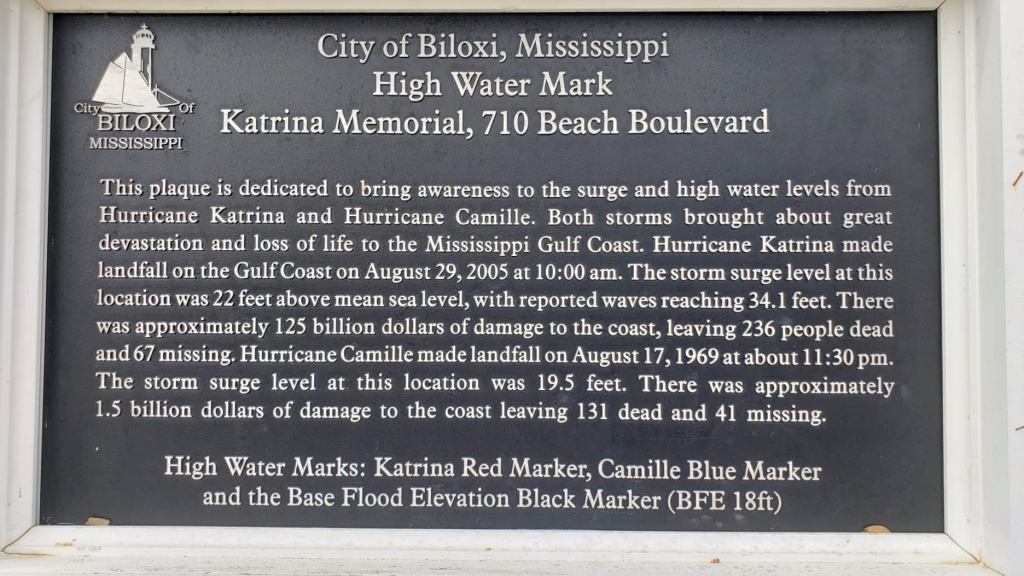
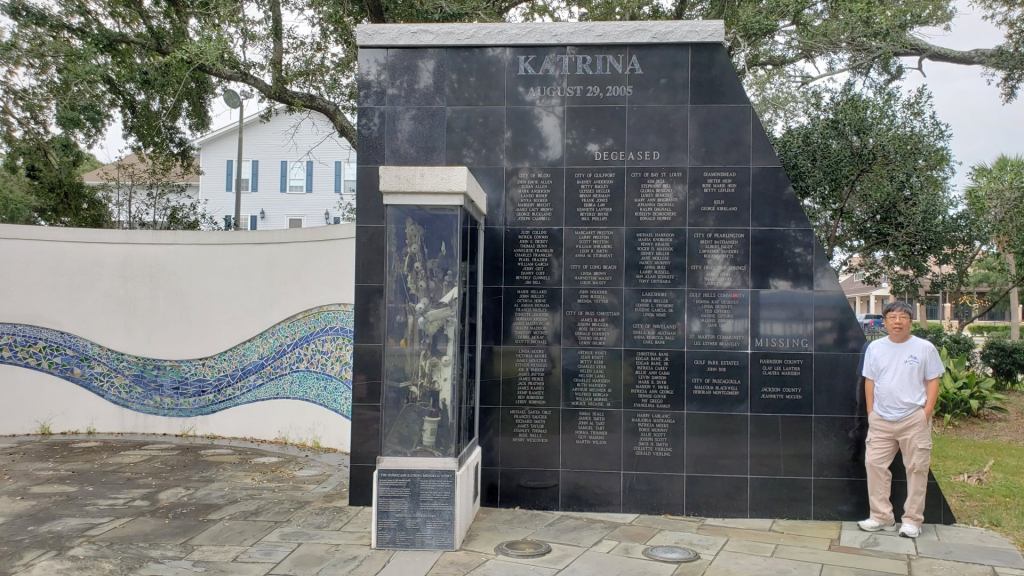
Trung tâm thành phố có đài tưởng niệm nạn nhân của trận bão Katrina năm 2005.
Bão Katrina đã tàn phá Biloxi hư hại trầm trọng. Thị trưởng thành phố này ví Katrina như một trái bom nguyên tử đã nổ trên Hiroshima, hay là một trận sóng thần tsunami đã ập vào đất Mỹ.


Bên kia đường khu tưởng niệm là biển với sòng bài Hard Rock Cafe.
🎸🎸
Casino Hard Rock Cafe trước đây bị bão Katrina tàn phá hư hại nặng 2 ngày trước khi khai trương, phải xây cất lại hoàn toàn, lớn và đẹp. Nhiều di tích các nhạc sĩ bị bão thổi bay mất trên biển được dân chúng trao trả lại hiện được trưng bày ở đây, quần áo lính của Elvis Presley. Cây đàn guitar của Johnny Cash, B.B. King, KISS. cũng được trao lại.


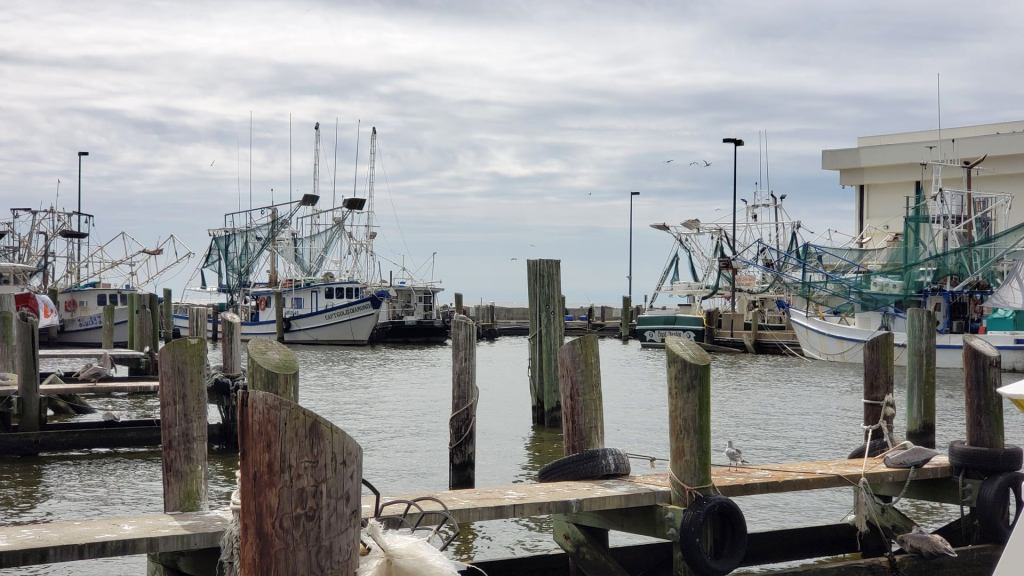
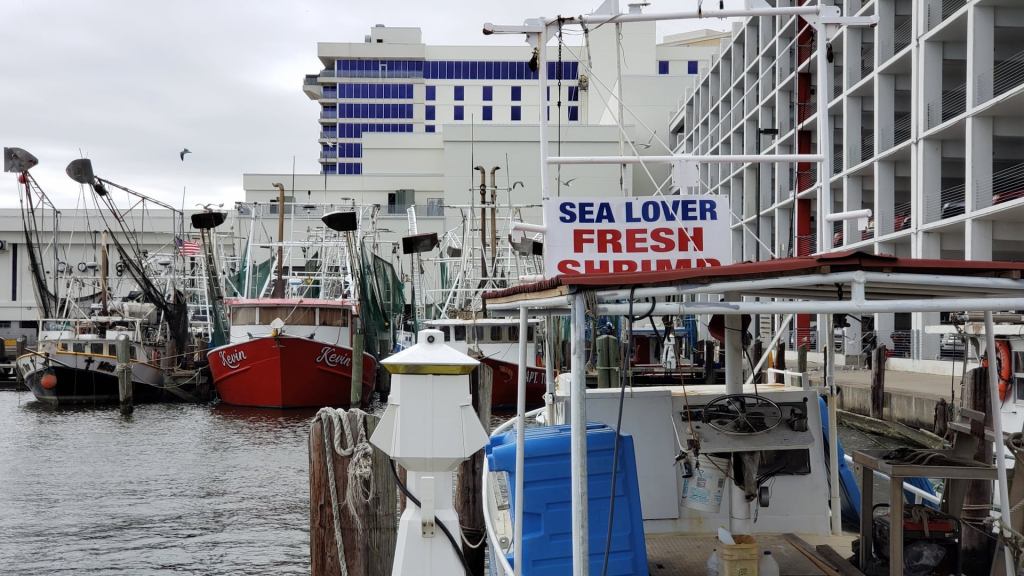
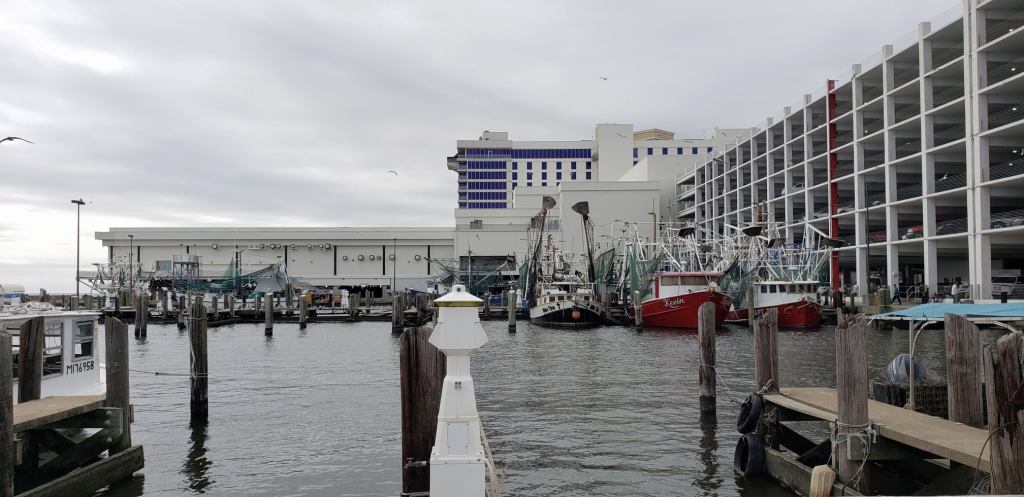
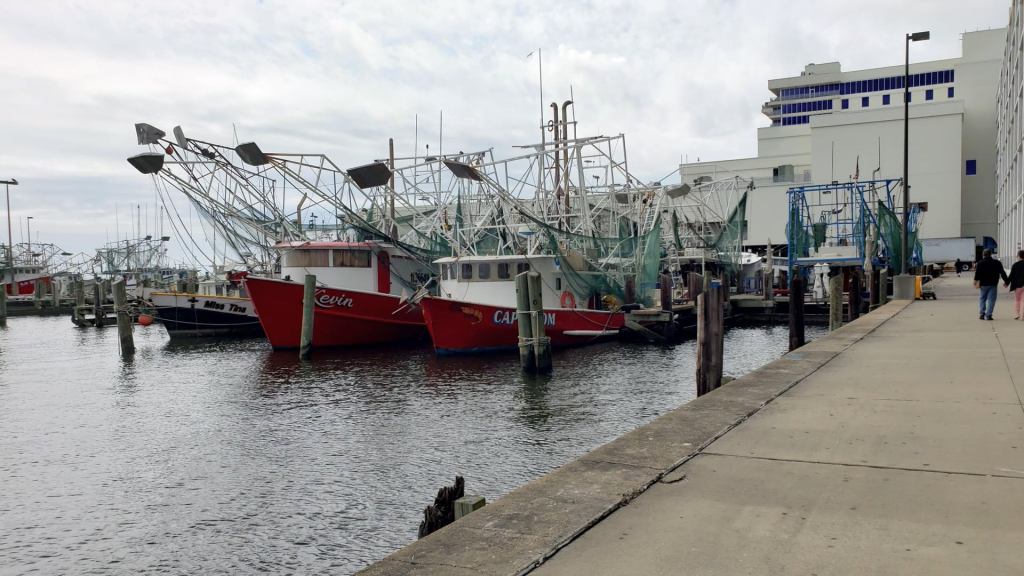
Điều đặc biệt là ngay sau casino Hard Rock là âu thuyền của phần lớn ngư dân Việt.
🦑 🦞 🦀 🐟 🦪


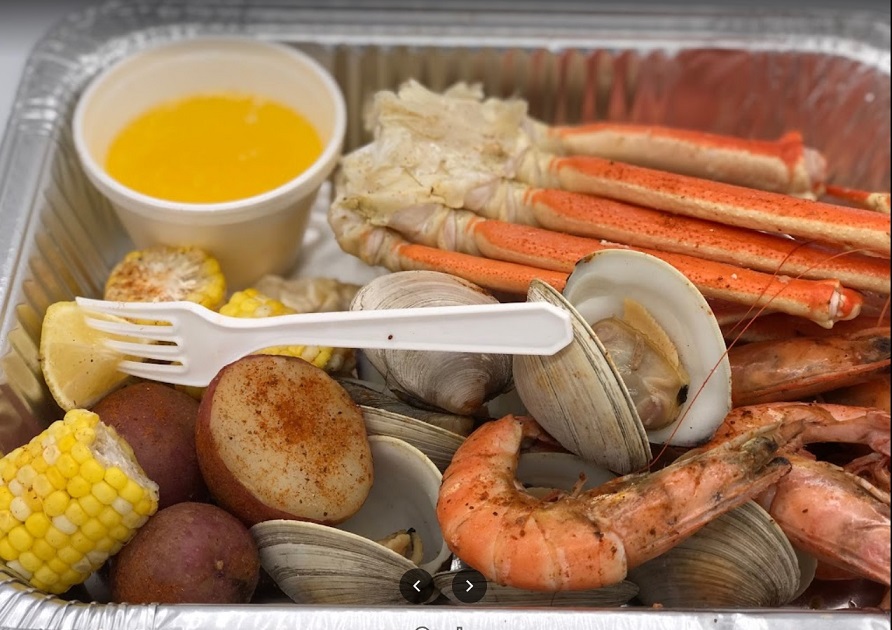
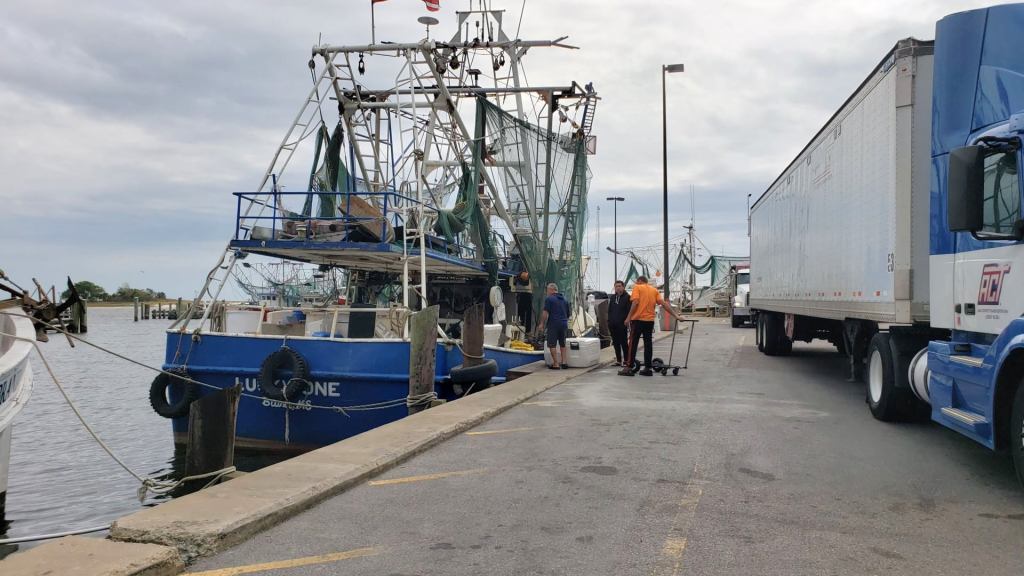
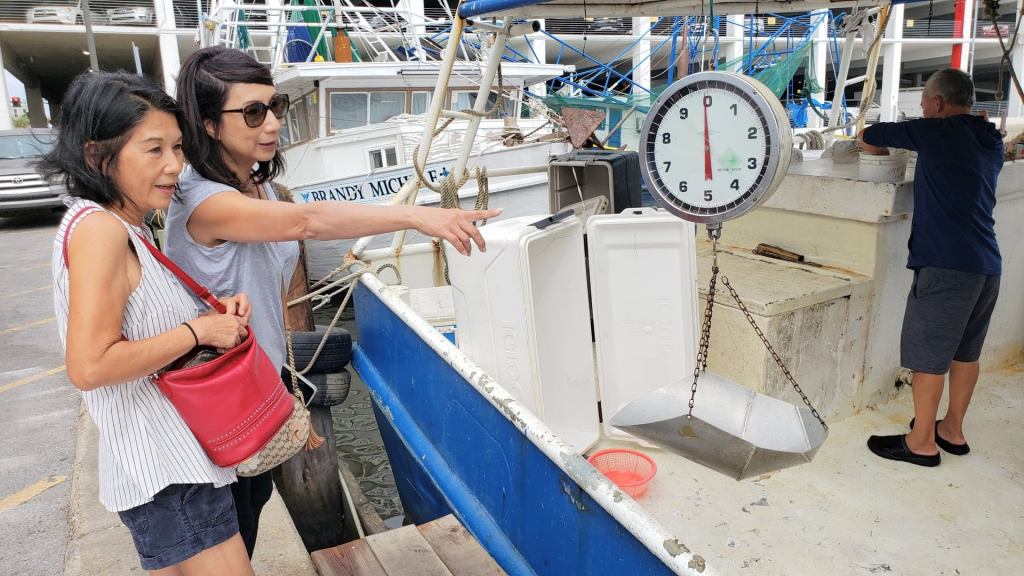
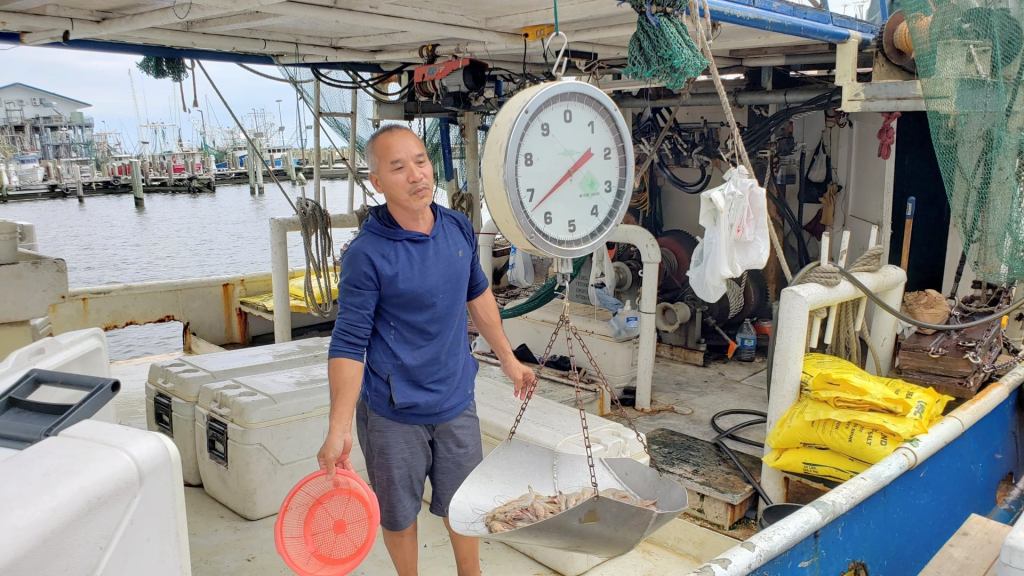
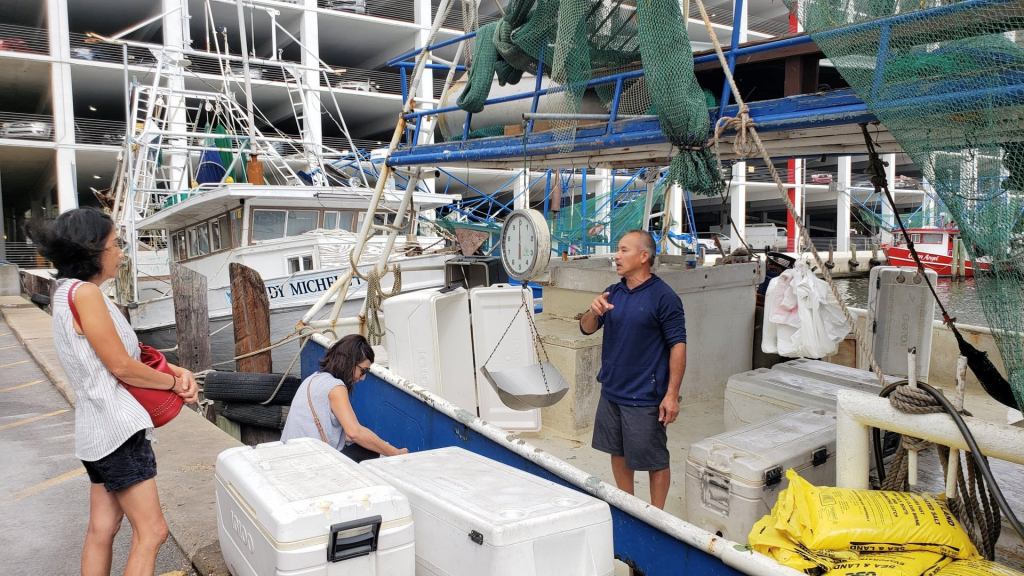
Những con tàu ‘cánh bướm’ 🦋 ở đây thuộc loại đánh tôm ở Bay. Thường nhổ neo ban đêm và trở về bến để bán vào lúc 6, 7 giờ sáng nên tôm rất tươi. Đôi khi còn có cá nhỏ, cua, mực, hào, crawfish nhưng nhiều nhất vẫn là tôm tươi đủ loại medium, large, jumbo. Tôm không đầu thì đắt hơn một tí. Mua mang đi xa thì cho thêm nước đá.
Mua 4 pound tôm loại lớn với giá $5/lbs được anh chủ tàu vui tính cân dư cả pound. 🍤🍤🍤


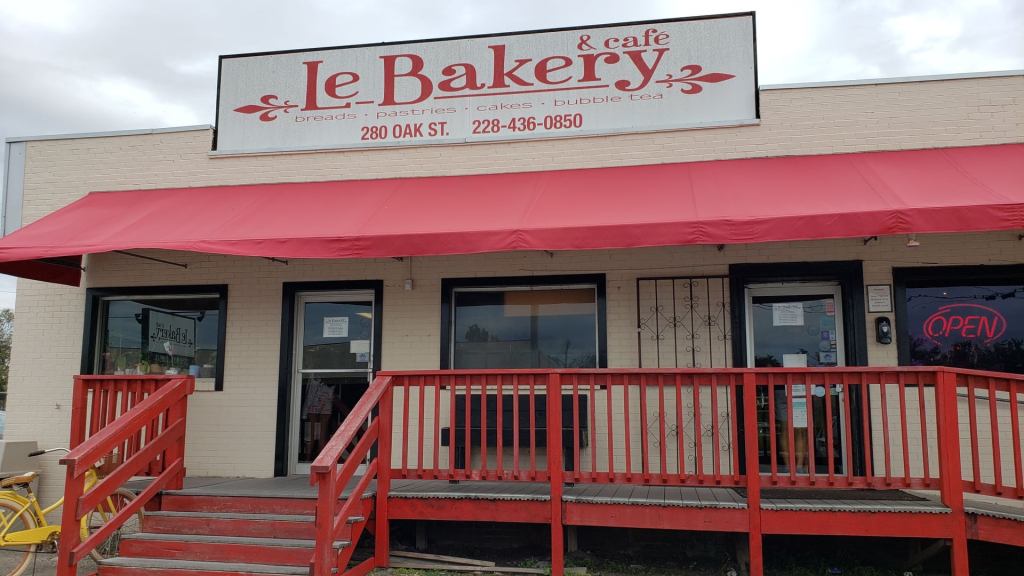
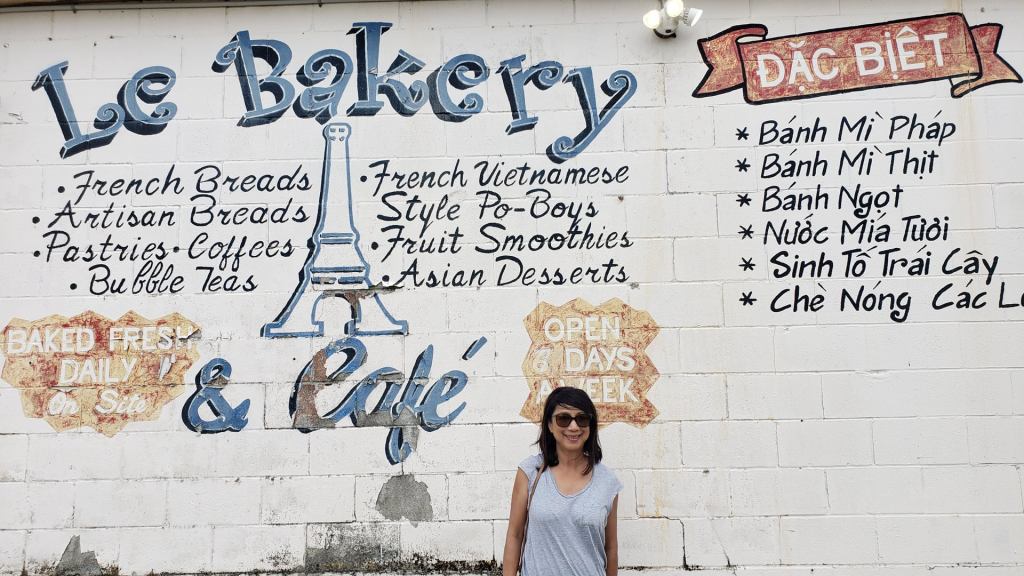
⛪️Trên con đường Oak Street, ngôi chùa Vạn Đức và nhà thờ Các Thánh Tử Đạo nằm sát bên cạnh nhau, hàng xóm láng giềng vui vẻ. Cách đó không xa là Le Bakery làm bánh mì thịt cho đến bánh cưới.🥐🥖


♥️🔔❤️🔔💖 ♥️🔔❤️🔔💖
Sự thành công làng chài nơi đây là sức mạnh tinh thần và tình yêu thương. Cha con lúc vui lúc buồn có nhau, sớm chiều kinh kệ ngân nga, tình thương trải dài như những làn gió biển khi mạnh khi nhẹ, một không khí chan hòa, nhẹ nhàng và tự nhiên tự tại. Dù đời sống dân chài có lúc cơ cực phải “ăn sóng nuốt bão”, nhưng cũng như những người anh em của bác thuyền chài thì họ lúc nào cũng bộc trực, nhiệt tình, thẳng thắn, vẫn một nụ cười hồn nhiên.😉😁

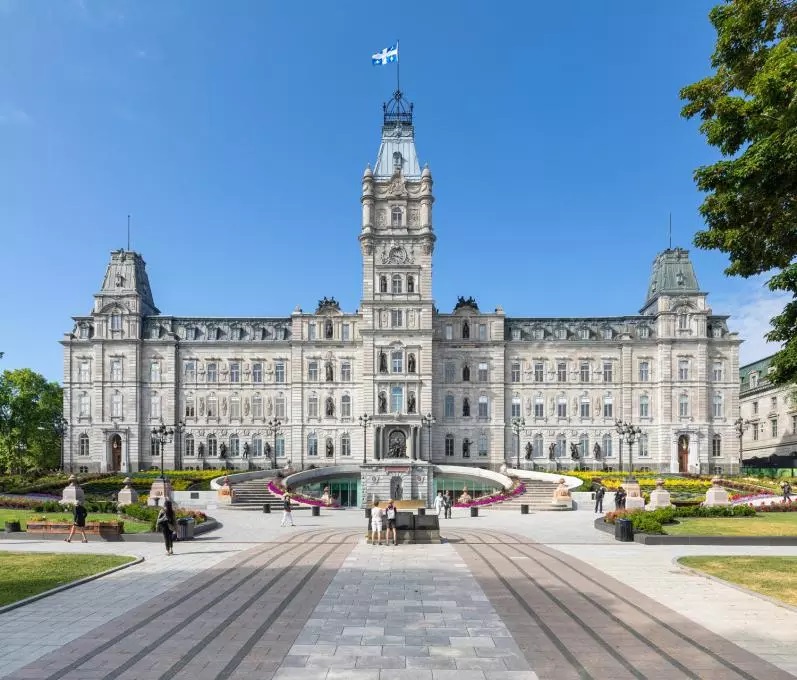
Parliament Hill – Quebec, Canada

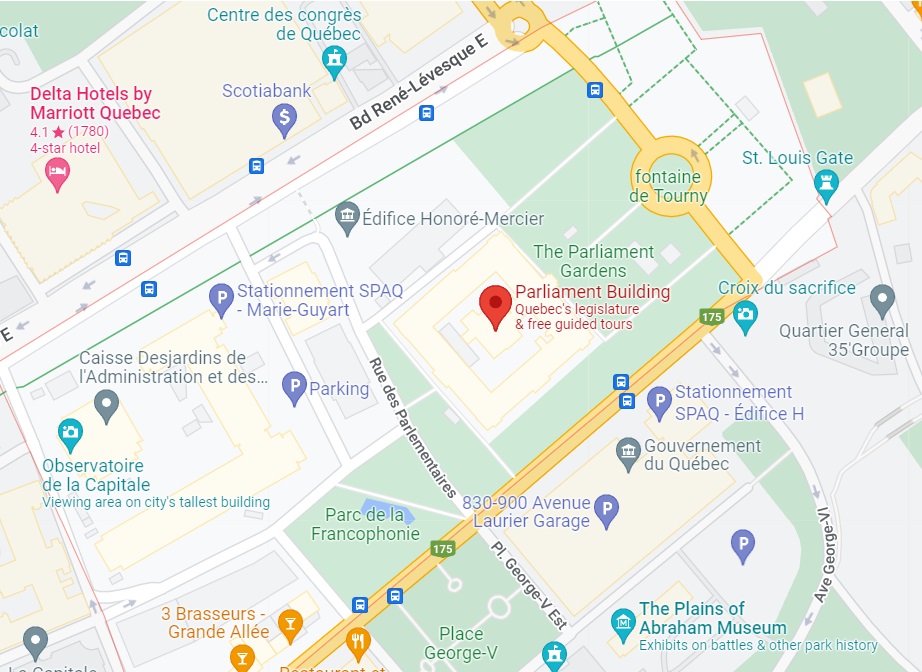
Parliament Hill is located in the Upper Town, just outside the fortifications. It’s home to a number of government buildings, the famous Plains of Abraham, and the festive section of Grande Allée.

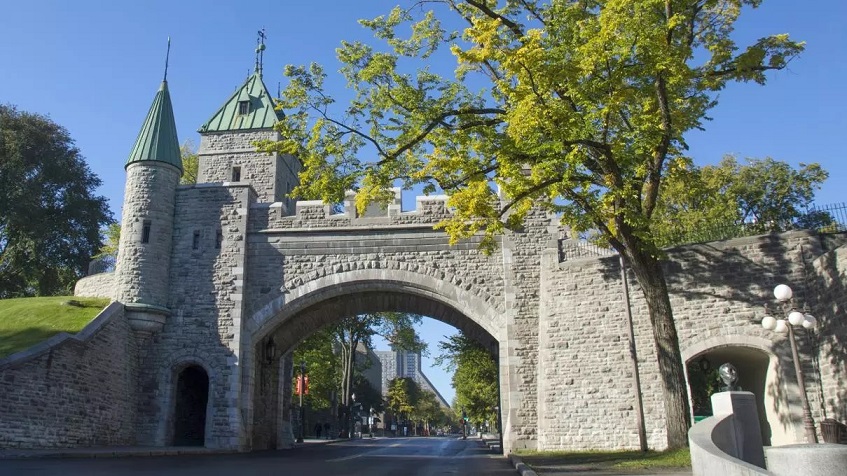
St. Louis Gate

The Saint-Louis Gate is one of the entry points in the fortified walls surrounding Old Québec. On the inside of the walls, rue Saint-Louis stretches from the gate to Château Frontenac, while on the outside can be found the Parliament Building and Grande Allée.

This iconic gate is part of the fortification system comprising bastions, gates and defensive structures that account for Québec City’s renown as a fortified colonial city and the reason Old Québec was named a UNESCO World Heritage Centre. Only three other gates that were part of the original fortifications survive: the Kent, Saint-Jean and Prescott gates.

The history of the Saint-Louis Gate

The first Saint-Louis Gate was in the late 17th century under the French Regime at its present location.

During the British Regime, the army closed the gate doors at night to restrict travel between the city and outlying areas, which disrupted trade and hampered the city’s development. When the British troops left in 1871, the gate doors were removed to permit traffic to flow freely.

Appreciative of the historical value of this architectural treasure, the newly appointed Governor General of Canada, Lord Dufferin, was opposed to having the ramparts and gates torn down. He, along with an Irish architect specializing in the reconstruction of medieval military structures, developed a plan to preserve and enhance these defensive works. The result of their efforts are the fortifications and gates seen today. The current Saint-Louis Gate dates back to 1878 and is both much larger and more esthetically pleasing than the original.

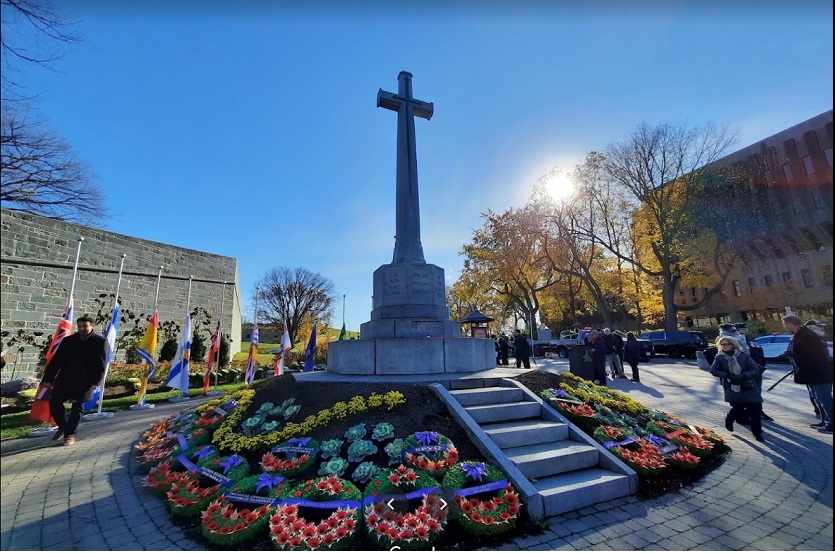
Croix du sacrifice

The Cross of Sacrifice: Thousands of Canadians died in the two great world wars and it is in remembrance of their sacrifice that a cross has been erected next to the entrance to nearby Battlefields Park from the Porte Saint-Louis. Every year, on November 11, Armistice Day, a ceremony to commemorate these historic events takes place here, organized by Branch No. 260 of the Royal Canadian Legion. If the model of the Cross of Sacrifice was inspired by France, the idea, it, comes from Great Britain and is attributed to Lieutenant-Colonel LG Scott who issued it to his colleagues during a meeting of veterans .

 It was around the 1920s. A committee was formed to carry out the project, and a subscription launched in the public, which brought in the amount of $4,000. The monument was unveiled on July 1, 1924 by the Governor General of Canada, Lord Byng of Vimy. This ceremony gave rise to a great patriotic demonstration accompanied by the band of the 22nd Regiment. The Cross of Sacrifice is made of a single stone. The four angles have been knocked down to give the shaft the octagonal shape. The sword occupies almost three quarters of the facade. A copy of the program for the day of July 1, 1924, some newspapers and coins of the time have been deposited in the base of the monument. A second inauguration was to take place in 1947.

It was then that a few handfuls of soil from France were added to the base, an initiative of the “Société Alsace-Lorraine, terre française”. An inscription reads: “To our dead of the great war” with an English translation. In 1947, the memory of the heroes of the 1939-1945 war was joined, symbolized by these words: “A nos glorieux Morts”/“To our glorious dead”. (Reference: The commemorative monuments of Quebec, by GE Marquis.) It should be noted that after the Korean War, in 1953, a sentence was added evoking this other conflict. All these memories are now melting into each other. Monique Duval, Quebecensia, volume 17, no 1, December 1996

Fontaine de Tourny

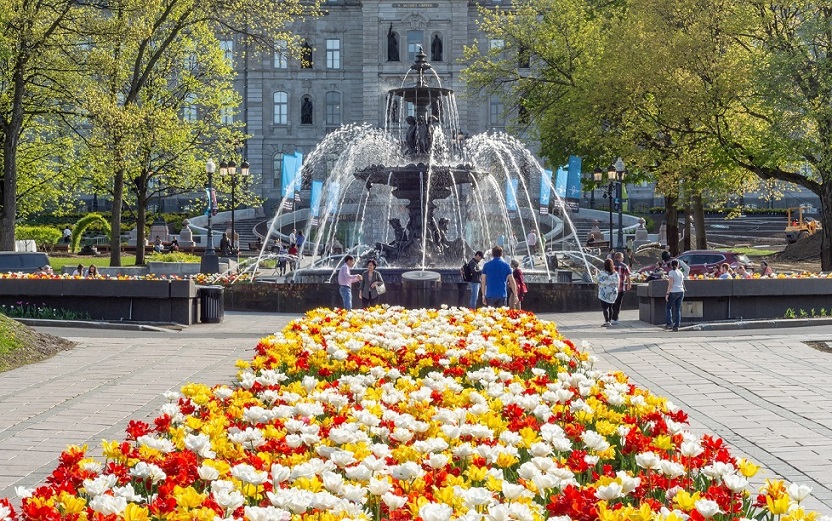
This majestic fountain, adorned with numerous figures and boasting 43 water jets, stands in front of the Parliament Building.

Originally installed in Bordeaux, France, in 1857, and then removed in 1960, the fountain was discovered by chance during a visit to a flea market in Paris by a businessman from Québec City. At the time he was looking for a unique gift to make to the City of Québec for its 400th anniversary. He had the fountain shipped to Québec City, where it was restored before being presented to the city. 

History of the Tourny Fountain

Although only recently installed in Québec City, the Tourny Fountain has a fascinating history. Six copies of this work, designed by French sculptor Mathurin Moreau in 1853, were made, and it was exhibited at the 1855 World’s Fair in Paris.

Delighted by the beauty of this work, the mayor of Bordeaux (a twin city of Québec City) acquired two of the six and had them installed in the streets of Tourny in the centre of the city. In 1960, the two were dismantled during the construction of an underground parking lot. One of them later wound up at a Parisian antique dealer.

In the early 2000s, Québec City businessman Peter Simons was mesmerized by the esthetics of the fountain, despite its dilapidated state. Confident in its potential, Simons purchased the fountain and hired a Parisian specialist to restore it. He know that it would complement the architectural style of the Parliament Building perfectly.

The fountain was then shipped to Québec City, restored and presented to the city to celebrate its 400th anniversary. This gesture by the Simons family was an expression of thanks to local residents for contributing to the success of the Simons fashion retail store, located in Old Québec since 1840. The five other copies of the fountain are in Porto, Angers, Soulac, Saint-Quintin and Geneva.

Parliament Building

The Parliament Building was erected between 1877 and 1886. It is an imposing structure whose four wings form a large square. Its architecture, inspired by the Louvre Palace in Paris, makes it one of the only French-style institutional buildings in Québec City. It is Québec’s oldest historic site and the seat of Québec’s government. The building’s main facade boasts 26 bronze statues erected to the memory of key historical figures. It’s a fascinating place full of secrets and surprises.

You can take a free guided tour of the Parliament, where the national assembly’s 125 members determine the fate of the province. The tour lasts 60 minutes and delves into the history and workings of Québec’s parliamentary institutions as well as the history of the province itself. Cap off the experience with a meal at Le Parlementaire, a swank restaurant that serves up delicious local products. It’s one of the hill’s best‑kept secrets!

Located in the heart of Québec City, just steps from Old Québec, the National Assembly offers you a unique experience through its free guided tour. Learn about the Parliament of Québec and hear some remarkable stories! This fascinating tour sheds light on Québec’s history as well as its parliamentary institutions and their major contribution to Québec society. The tour features the National Assembly’s beautiful architecture and works of art. Visit one of Québec City’s top tourist attractions!

Opening Hours

Monday to Friday: 8:30 a.m. to 4:30 p.m.
Saturday: 9:30 a.m. to 4:30 p.m.
Sunday: Closed

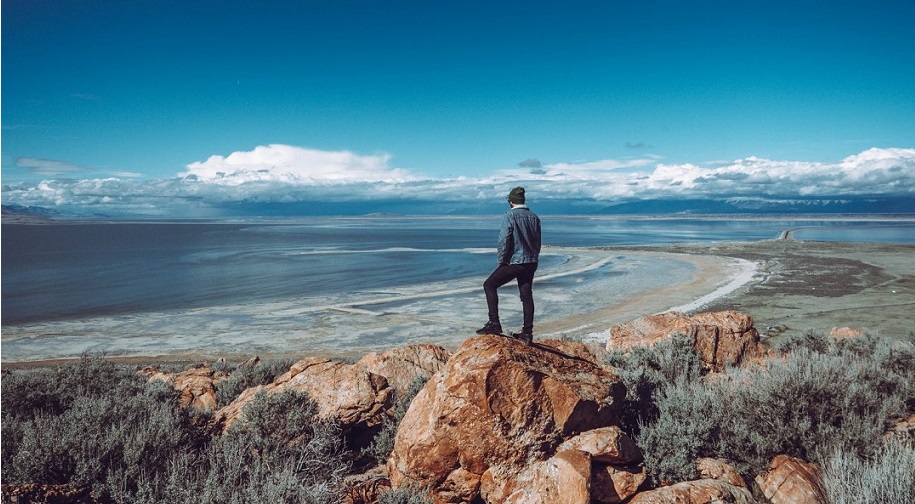
Antelope Island State Park – Utah

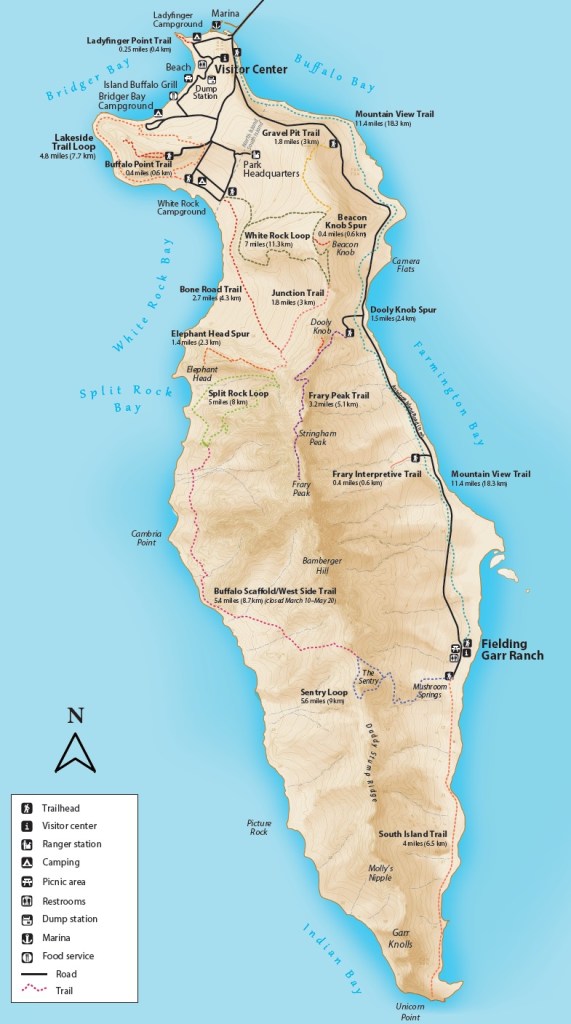
Antelope Island State Park is an island in the Great Salt Lake and can be reached from the mainland along the Antelope Island Road, a small but scenic road that can be accessed by paying the entrance fee at the toll booth

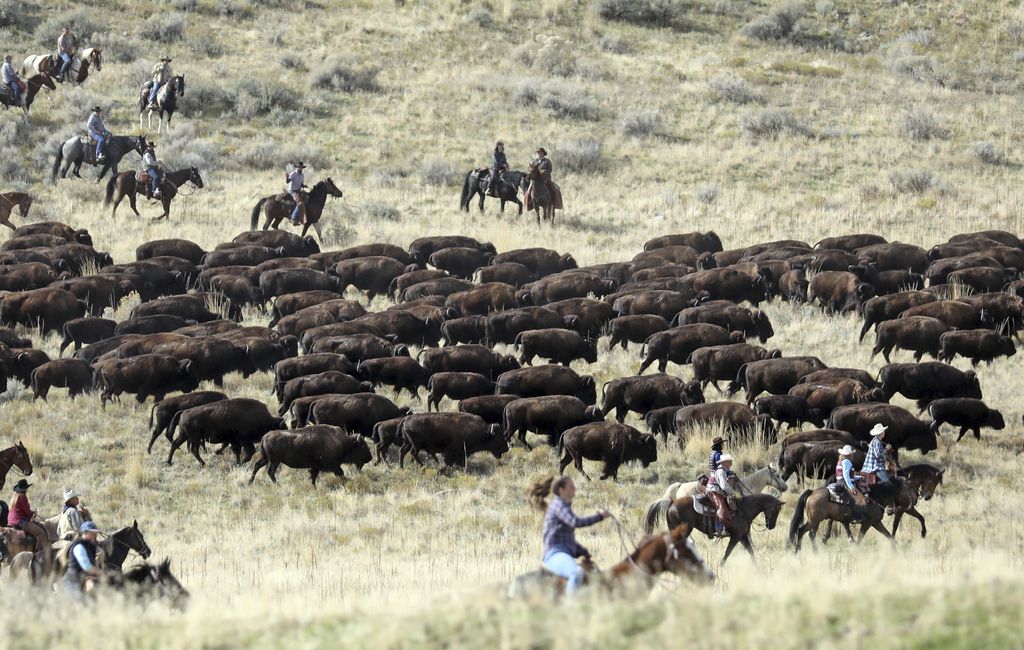
What makes Antelope Island especially impressive is its surreal landscape, made of golden prairies and beaches that fade into the horizon, and its fauna, composed of bison, antelope, deer, coyotes, bighorn sheep and various species of birds. The most representative image of this natural area is a herd of bison peacefully grazing on the prairies at the foot of the mountains (for example Frary Peak, the highest peak).

You can either drive around the park, stopping at viewpoints to admire the beauty of the views and wildlife, or you can hike the many trails available. Many people also swim here, taking advantage of the high salinity of the lake, which seems to enable you to float without too much effort, although the strong smell could make you want to pass this up…

How long does it take to visit the park?

The park is not big and if you want to visit it by car you could manage to do it even in 2 hours. Obviously, things change if you decide to walk the trails. Here are some tips on how to plan an itinerary for either option:

Visit by Car

If you are looking for an itinerary that allows you to enjoy the best of the park in about 2 hours, follow this route:

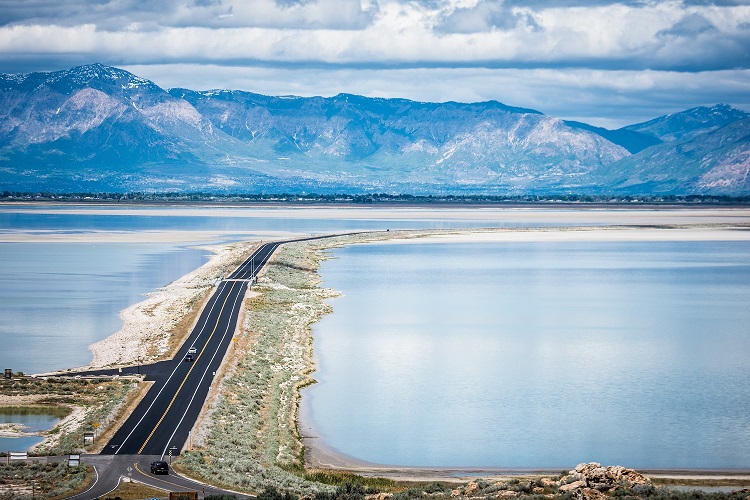
A seven-mile causeway crosses the Great Salt Lake connecting Syracuse, Utah, to Antelope Island State Park.

As soon as you start driving along the Antelope Island Road, you will immediately realize you are in an unusual place. The spectacular road leading to the island (Davis County Causeway) is like a thin layer of land skimming over the salt lake. On your left you will be greeted by the majestic Frary Peak reflected in the water, while flocks of birds will fly alongside you as you drive.

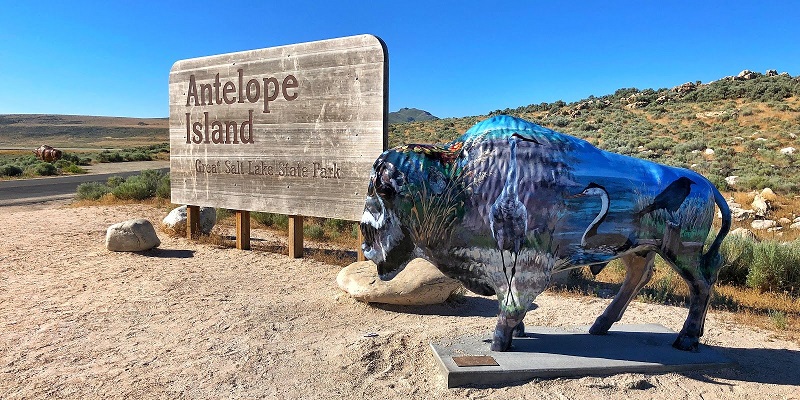
Near the Antelope Island State Park sign (and its unsightly blue bison), I suggest you turn right and head towards the Visitor center, where, in addition to picking up the map and requesting information, you can enjoy a wonderful view of the road you have just driven.

Visitor’s Center

The Visitor’s Center is very small. There is a table with different animals bones or horns that is always fun because it’s a hands-on activity. You are allowed to touch and hold anything on the table.

Bird Feeder at the Antelope Island State Park Visitors Center

Our favorite part of the Visitor’s Center is the bird feeder. There is a large window where you can watch the birds. We even saw big chukars coming to the feeder. The ranger told us that there is a rabbit that lives in the rock behind the feeder so if you are there early you can see him. We did not, but we watched for a long time.

https://goo.gl/maps/nqdbuMaiJYtzFV4i8

Buffalo Point

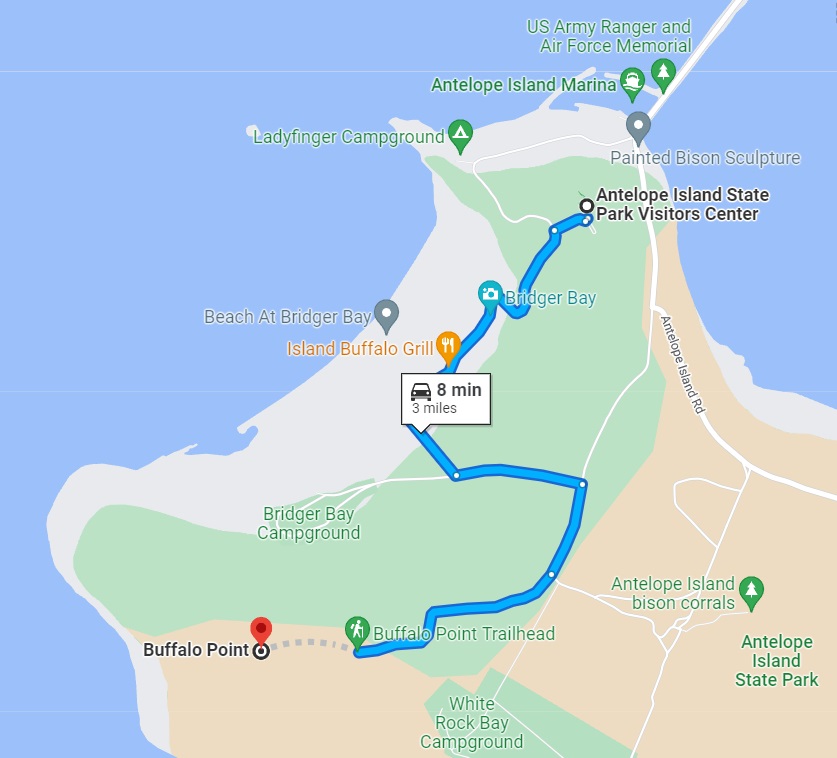
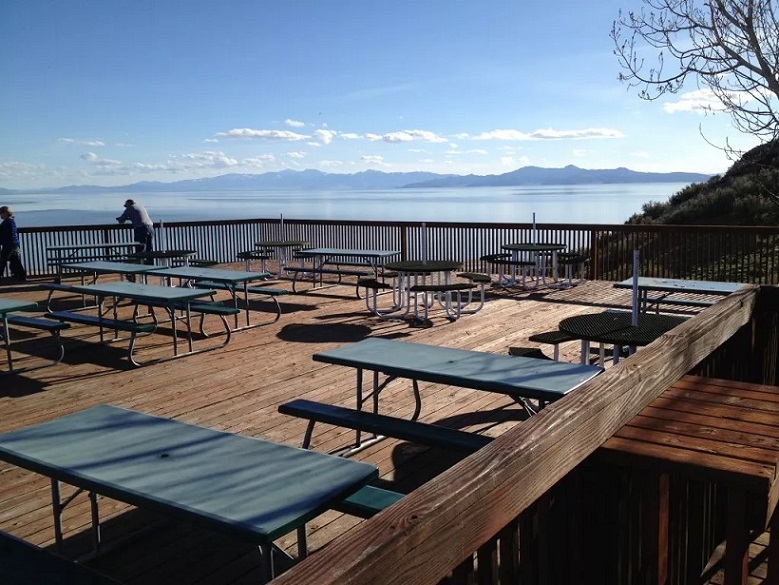
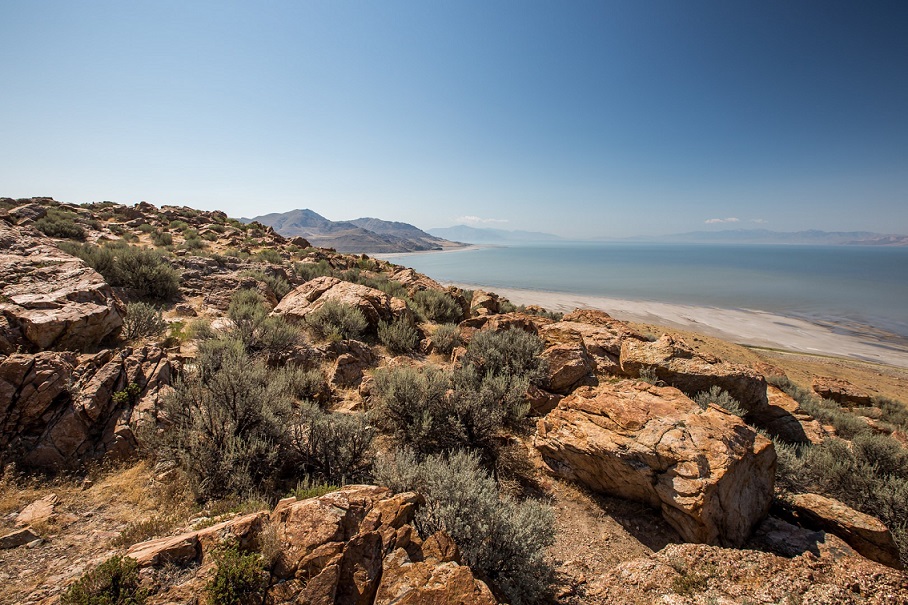
From the Visitor center, heading south, you’ll come across a number of trails and viewpoints. You’re free to explore the whole area, but whether you’re a hiker or just a visitor on the road, you don’t want to miss Buffalo Point, a scenic spot with picnic tables that gives you a beautiful view of the western side of the island.

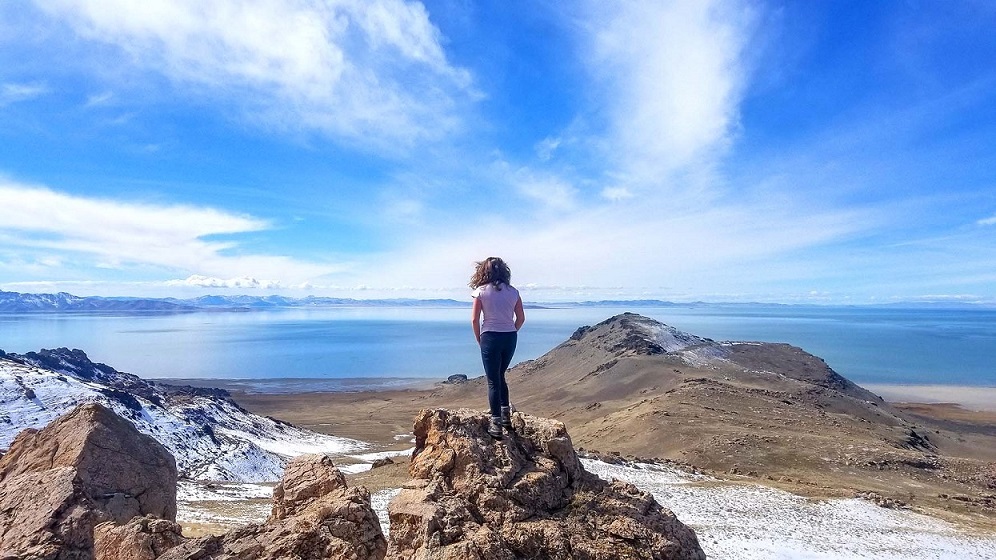
Buffalo Point Trail climbs up a small peak and then you can walk across the peak to an viewpoint for the Great Salt Lake on both sides. The trail is steep on the way up, but across Buffalo Point it is flat and relaxing. This trail is only 0.6 mile roundtrip.

The trail is easy to spot, and the hike, is short and easy to walk. The parking lot, which also has remarkable views, has restrooms, a large panoramic patio with benches and even binoculars to see things more closely. This trail is an excellent place for watching bison grazing. The short hike leads to a rock from which you can enjoy splendid views of the lake and some smaller islands.

Buffalo Point

At this point, go back to the blue bison statue and this time take the road along the east bank of the lake, at Farmington Bay. This is the best area to sight the bison, which you will encounter along the way in large numbers and probably also up close (Here and in Yellowstone, they have the habit of crossing the road). In this area, if you’re lucky, you’ll also see some antelope, one of the fastest land animals in the world,  and is more difficult to spot than bison, which move in large herds.

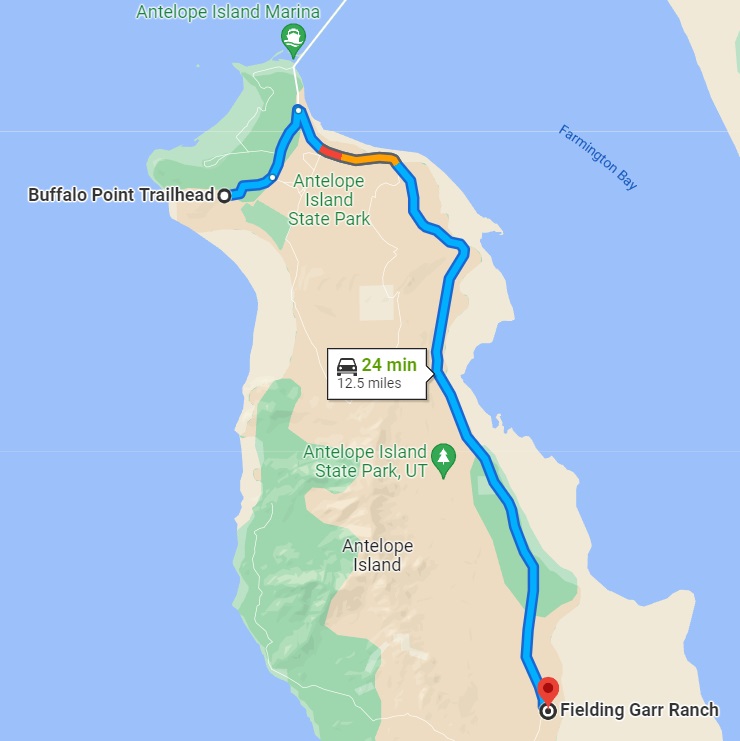
The road from the painted bison to the Fielding Garr Ranch is about 11 miles long and, if you want to travel all the way, it may take you even 1 full hour to complete round trip. Along the way, after almost 6 miles, you will find the junction to Frary Peak Trailhead Road, which leads to 2 of the park’s most popular trails: Frary Peak Trail and Dooly Knob Trail.

https://goo.gl/maps/nuiJRs4X9QL9LK7t8

Fielding Garr Ranch

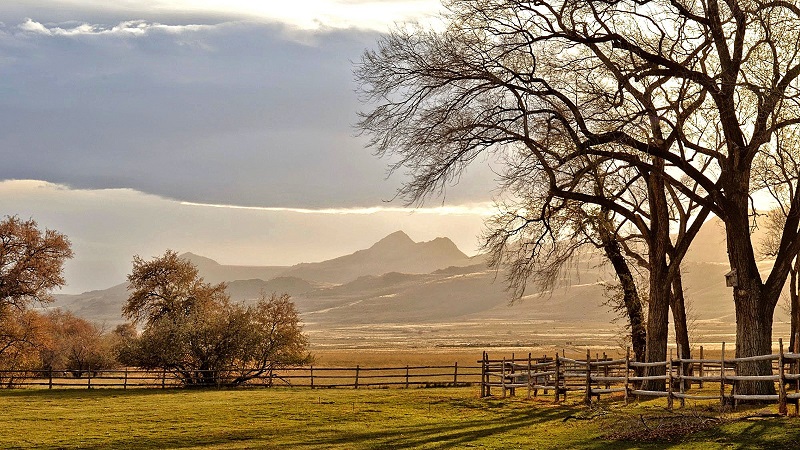
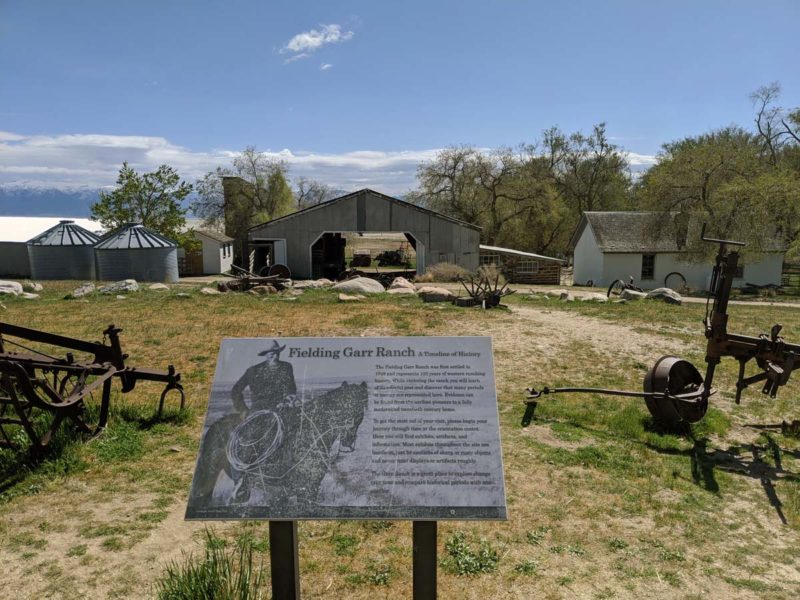
The Fielding Garr Ranch was the first permanent residence on Antelope Island and was inhabited from 1848 to 1981.  We were able to take a guided tour of the Ranch, given by a park historian, to learn all about how the homesteaders were able to survive in such a desolate place.  The State Park occasionally provides guided tours, but you do not need to be guided to visit and experience the Ranch.

Fielding Garr Ranch is a hands-on museum, which means that you can touch and feel almost everything you see.  The home and the barn are open to take a walk through.  There is even a water pump you can try and some fake animals you can rope.

The oldest building in Utah that’s still on its original foundation sits upon an unimposing ranch on the southeastern shore of Antelope Island in Davis County, Utah.

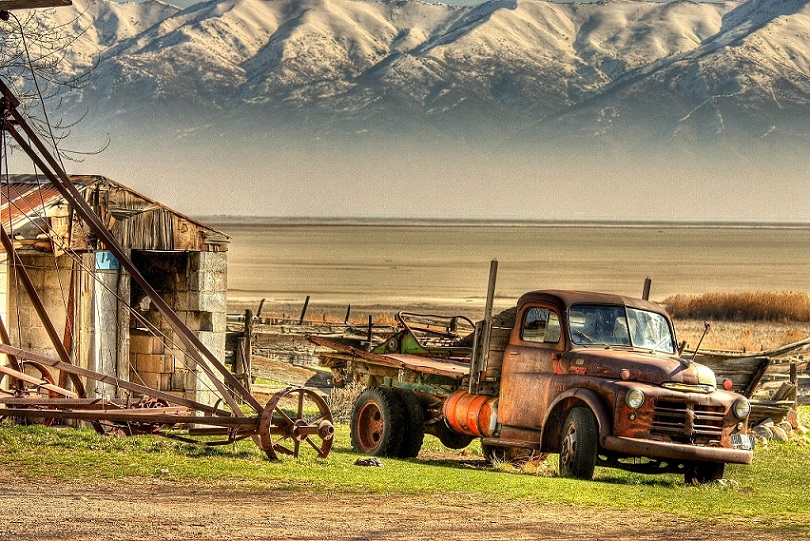
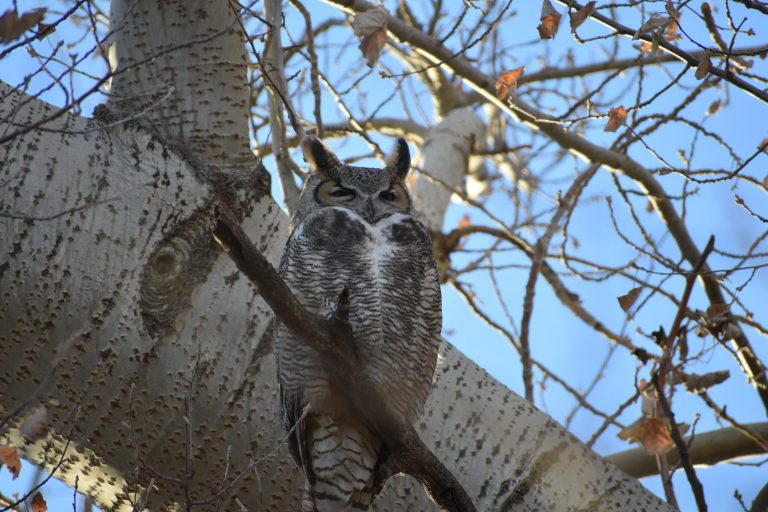
 The ranch is no longer a working ranch, but you can still see the old buildings and the farm house. We always love seeing old pioneer relics, and the old farm equipment is very interesting. Two favorite activities here: one is ringing the old bell, and the other is trying to rope the wooden cattle. As far as animals, there are a few horses, and we always see deer here for some reason. There is a great-horned owl that hangs out around the ranch.

Walk through the large barn that is filled with old farming equipment.

Make sure to look for the great-horned owl at the ranch.

Lady Finger Point

Another shorty but goody is Ladyfinger Point. Located on the Northwest side of the island, you’ll get views of Egg Island which is preserved as a bird sanctuary. Egg Island is actually reachable from Ladyfinger Point when the water levels are low, but it’s actually off-limits to hikers in order to preserve the safety of the birds that nest on the island.

This trail is a short .25 mile walk out to the end of Lady Finger Point and provides a great view of Egg Island and the north side of the Great Salt Lake.  For many, this is a great bird-watching area.  We even saw a few jackrabbits!  This is a great little trail for kids.

Getting Here

Take a right as you enter Antelope Island from the causeway, pass the marina, and you will see a shaded picnic table and some restrooms next to a parking area.  This is the trailhead.  If you get to the Visitor Center you have gone too far.

Bryce Canyon National Park – Utah

Bryce Canyon became a National Monument in 1923 and was designated as a National Park in 1928. It is the second most popular of the “Mighty 5” Utah national parks and has 2.5 million visitors annually.

The park is 35,835 acres, it is the smallest national park in Utah.
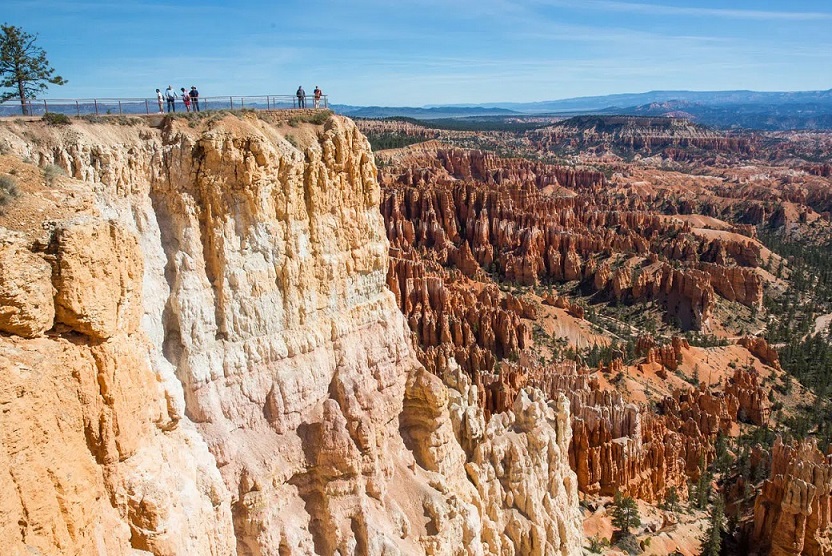
Bryce Canyon is not a single canyon, but a series of natural amphitheaters or bowls, carved into the edge of a high plateau. The largest is Bryce Amphitheater, it is 12 miles long, 3 miles wide, and 800 feet deep.

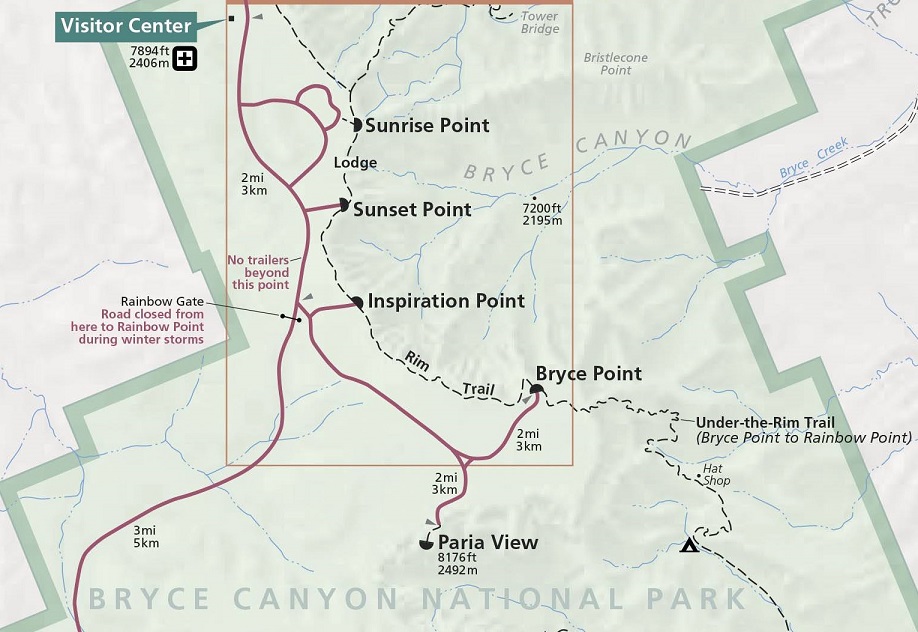
Perhaps every visitor to the park will spend at least some time marvelling at its four main viewpoints, all found within the first few miles of the park: Bryce Point, Inspiration Point, Sunset Point, and Sunrise Point. Between April and October a shuttle service is operated in this area of the park to reduce congestion.

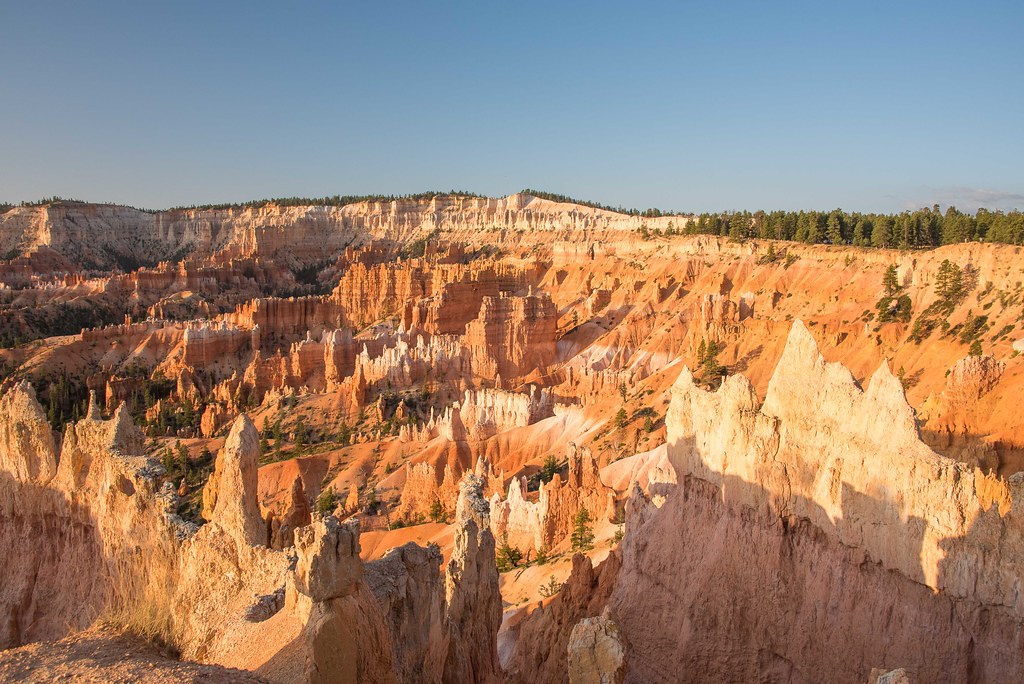
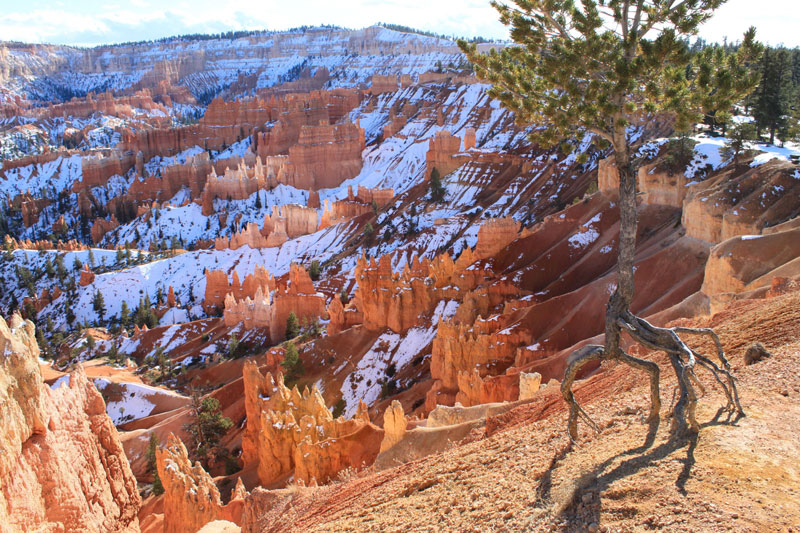
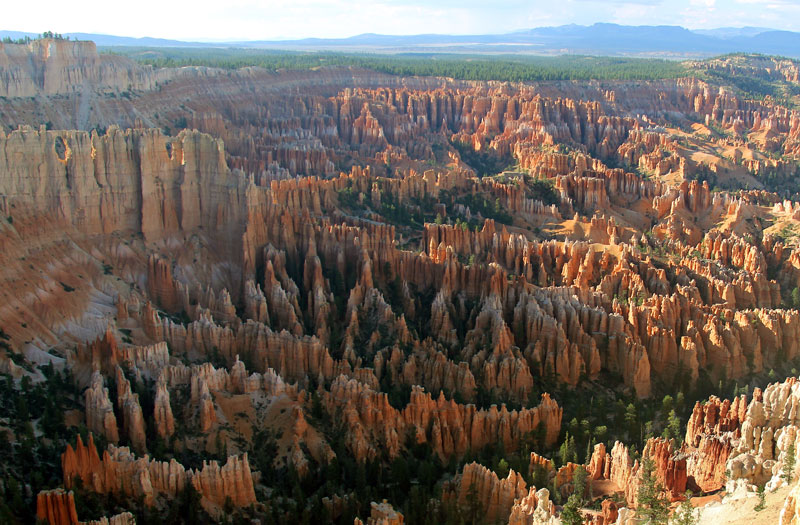
Bryce Canyon has the largest collection of hoodoos in the world, some are up to 200 feet high. Hoodoos are tall skinny spires of rock formed over thousands of years of repeated freezing and thawing of water.

Other viewpoints are found all along the park’s 18-mile main road which travels from park’s only entrance in the north along the plateau rim to its highest elevations in the south (over 9,000 ft / 2,743 m). 

Driving through Bryce Canyon will take you approximately 4 hours if you do the full scenic drive and take your time at each stop.

The Bryce Canyon scenic drive includes 13 viewpoints along the 38-mile roundtrip adventure.

BRYCE CANYON MAIN VIEWPOINTS

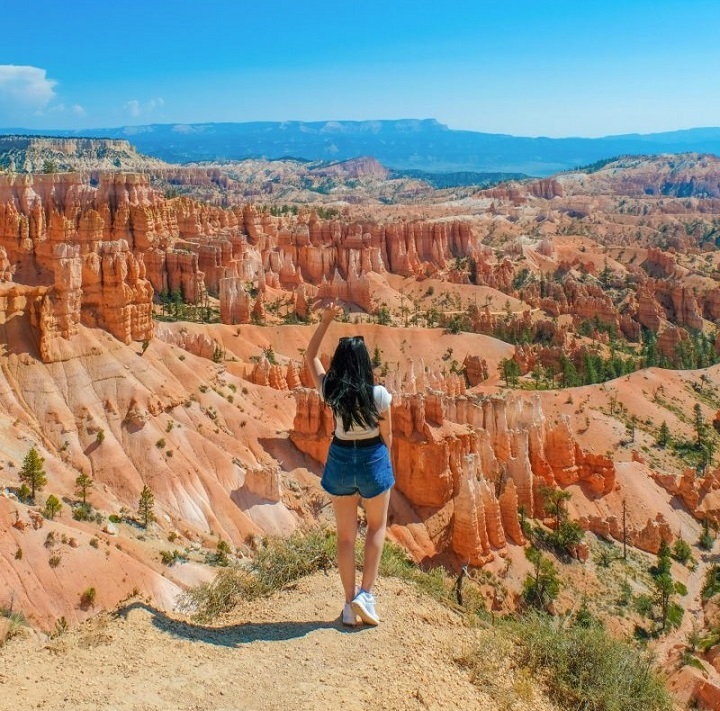
Sunrise Point 

Start your morning at Sunrise Point for one of the most breathtaking views of Bryce Canyon. The viewing point is just off the scenic road, along the canyon rim, about a mile from the visitor center.

Morning @ Sunrise Point @ Bryce Canyon National Park

Sunrise Point offers incredibly colorful vistas at sunrise—hence the name—as the sun casts an early morning glow on the red rock hoodoos. Cast your gaze northeast to see the Boat Mesa and Sinking Ship, incredible rock formations set against the majestic Pink Cliffs and the backdrop of the Aquarius Plateau. Boat Mesa is especially notable, rising 8,073 feet above the Fairyland Canyon floor. The Sinking Ship tips in a precarious reminder of 15 million years of tectonic shifts. Also take note of the Limber Pine’s elegant balancing act on exposed roots on the eroding rim. The early morning light is exceptional at Sunrise Point, making it the ideal location for photography or just enjoying dawn’s peace and quiet.

Sunset Point

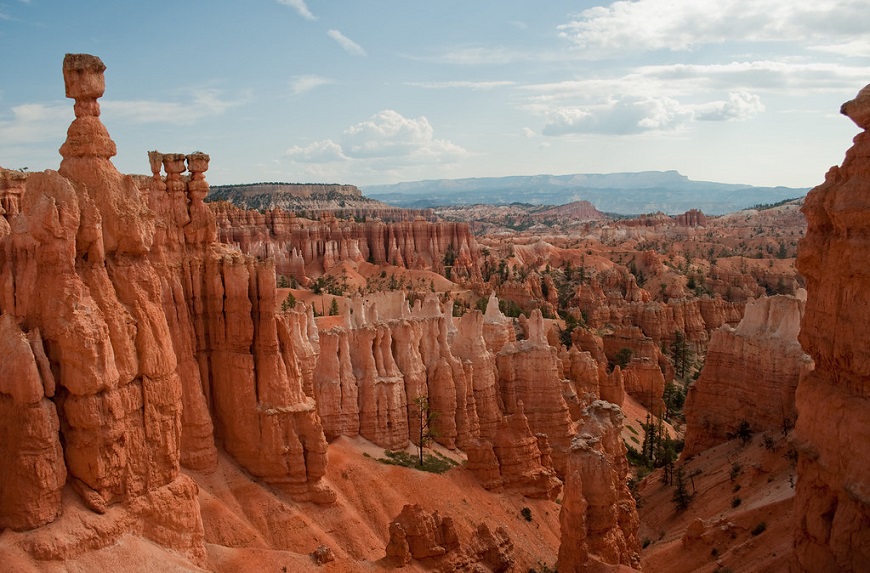
Sunset Point is a well-visited overlook due to the popular Thor’s Hammer and Silent City you can see from here. The name Sunset Point is deceptive thought because it’s NOT a good location for sunset photography. At this viewpoint, the best Bryce Canyon photos happen at sunrise when the light illuminates the hoodoos.

Thor’s Hammer and many formations, below Sunset Point.

Sunset Point is home to some of Bryce Canyon’s most famous hoodoos, including the Silent City, a maze of hoodoos and fins concentrated in a tight formation, and Thor’s Hammer, located just below the overlook on the northern edge. Because Thor’s Hammer stands alone, it’s easy to spot. The colors of the rock at Sunset Point are quite striking, with iron oxide minerals making the bright reds, oranges and yellows stand out.

Sunset Poin

Ancient Douglas fir trees accent the landscape, making it a popular spot also for birds and bird watchers. Sunset Point is located about a mile from the Visitor Center between Sunrise Point and Inspiration Point. The Navajo Loop Trail starts here, descending 550 feet into Bryce Canyon.

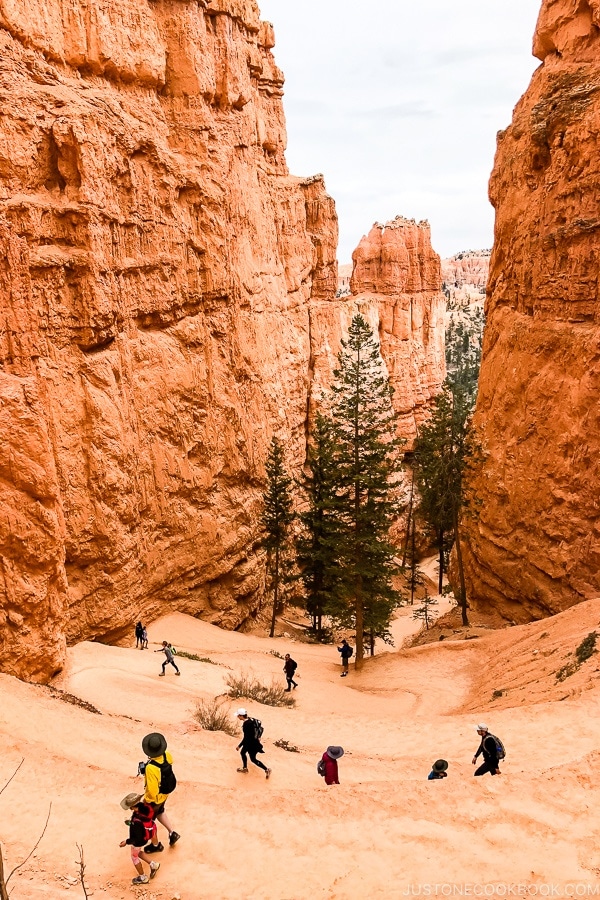
Navajo Loop Switchback

If you park at Sunset Point in Bryce Canyon and hike down the trailhead to Navajo Loop Trail to the switchbacks (around 500 ft), you will have seen the prettiest part of the hike. This area is really gorgeous and you shouldn’t miss it.

The Navajo Loop trail has a steep switchback that sits between two canyons. Both canyon walls are hundreds of feet high.

Inspiration Point

Hop back into your car and drive the short distance to Inspiration Point. Now that’s a lot of hoodoos!

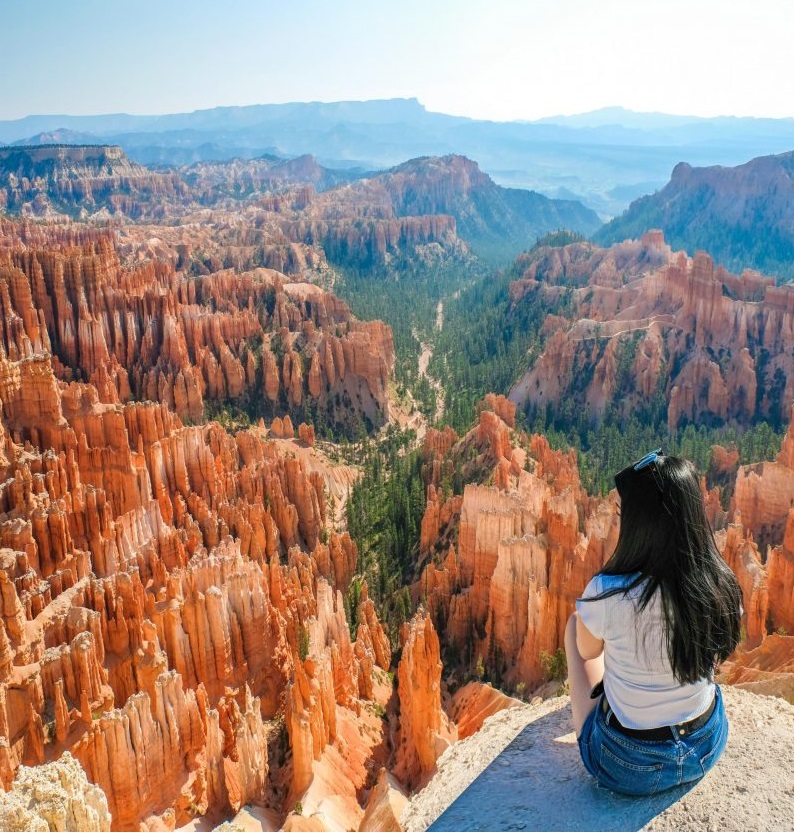
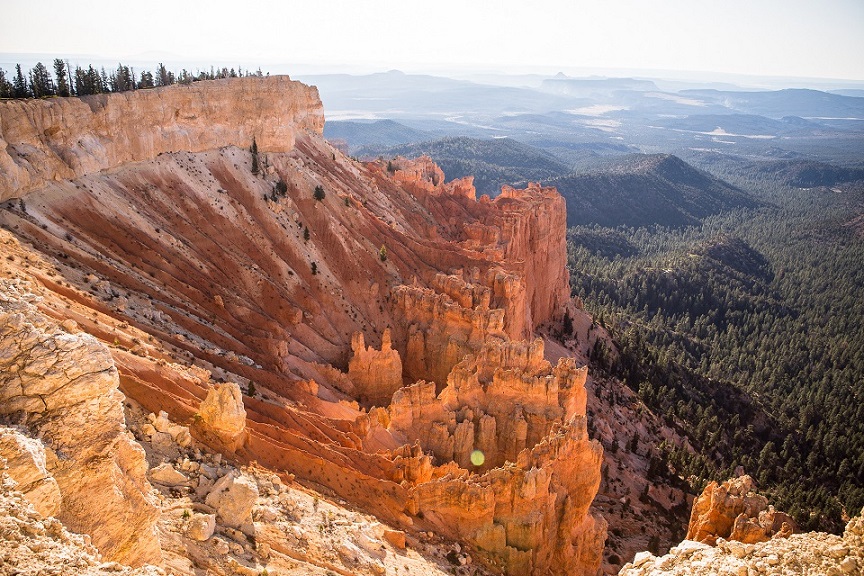
Three-quarters of a mile south of Sunset Point, Inspiration Point beckons Bryce Canyon National Park’s visitors throughout the day. Beautiful from sunrise to sunset, Inspiration Point was named by early Utah settlers, and it’s easy to see why. From here, the view stretches seemingly forever, as light catches the fins, spires, hoodoos and ever-eroding canyon walls. It’s like Bryce Canyon’s main amphitheater is on fire, glowing with reds, oranges, pinks and more. The Claron Formations Pink and White members are clearly evident here, and Boat Mesa is easily viewed. Bristlecone pine trees of mixed ages dot the red rock cliffs and slopes.

Inspiration Point

Inspiration Point consists of three levels that provide spectacular perspectives of the Bryce Canyon Amphitheater. From its lofty vantage points, visitors look toward the Silent City’s hoodoo forest.

Bryce Point

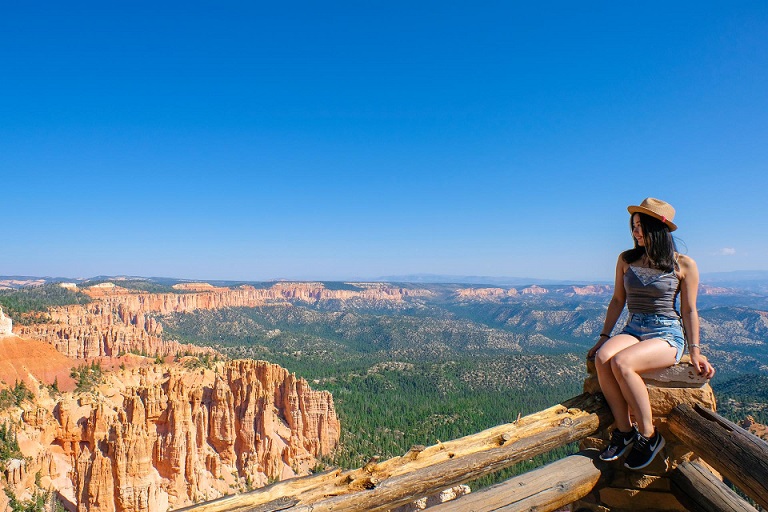
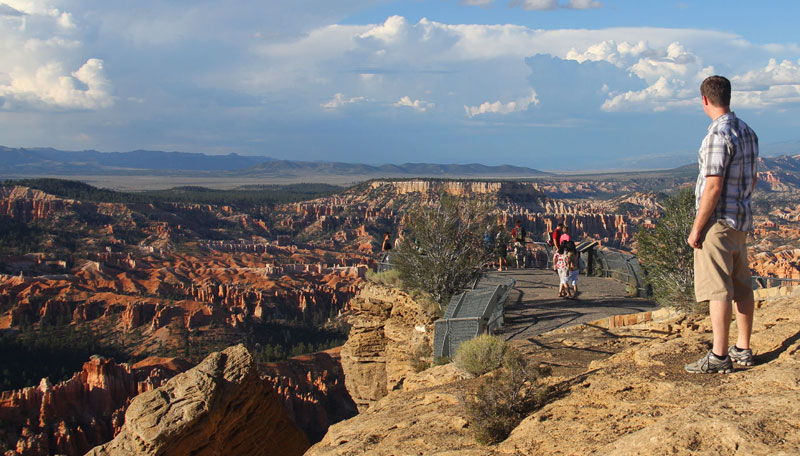
Bryce Point gives visitors fantastic panoramic views and photo opportunities.

Famous for its astonishing sunrise as the sunlight floods the top of the hoodoos with a brilliant burst of light and then works its way down into all but the deepest crevices, this north-facing viewpoint is also beautiful throughout the day. Catch a great view of Boat Mesa and the rich colors of the Claron Formation. Bryce Point is also a popular birding spot; keep an eye out for a rare glimpse of the California condor.

This Bryce Canyon viewpoint is named for Ebenezer Bryce, who settled the area in 1870. Due to its elevation at 8,300 feet, Bryce Point offers one of the most scenic vistas of the hoodoo-filled red rock amphitheater.

Take a driving tour to the south end of the park

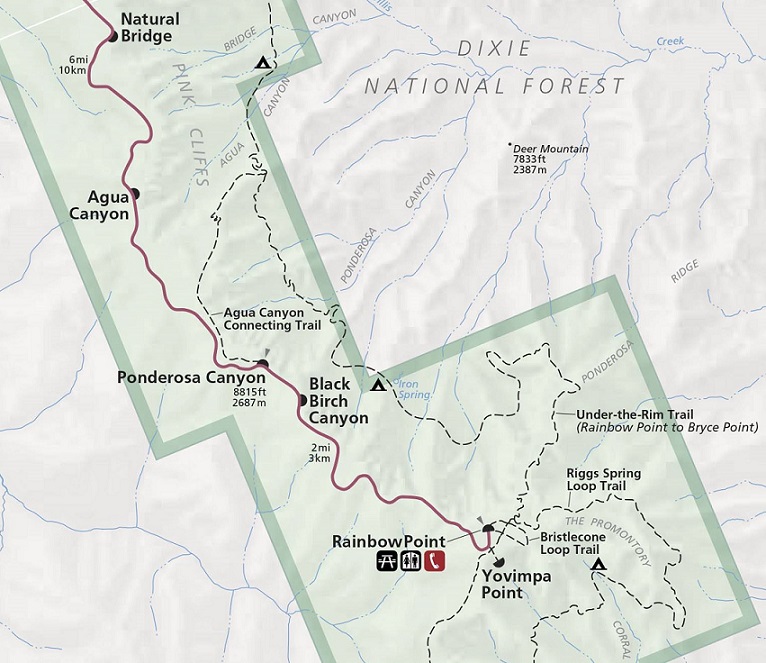
While many of the park’s attractions are north, don’t skip driving the park road to the south. From the park entrance to the end of the road at Rainbow and Yovimpa Points, the main park road is 18 miles. The road beyond the amphitheater is called the Southern Scenic Drive because of the many viewpoints along the way.

Swamp Canyon

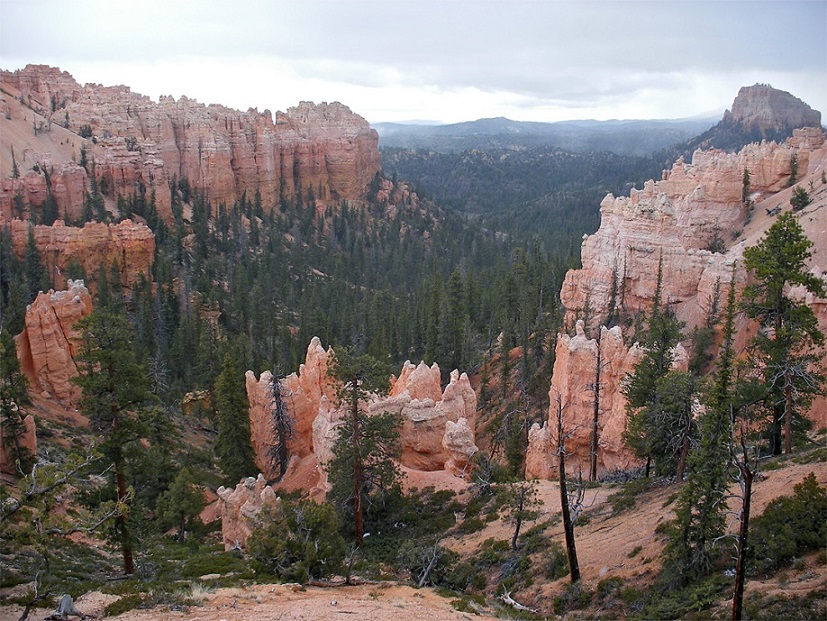
This unusual canyon is surrounded by fins and hoodoos on both sides.

Hoodoos and fir trees along Swamp Canyon

Swamp Canyon is Bryce Canyon National Park’s tiniest overlook and is bounded by fins and hoodoos, formed from collapsed arches. At 7,998 feet elevation, it offers an intimate vantage point for appreciating the scale of these magnificent formations.

 The overlook makes the area look sheltered and small, but below is a lush waterland where two tiny creeks and a natural spring provide enough water to upkeep the lavish green surroundings.

Natural Bridge

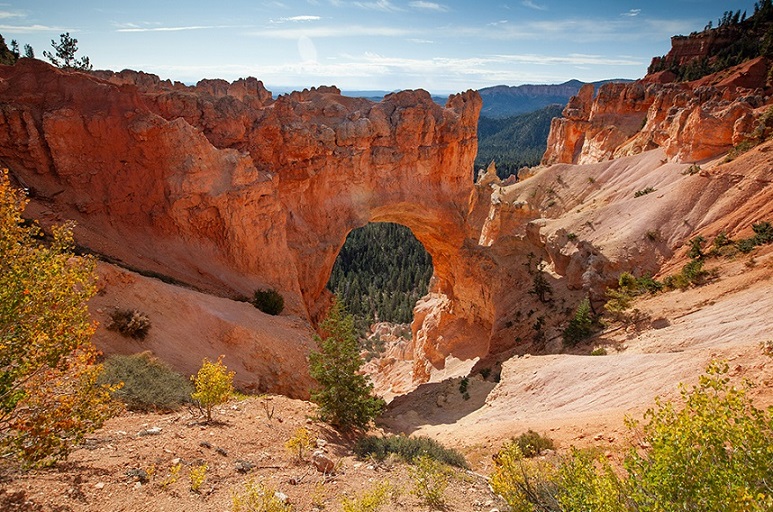
Known as the Natural Bridge, this natural arch is one of favorite Bryce Canyon photos.

The structure called Natural Bridge is technically an arch. Formed originally as a small ice window in a large prominent fin, the forces of erosion have made Natural Bridge one of the most popular Bryce Canyon views along the scenic drive. You will see similar features within the park as you go on various Bryce Canyon hikes, but none as impressive at nearly 125 feet tall.

Rainbow Points & Yovimpa Points

Located as far south as you can drive in Bryce, this viewpoint is good, but not nearly as great as Inspiration Point or the views from the Rim Trail. To get here, it takes about 20 minutes of driving from Bryce Point.

Rainbow and Yovimpa Points are the highest points, share the same parking lot. From Rainbow Point, the views are to the north and Yovimpa Point views are to the south.

At an elevation of 9,100 feet, Rainbow Point provides expansive views of the whole of Bryce Canyon and beyond. It is at the park’s far southern end, and its views looking north toward the hoodoos are some of the best you’ll see.

SEE THE GRAND STAIRCASE AT YOVIMPA POINT

For a totally different experience, walk from the Rainbow Point parking lot down to Yovimpa Point and look to the south for a clear view of the dazzling sequence of rock layers known as the Grand Staircase. This spectacular showcase of the planet’s natural processes stretches hundreds of miles through Bryce Canyon, Zion National Park, and the Grand Canyon.

Yovimpa Poin

The layers of rainbow sedimentary rocks of the Grand Staircase are the result of hundreds of millions of years of tectonic activity and weather. You can clearly see five distinctly colored steps: Pink Cliffs, Grey Cliffs, White Cliffs, Vermilion Cliffs, and Chocolate Cliffs.

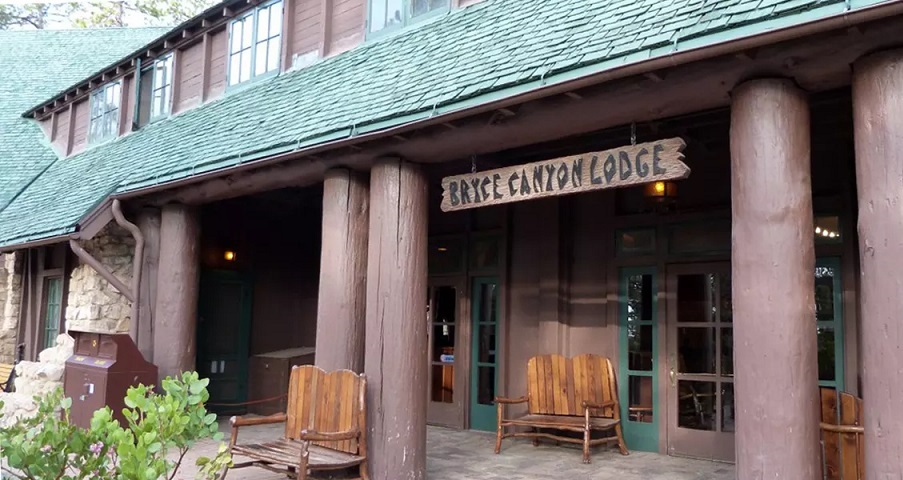
Bryce Canyon Lodge

After visiting Bryce, we stopped by Bryce Canyon Lodge for a quick lunch and to catch our breath a bit.

Bryce Canyon Lodge sits a few hundred feet back from the rim of the canyon. It’s a historic lodge that dates back to 1924. With 114 rooms, the lodge has suites, motel-style rooms, and cabins. The lodge and cabins are the work of master architect Gilbert Stanley Underwood and are excellent examples of the type of rustic architecture sometimes called “parkitecture.” Encouraged by the National Park Service and often built by the railroads, these classic park structures evoke the golden era of the national park service.

The food was actually pretty good and decently priced for a national park.

Lunch Menu:

https://www.brycecanyonforever.com/dining

Red Canyon

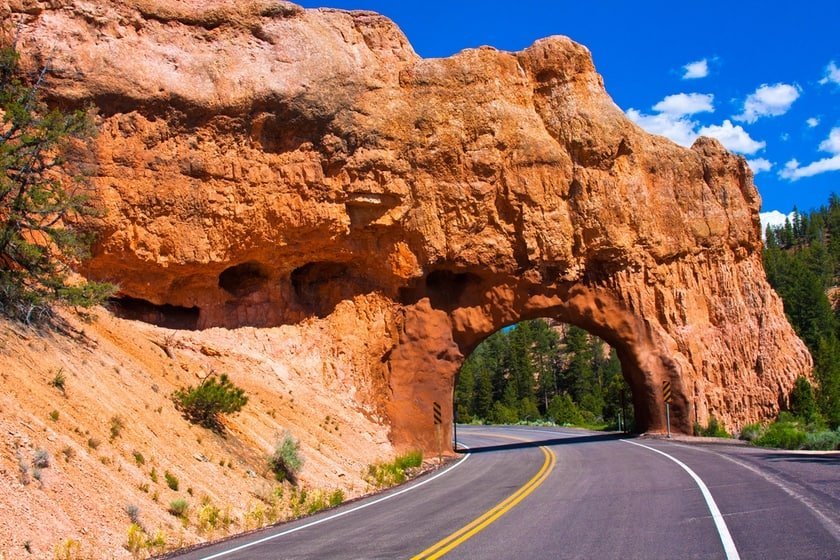
Red Canyon is the sister canyon to Bryce Canyon. Red Canyon is located along Scenic Byway 12, 15 miles outside of Bryce. This all-American byway is one of the most scenic drives in the southwest. You’ll pass under rock arches spanning across the road that were featured in the Pixar Cars movie.

Because Red Canyon is part of Dixie National Forest, rather than a national park or monument, there is no fee to enter the canyon. Your first stop when visiting Red Canyon should be the new visitor center, which was completed in the winter of 2004.

The road through the heart of the Red Canyon is 4 miles long, and most people keep driving without ever stopping, settling for what they can see along the way. For this reason, the clearings on the sides of the road are often deserted or almost deserted, but you can also take advantage of them, in case you want to take some pictures or head on a trail to reach a better vista point.

One of the most characteristic and unforgettable moments of this short scenic road inside the Red Canyon is when you drive under the two red rock tunnels. There could not be a more appropriate entrance to the landscape of pinnacles and rocks with bizarre shapes in Bryce Canyon than this canyon.

Capitol Reef National Park – Utah

Capitol Reef National Park is the second biggest national park in Utah, second only to Canyonlands National Park near Moab.

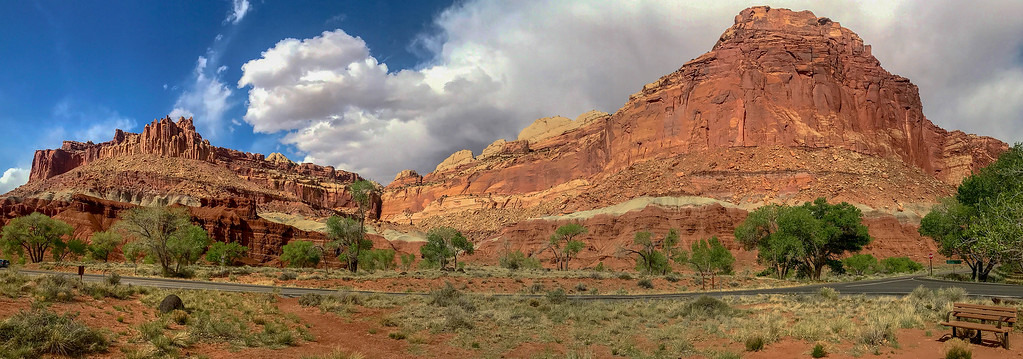
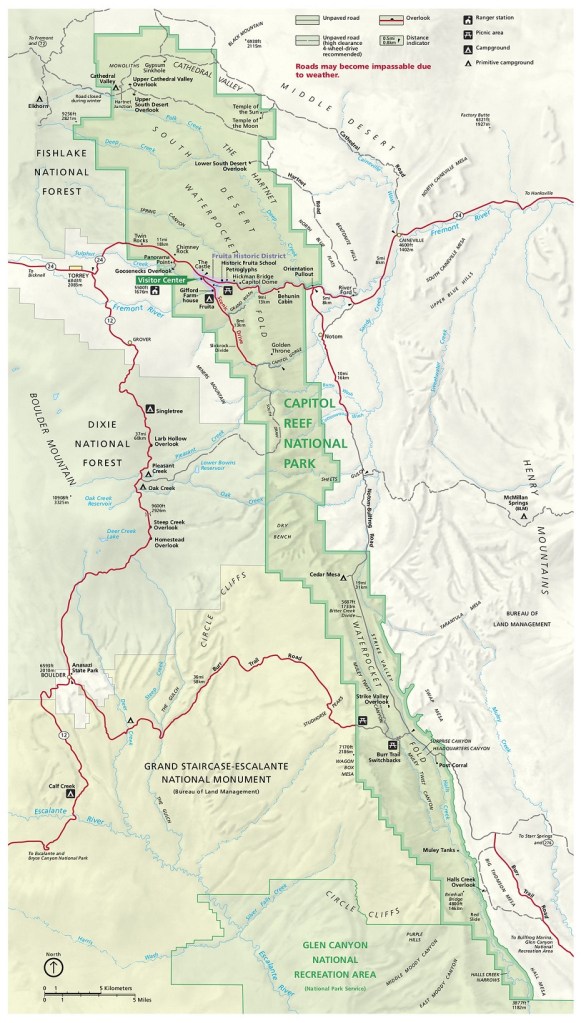
Located in south-central Utah in the heart of red rock country, Capitol Reef National Park is a hidden treasure filled with cliffs, canyons, domes, and bridges. Capitol Reef runs predominantly north to south, at 60 miles long but only 6 miles wide.

The area of Capitol Reef is located in what’s scientifically called the Waterpocket Fold, or a literal wrinkle in the Earth’s crust (as unnerving as that sounds) created over millions of years of deposition, uplift, and erosion. This fold extends for over 100 miles and creates a stunning visual display of rock that makes you feel like you’re driving into an actual shelf of ocean reef above-ground. This reef-like appearance lends to the park’s name, as well as the naturally-occurring white domes of Navajo Sandstone. These domes are visually similar to those found on the tops of “capitol” buildings throughout the U.S, hence the name Capitol Reef.

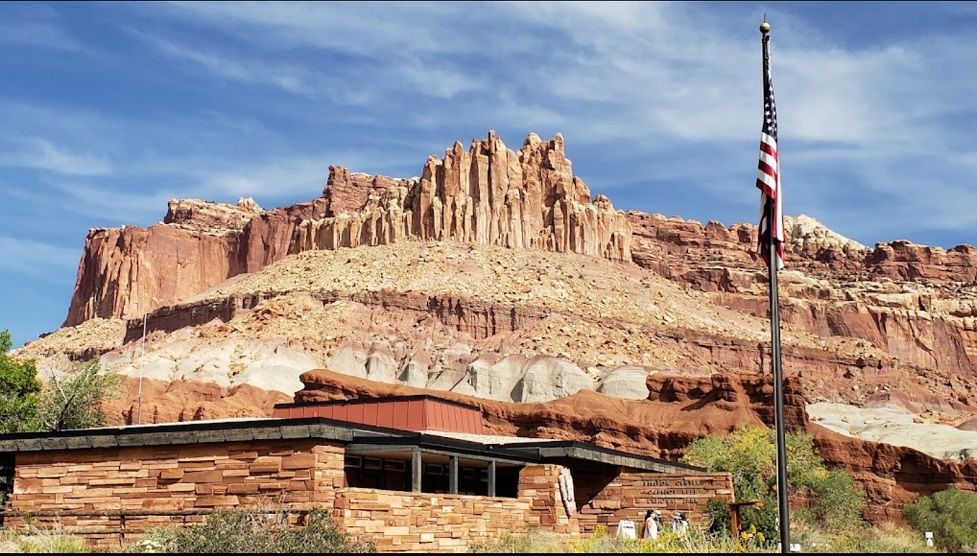
The Castle – Directly across the highway from the visitor center rises a huge sandstone cliff known as “The Castle”. At its highest point this colorful formation rises nearly 1,000-feet above the surrounding valley.

Capitol Reef is an easy going, straight forward and family friendly park to visit. You can visit in half a day and accomplish most of the best bits, unlike Zion, where you need at least two full days to do everything.

Fruita Historic District is the most-visited and most accessible part of Capitol Reef National Park. Many of Capitol Reef’s top attractions are located in this park area, just off Highway 24. Here you’ll find historic buildings from the Mormon homestead, the Capitol Reef Visitor Center, and several hikes and scenic drives.

The other two areas, Cathedral Valley and the Waterpocket District (Strike Valley), are more remote and difficult to access. Capitol Reef was named a national monument by President Roosevelt in 1937, and a national park in 1971.

Unlike other national parks, there is no official entrance station. Instead, visitors are expected to self-pay at either the visitor center or the north end of the Capitol Gorge Scenic Drive.

Sites to See Along Capitol Reef NP -Driving Tour

Capitol Dome

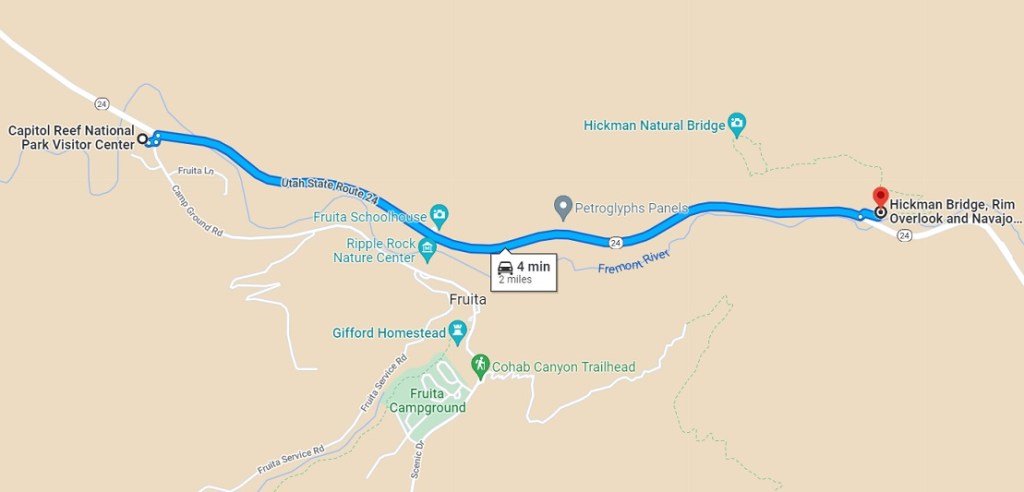
Capitol Dome is best viewed from the Hickman Bridge Trailhead, on Utah State Route 24, two miles (3.2 km) east of the visitor center. The trailhead parking area has a vault toilet and is suitable for passenger cars and a limited number of RVs.

Capitol Dome is a majestic white sandstone formation that resembles the U.S. Capitol building. The park was partly named for this landmark.

https://goo.gl/maps/cKuaEfjahFnWG3bZA

Scenic Drive

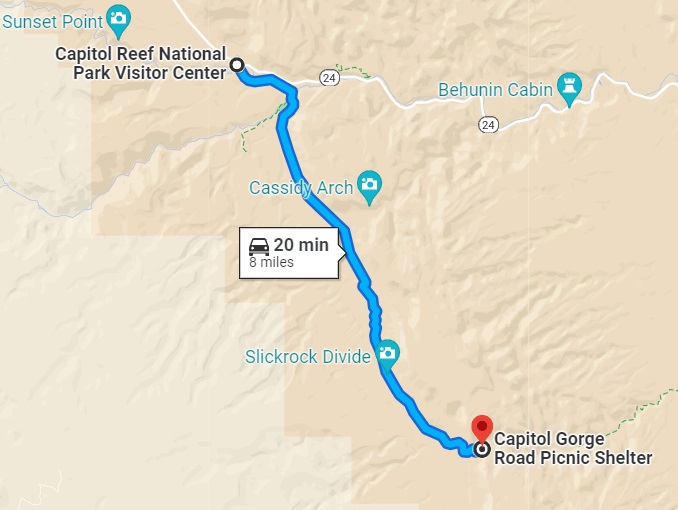
Beginning in the Fruita District and ending at Capitol Gorge Road. More than ten viewpoints along this short drive have must-see views of this park’s historic area.

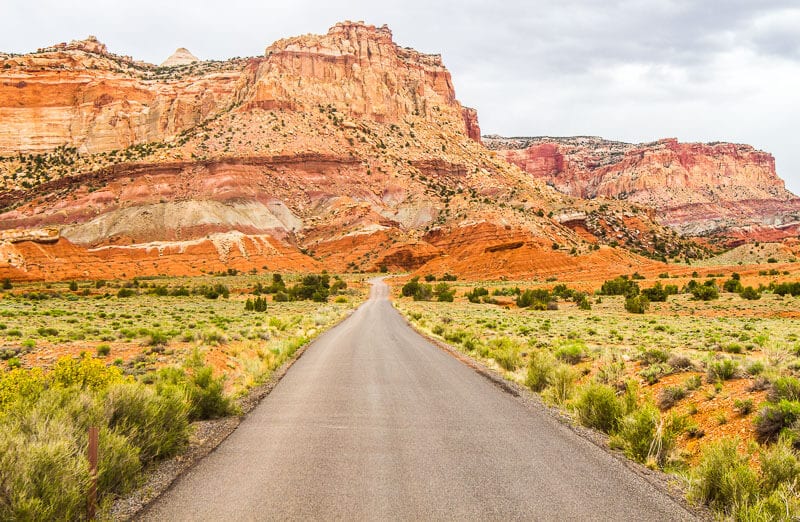
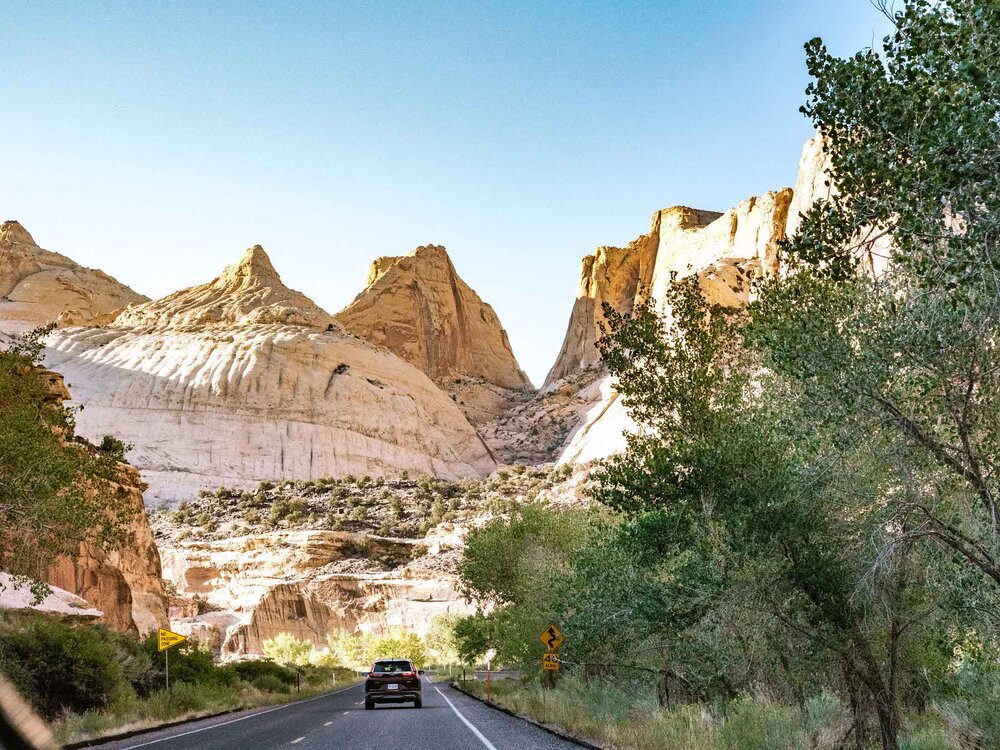
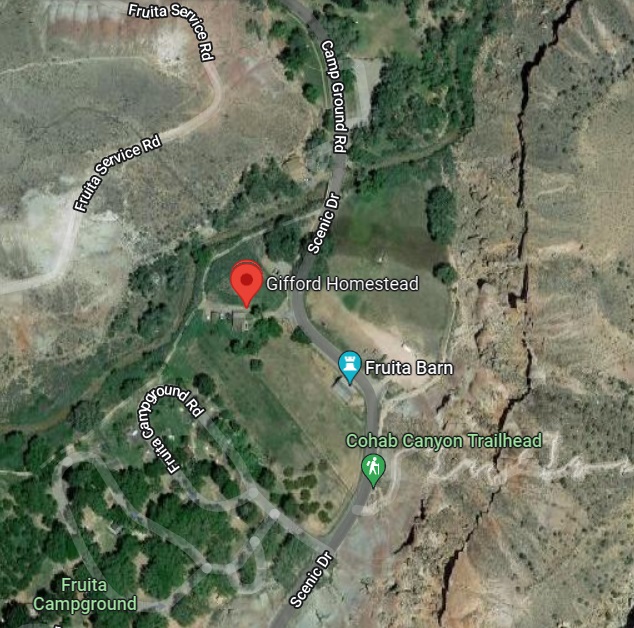
The Capitol Reef Scenic Drive is the perfect way to get up close and personal with the Waterpocket Fold. This 8-mile stretch begins at Gifford House near the Fruita Utah orchards and continues to the Capitol Gorge trailhead parking lot. Along the way, you’ll see varying mesas and plateaus of all different colors plus unique plants and vegetation. There are plenty of pull-outs along the way if you want to get out and explore further on foot. Make sure to set aside 1 -1 1/2 hours to do this drive at your own pace.

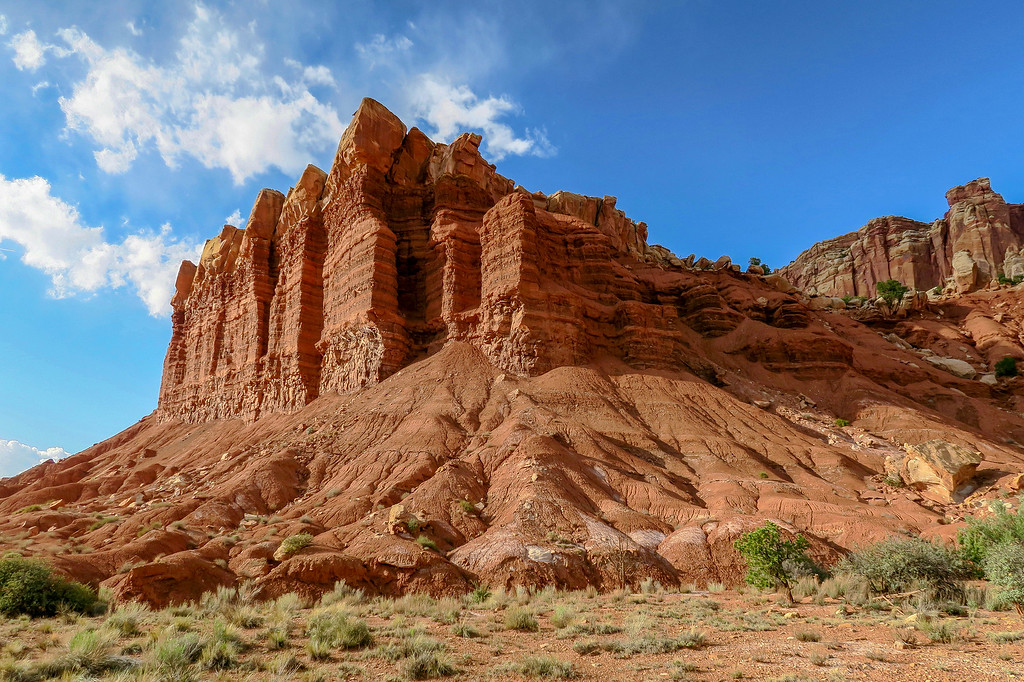
Continue south past Slickrock Divide to where the rock lining the reef deepens into a ruby red and forms odd columns and spires that resemble statuary. Called the Egyptian Temple, this is one of the most striking and colorful areas along the road.

A formation known as the Egyptian Temple along the Scenic Drive in Capitol Reef National Park. The Egyptian Temple provides one of the most striking and beautiful examples of weathering and erosion.

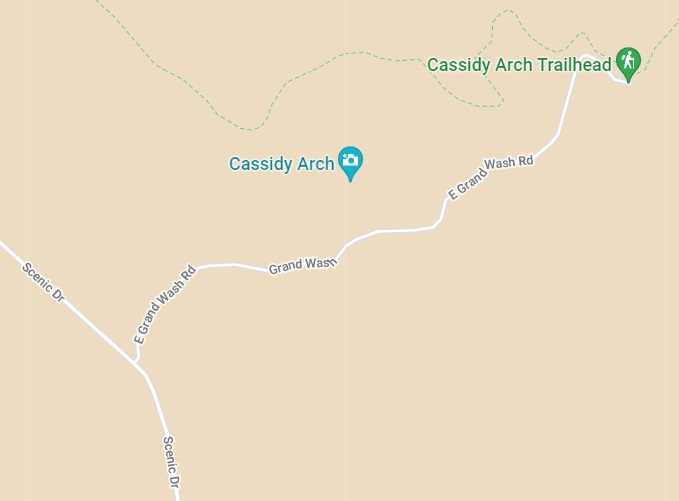
A few miles into the scenic drive, you’ll reach the turn for the unpaved Grand Wash Road, providing access to popular trails like the Cassidy Arch Trail.

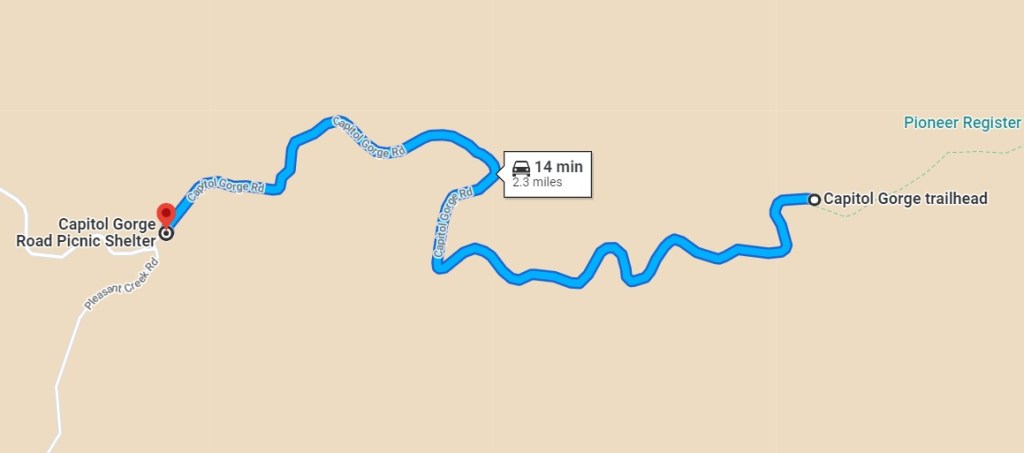
At the end of the 8-mile drive, the unpaved Capitol Gorge Road continues for another 2 miles.

https://goo.gl/maps/oFf45htmfAbyhSMeA

Capitol Gorge Road

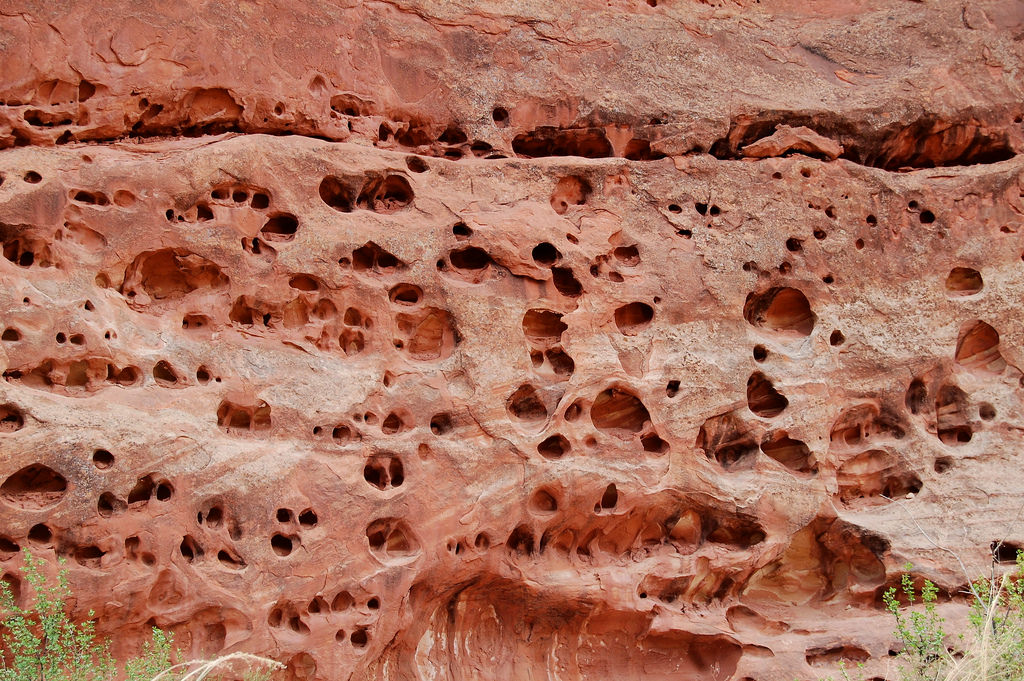
Followed the Scenic Drive, taking in the wide open spaces and richly colored towering bluffs then turned onto the Capitol Gorge Road, an unpaved road that was 2.4 miles (3.8 km) one way. Taking this road as not only is the scenery breathtaking but you can also see up close impressive geology, such as solution pockets.

The deeper into the gorge the tighter the surrounding cliffs squeezed in.

 Solution Pockets are found in sediment that has become rocks from being under immense pressure. Weak parts of the sediment have been eroded away by the elements, leaving small pockets in the rock’s surface, which I found to be interesting to look at.

 Solution Pockets : These pock marks in the Wingate Sandstone are due to differential erosion of poorly cemented sand. This view is from along Capitol Gorge Road in Capitol Reef National Park, Utah.

Capitol Gorge is about 2.5 miles and ends at a trailhead to Capitol Gorge. the road is levely as it winds up through a canyon. Be sure to take the short trail further into the gorge, where you will see interesting geology, pioneer carvings, and diverse flora.

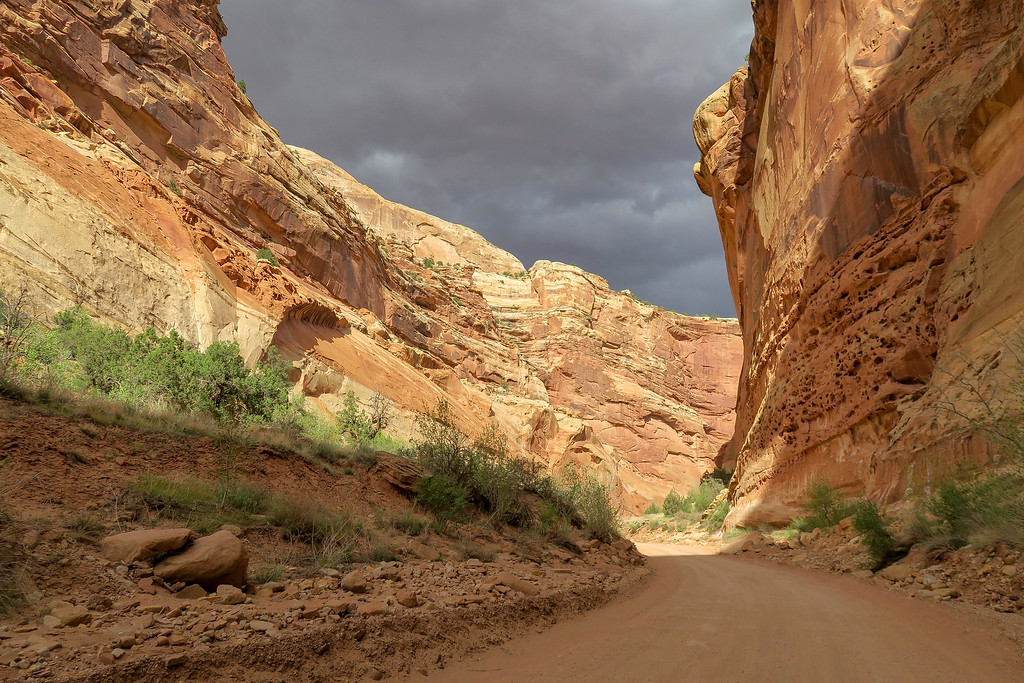
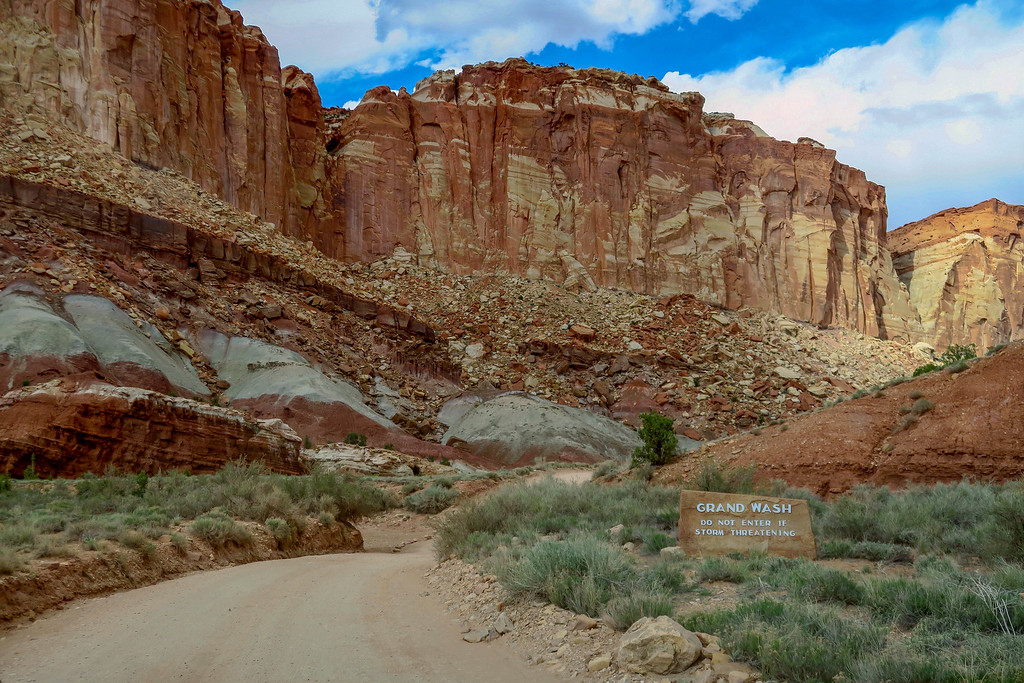
Grand Wash Road

Turn off Scenic Drive onto Grand Wash Road, which extends 1.3 twisting miles, to reach the Grand Wash trailhead and several scenic and historic pullouts. The trailheads for the Cassidy Arch Trail and Grand Wash Trail are at the end of the road, along with parking and restrooms.

Grand Wash – About three-and-a-half miles south of the visitor center, on Scenic Drive, a gravel road breaks east into a nearby canyon. This is the road through Grand Wash. At about a mile-and-a-half in length

The Scenic Drive leaves the Fremont River valley and climbs a desert slope, with the rock walls of the Waterpocket Fold rising to the east. Turn east to explore Grand Wash, a dry channel etched through the sandstone. A dirt road with sheer rock walls rising along the sandy streambed.

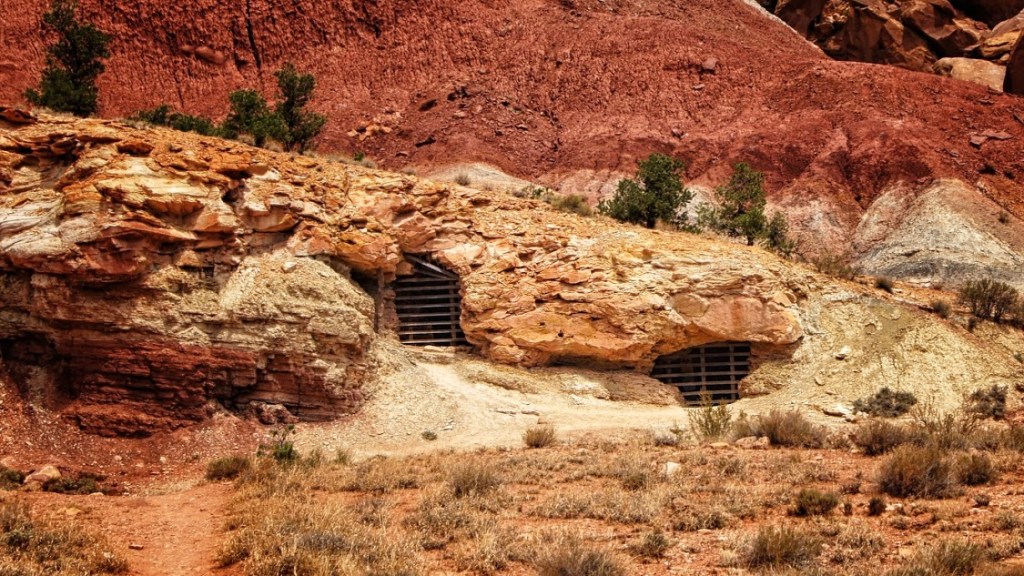
Uranium Mines – Immediately after turning onto Grand Wash Road our attention was drawn to a couple small holes dug into the base of the adjacent cliff. Believe it or not these are historic uranium mines dug in the early to mid-20th Century. When the park was created, and then expanded, many of these old mines were shut down.

Fruita Historic District

Pick Fresh Fruit and Walk Through History in Fruita Utah
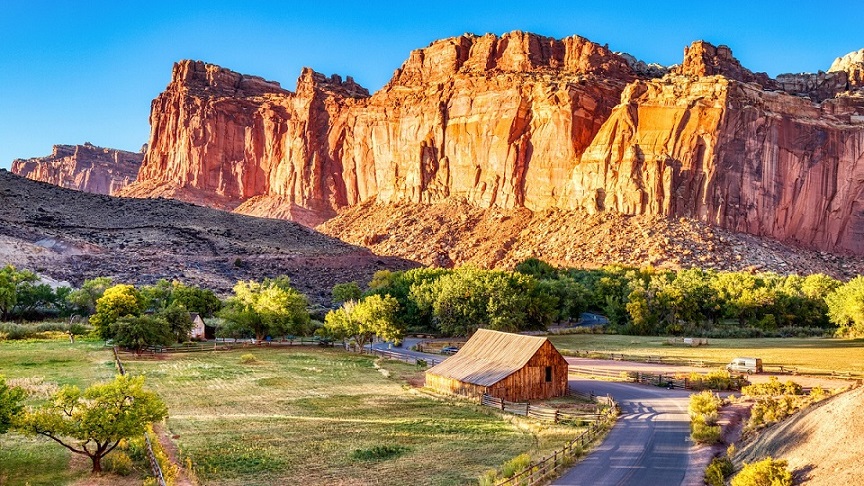
Landscape with Monumental Old Barn in Fruita, Capitol Reef National Park, Utah

The small settlement of Fruita inside the park has more than 2,500 fruit trees, some of which were originally planted by Mormon pioneers. Fruita was first established by Mormon settlers in 1880 and received its namesake due to its vast collection of orchards. Today the settlement is federally owned, and visitors can stroll through the orchards and eat fruit fresh off the trees.

Although the orchards are considered “historic landscape,” visitors are encouraged to explore and pick fruits freely. Picking is free.

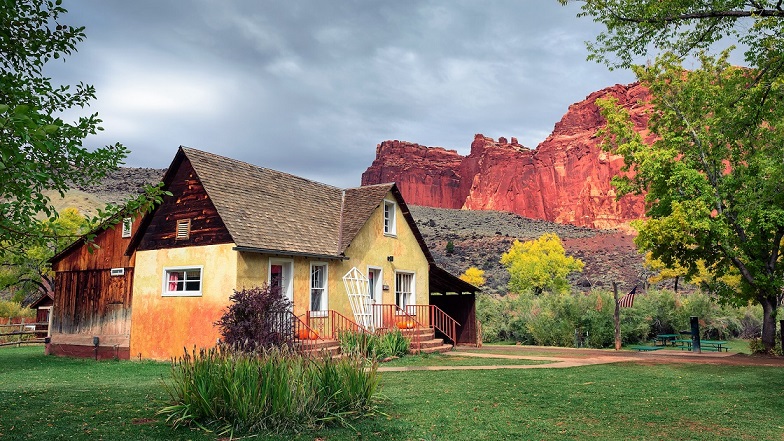
Historic Gifford farmhouse in Fruita, Utah, located in Capitol Reef National Park.

Visit the Gifford Homestead in the Fruita Valley, which was important enough for famous Western writer Wallace Stegner to describe it in his book American Places. The restored farmhouse, along with its barn, smokehouse, and garden, was built in 1908 by a Mormon polygamist and gives visitors a picture of Mormon life in the early 1900s.

The Gifford Homestead, one of the last remaining structures in old Fruita, sells local craftsmen’s dolls, soap, quilts, jams & jellies, and books. The pie, on the other hand, is the star of the show. They’re well-known for their fruit pies made with locally farmed ingredients! Stop in for some ice cream and a slice of fresh fruit pie. They should not be missed!

You may buy exquisite baked pies, coffee, scones, and cakes inside the home, which you can enjoy on picnic tables right outside the front door, surrounded by a serene scenery. The greenery of Gifford Homestead will astound you, especially after seeing the canyons’ red colors!

https://goo.gl/maps/XUHte7ETsDCpbLU56

Goosenecks

Catch the Views at Goosenecks and Panorama Point for Epic Views of the Waterpocket Fold
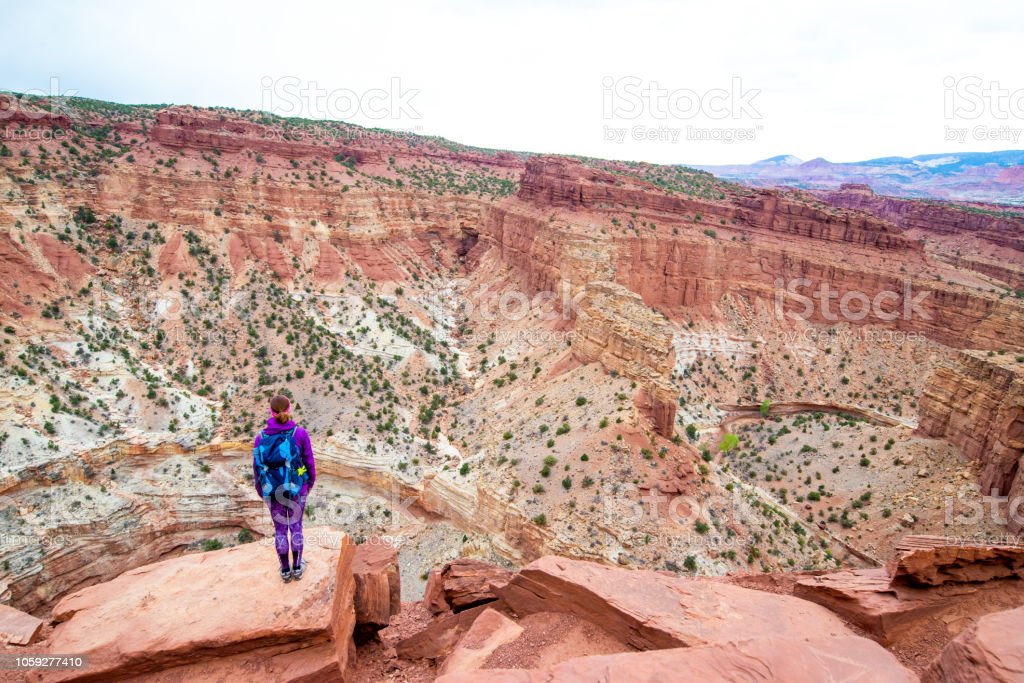
Young woman is looking at the Goosenecks in the Capitol Reef National park. Capitol Reef National Park’s Panorama Point overlooks the a canyon of goose neck turn in Utah’s Sulphur Creek.

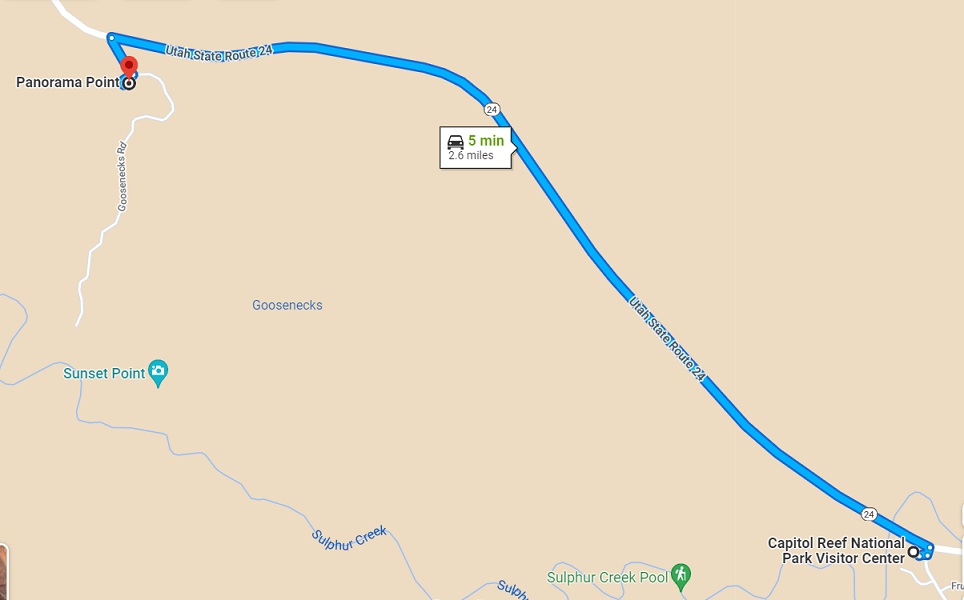
For dramatic and vertigo-inducing views of the steep canyons created by the Waterpocket Fold, take the turn-off from Route 24 towards the Goosenecks Overlook. On the way you’ll find Panorama Point, a quick drive on a paved roadway to a viewpoint that gives you the promised 360-degree views. However, suppose you continue further along the gravel road. In that case, you’ll arrive at the Googenecks, a super easy 0.1-mile trek allowing you to look directly down the steep canyon edge created by a simple sulphur creek below. This drop is believed to have formed over the last six million years and the very bottom exposes Kaibab Limestone, which can be up to 270 million years old!

Chimney Rock

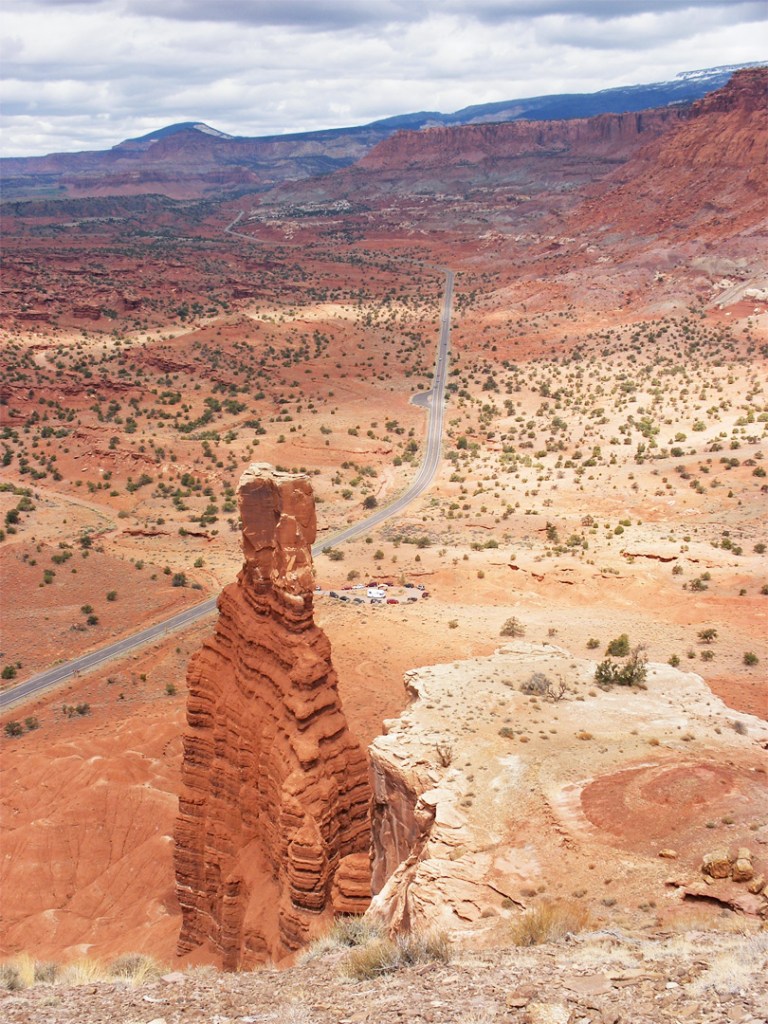
The most recognizable rock formations in Capitol Reef can be spotted from the road. Chimney Rock is a tall, vertical stretch of the mesa that has been separated from erosion to form its own unique column reaching up to the sky.

Chimney Rock is an impressive stone tower located along Highway 24 about three-miles west of the visitor center.

Potash Road – Utah

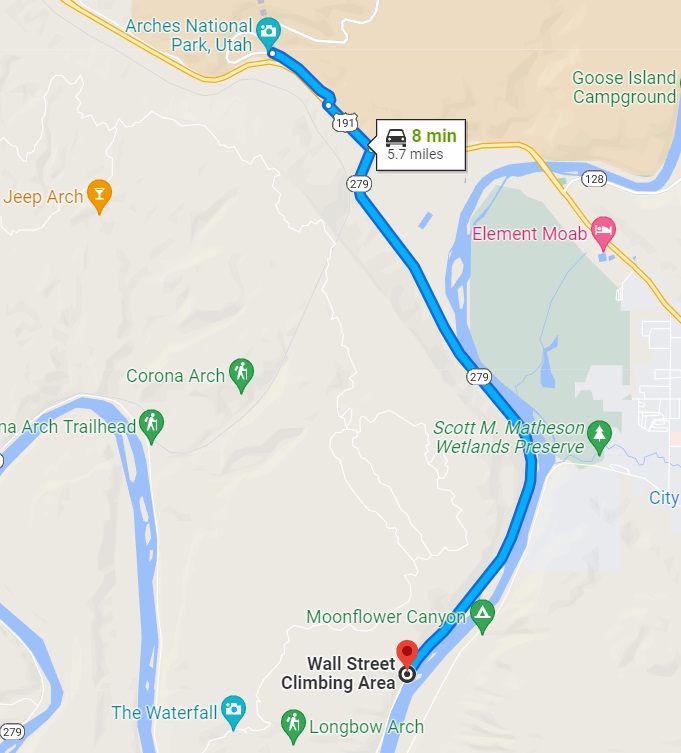
Potash Road or the Lower Colorado Scenic Byway is a quiet and less traveled state motor route that runs along the Colorado River just north of Moab, and ends at the border of Canyonlands National Park. If you take this 17-mile journey you will be treated to soaring sandstone cliffs, rock climbing, cycling trails, petroglyphs, dinosaur tracks, arches, and views of the Colorado River. The Potash route is also a very popular ride for road cyclists.

Find Utah State Route 279 four miles north of Moab, off of Highway 191. The first leg of the journey will take you past the Moab uranium tailings pile that is currently being relocated. Soon after this, you’ll enter a narrow gorge of the Colorado River where sandstone cliffs tower above the water.

Sites to See Along Potash Road

https://goo.gl/maps/nQs3Rm8bR7aAcxY9A

Wall Street

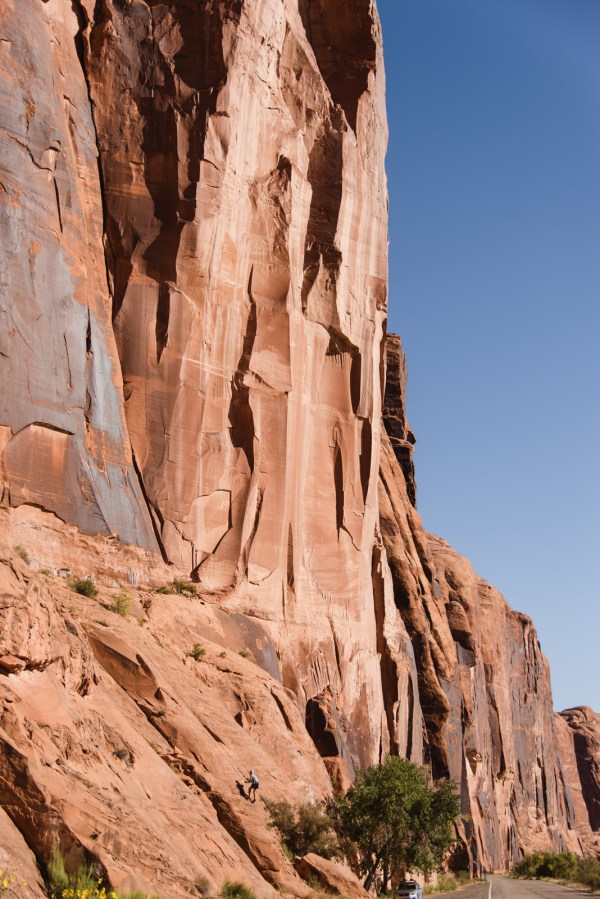
One of the first things you’ll notice while driving along Potash Road is “Wall Street”. This is a section of the cliffside filled with technical routes where you’ll see climber after climber making their way up.

Wall Street is a 1-mile long section of Sandstone along the side of the road, 10 minutes from Moab, Utah. There are around 130 climbs in that one mile; right on the side of the road, in some cases a foot or two off the road. They range from lower angle friction (good for getting used to climbing on sandstone) to strenuous, balanced, face climbs. There are also splitter cracks and demanding roofs. Wall Street has it all.

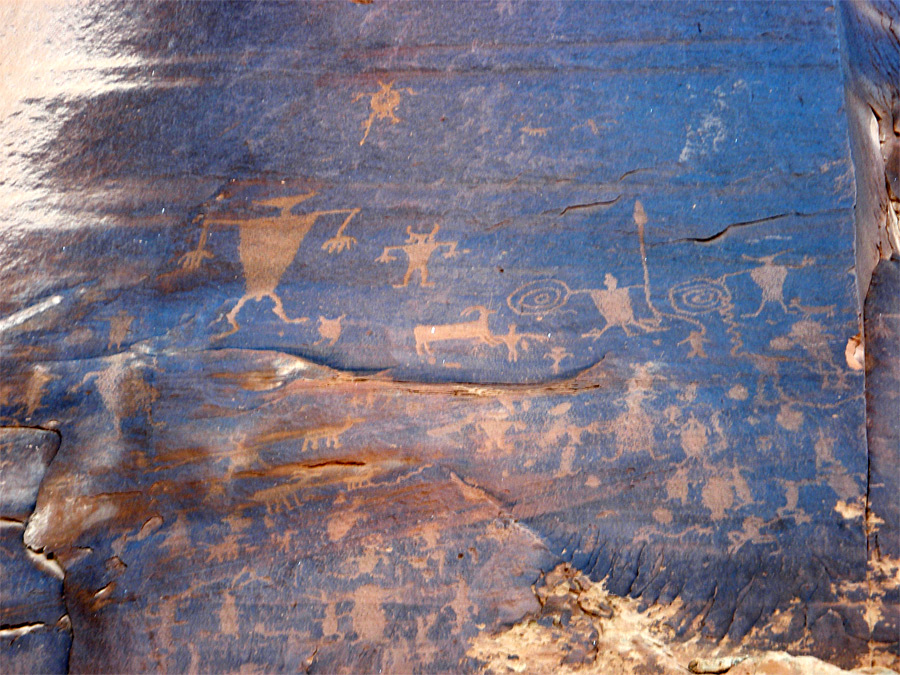
Petroglyphs

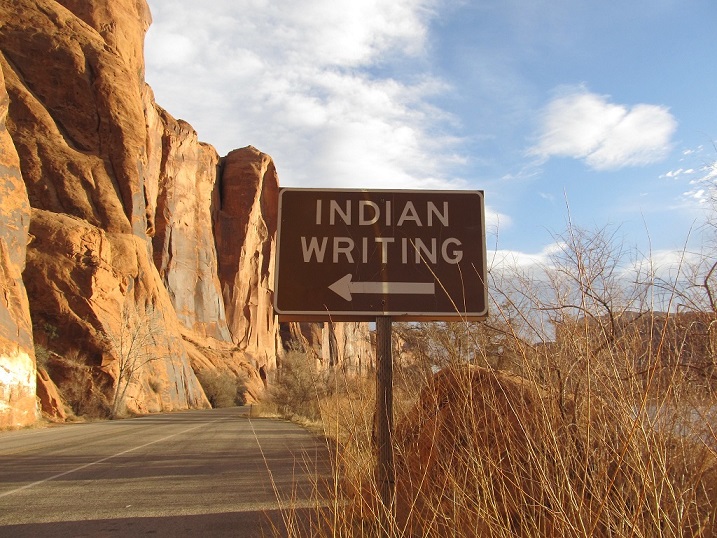
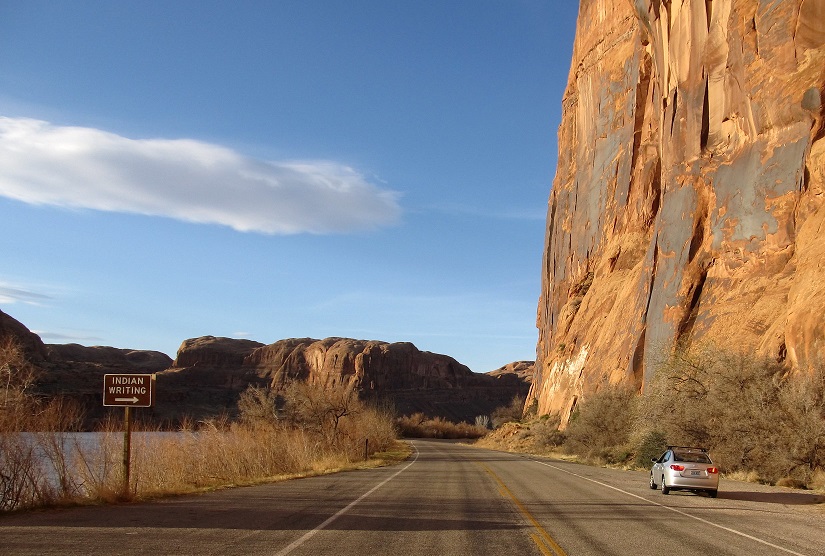
Also found in the Rock Wall area around mile marker 5, look for a sign at a riverside pullout that says, “Indian Writing.” About 25-30 feet up, you’ll see petroglyphs dating all the way back to the Formative Period.

If you’re dying to see Native American petroglyphs, but don’t want to do a hike to see them, your answer lies just over 5 miles down Potash Road. Now, there is a pullout and a sign on the Colorado River side of the road where you can easily park to see the petroglyphs. Across the road, on the cliffs look up and you’ll see a decently large panel of petroglyphs including images of anthropomorphic figures, animals and other symbols. These petroglyphs have been dated by archaeologists to between the Archaic and Fremont cultural periods. They’re a beautiful cultural site to behold and it’s very nice to be able to do so with such little effort as well.

At 5.1 miles (8.2 km) several petroglyph panels are visible on cliffs on the right side of the highway. Marked pull-offs on the left side of the road provide parking to view these panels.

Petroglyphs, including bighorn sheep, deer and humans

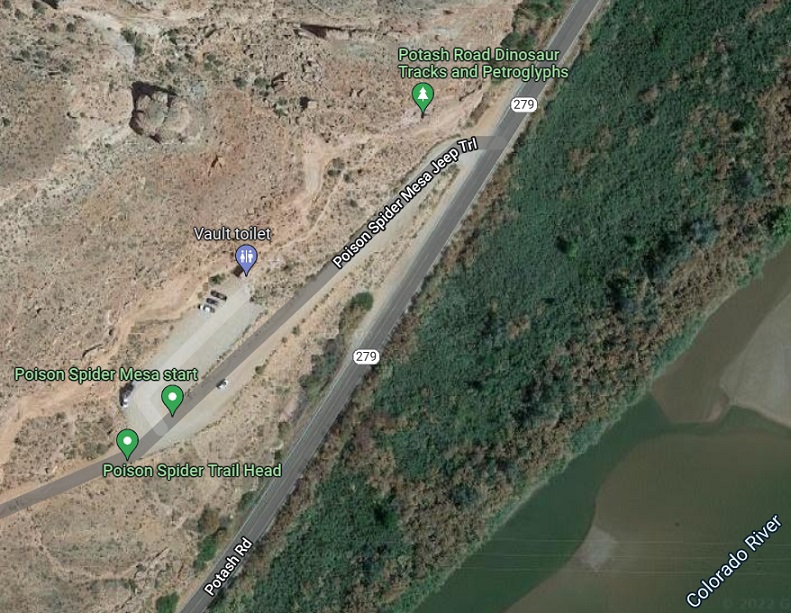
Dinosaur Tracks

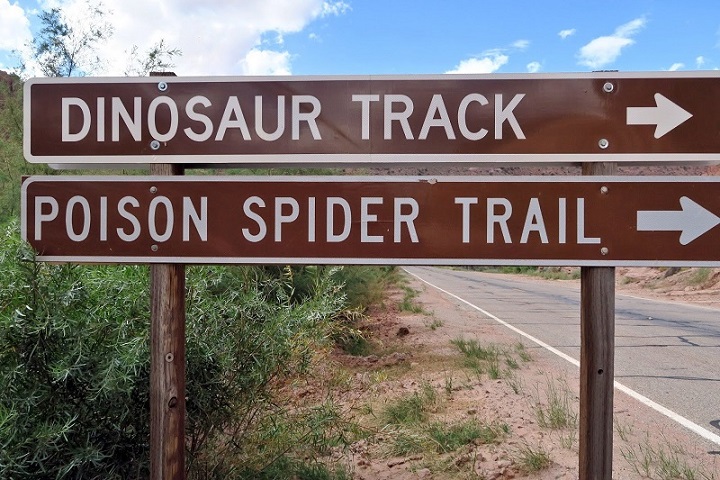
Less than a mile after the petroglyphs pullout, you’ll see a sign for Poison Spider Trail + Dinosaur Tracks to the right. Anyone who is a fan of paleontology and dinosaurs specifically does not want to miss this stop. It’s a short climb (about .25 miles round trip) up a slick rock bluff and it will lead you to a sign that lets you know you’re at the dinosaur tracks. Look up from there and you’ll find two 3-toed footprints in the rock before you.

Footprints from approximately ten different meat-eating dinosaurs can easily be viewed at the Poison Spider Dinosaur Tracksite. The tracks are found on two rock slabs which fell from overlying sandstone atop the cliffs.

At 5.9 miles (9.5 km) the Poison Spider Trail Parking will be on the right. A kiosk on the end of the parking lot, near the vault toilet, will have a map for a short trail to dinosaur tracks and rock art.

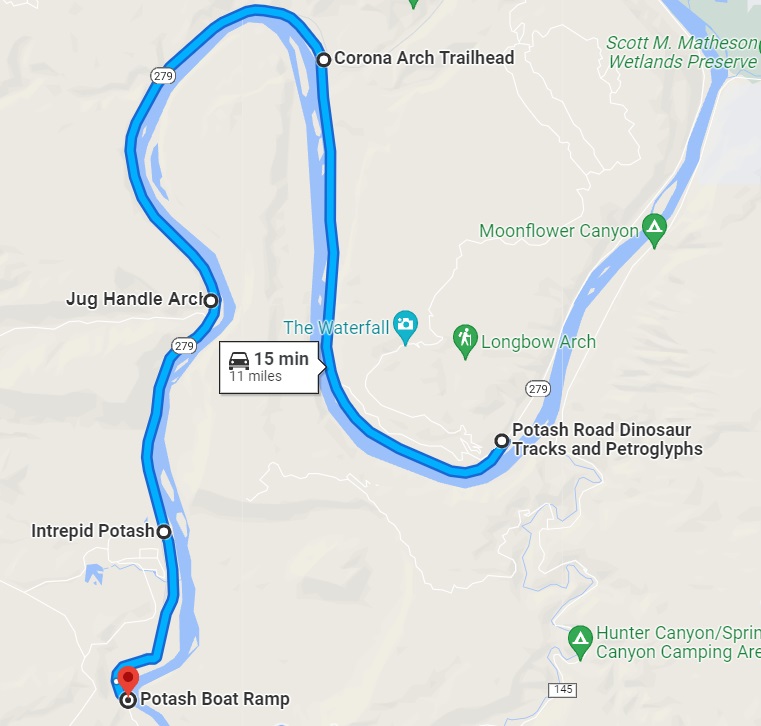
Potash Boat Ramp

Past the Corona Arch parking lot, the road begins to skirt the train tracks. After 3.5 miles, you will see the Jug Handle Arch, well indicated on the right side of the road. Immediately after the arch, you will find the intersection with Long Canyon Road.

Which as we will see, arrive at the site where the Intrepid Potash Company processes potash, a potassium compound (hence the name of the road)

https://goo.gl/maps/LV2F4E7Zf2kxPKNp6

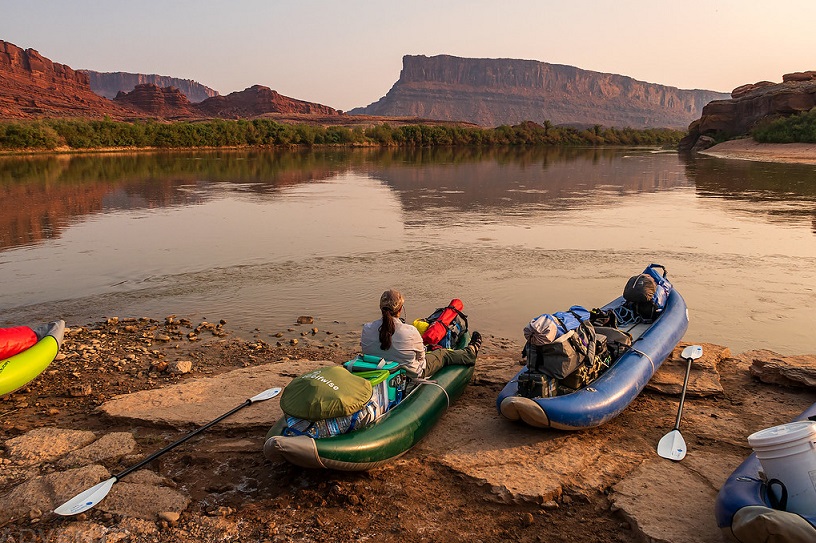
Another 1.5 miles on this epic journey will find you at the end of Potash Road in Utah, where you’ll arrive at Potash Boat Ramp. Finding yourselves at a beautiful stretch of calm water, sit at some of the picnic tables and take in the relaxing babble of the water and calm river landscape.

Additional Stop:

https://goo.gl/maps/bH1bG9o8nhM6ajjg7

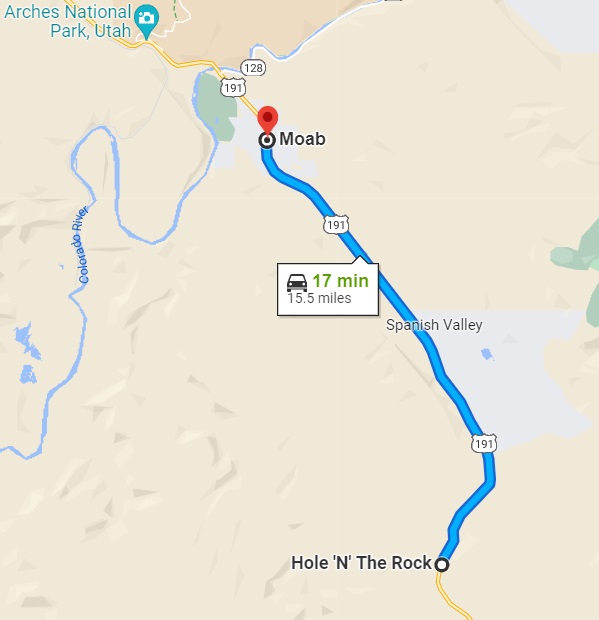
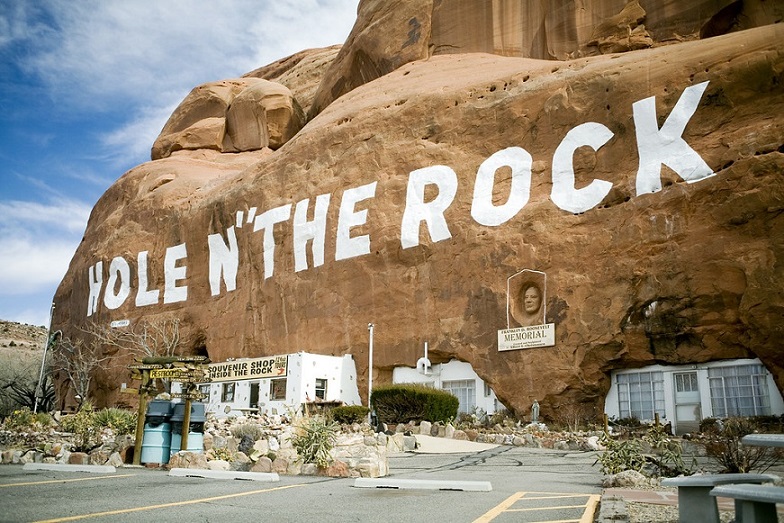
Hole ‘N the Rock

11037 South Highway 191, Moab, UT 84532

Canyonlands Country, Utah is home to a Hole N The rock: an amazing 5,000 square foot home, meticulously carved out from a canyon rock. What started out as a family fun almost a century ago, is now attracting visitors from all over the world.

The Christensen family began to dig a small alcove, for their sons to sleep, but over the years it developed into an intricately engineered marvel. Albert Christensen excavated over 50,000 cubic feet of sandstone from the rock to create the home, furnished with a chimney, 14 rooms, and even a built-in bathtub.

https://goo.gl/maps/CkTWFnFbQnXvXQWa6

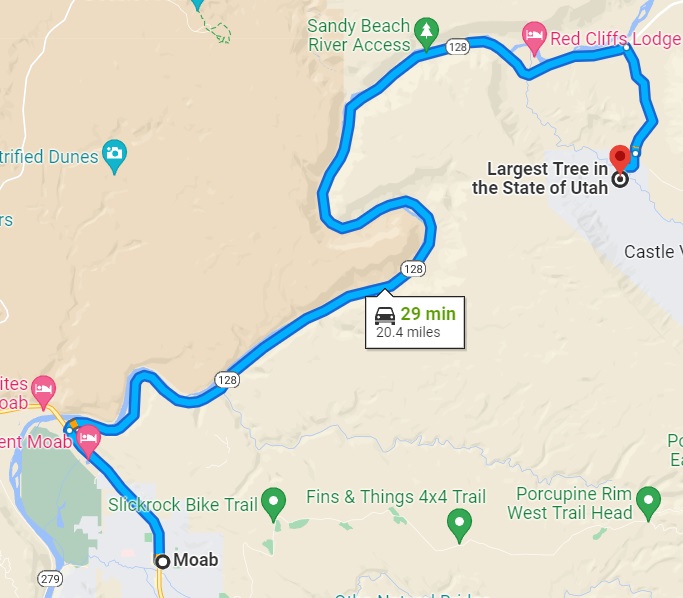
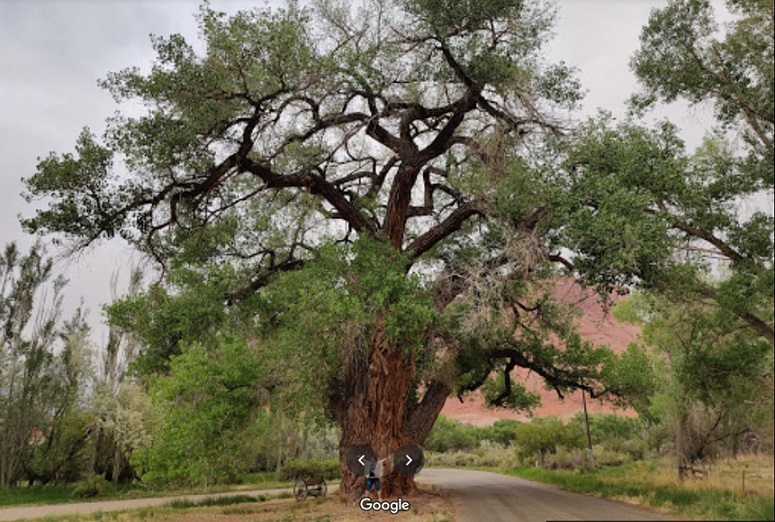
Largest Tree in the State of Utah

CASTLE VALLEY, Utah — In the heart of Utah’s red rock county, there’s something very big and green. The largest tree in the state was recently documented in Castle Valley, a small town east of Moab.

Just three miles from Moab to Upper Colorado River Scenic Byway U-128

For the first 13 miles (20.9 km) it parallels the Colorado River within a narrow section of the gorge, providing breathtaking views of the surrounding red sandstone cliffs. 

Referred to by Moab locals as the River Road, Scenic Byway 128 is one of the most interesting and breathtaking drives imaginable.

Dining

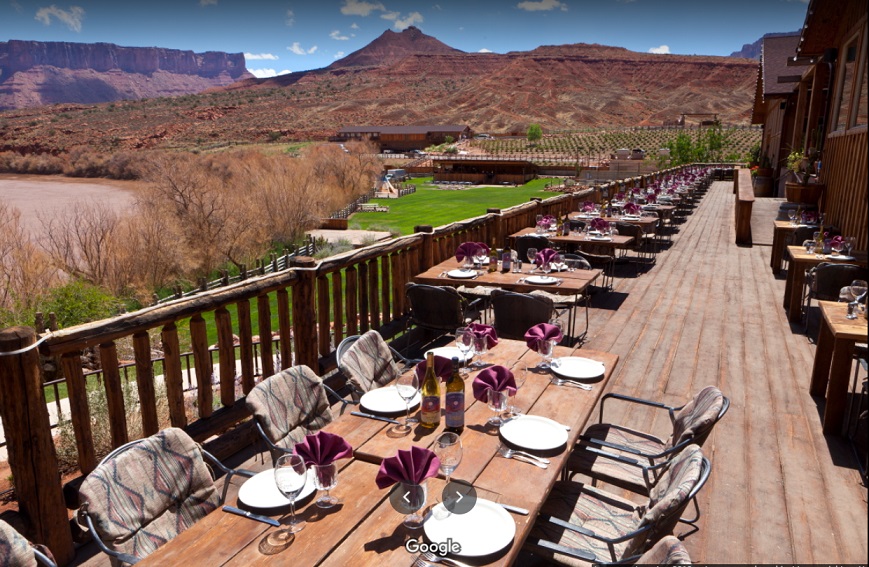
The Cowboy Grill at Red Cliffs Lodge

Milepost 14, Highway 128 Moab, Utah 84532

https://www.redcliffslodge.com/dining/individual-dining

Ăn gì ở Moab?


Thị trấn nhỏ này nằm khá cách biệt với những thành phố lớn nên hiển nhiên giá thức ăn ở đây cũng đắt đỏ hơn vì chi phí vậ chuyển. Tuy vậy, chúng tôi cũng đã thưởng thức qua một số nhà hàng ở dowtown:

  1. Singha Thai Cuisine: khá phong phú các món để lựa chọn, và theo đánh giá thì không kém gì các nhà hàng Thái nổi tiếng ở New York hay Boston.
  2. Sunset Grill: nếu bạn thích các món thịt nướng thì nên chọn nhà hàng Sunset Grill. Giá đồ ăn và rượu ở đây hơi cao nhưng đổi lại là view ngoài trời cực đẹp và lãng mạn. Lưu ý là phải đặt bàn trước khi bạn đến.
  3. Zax restaurant: phục vụ all-you-can-eat pizza và các món sandwich khác, nhà hàng này khá đẹp với kiểu trang trí đậm chất miền Viễn Tây hoang dã.
  4. Bankok House Too: có chỗ ngồi ngoài trời, phục vụ ẩm thực Thái, Việt Nam và cả sushi nữa.

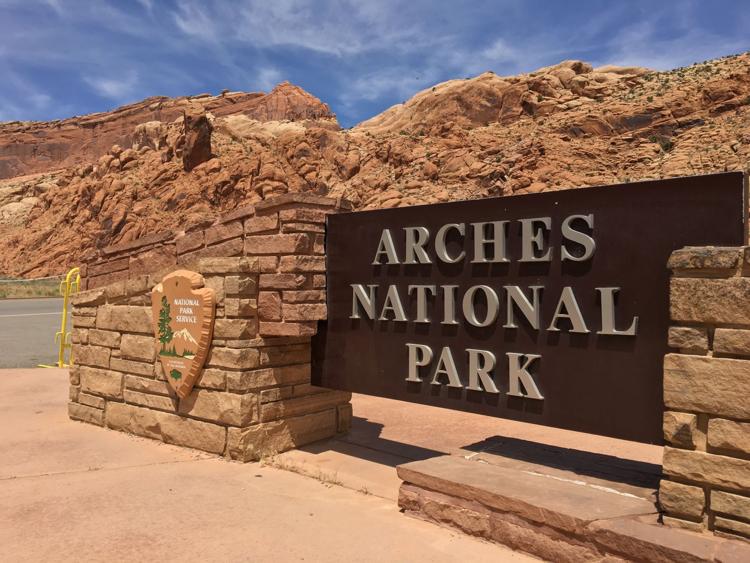
Arches National Park

Arches National Park is one of the top national parks in America: it’s a 73,234-acre wonderland of eroded sandstone fins, towers, ribs, gargoyles, hoodoos, balanced rocks, and, of course, arches northwest of Moab. The park protects an amazing landscape that includes the largest proliferation of arches in the world. Over 2,000 arches have been cataloged in Arches National Park. 

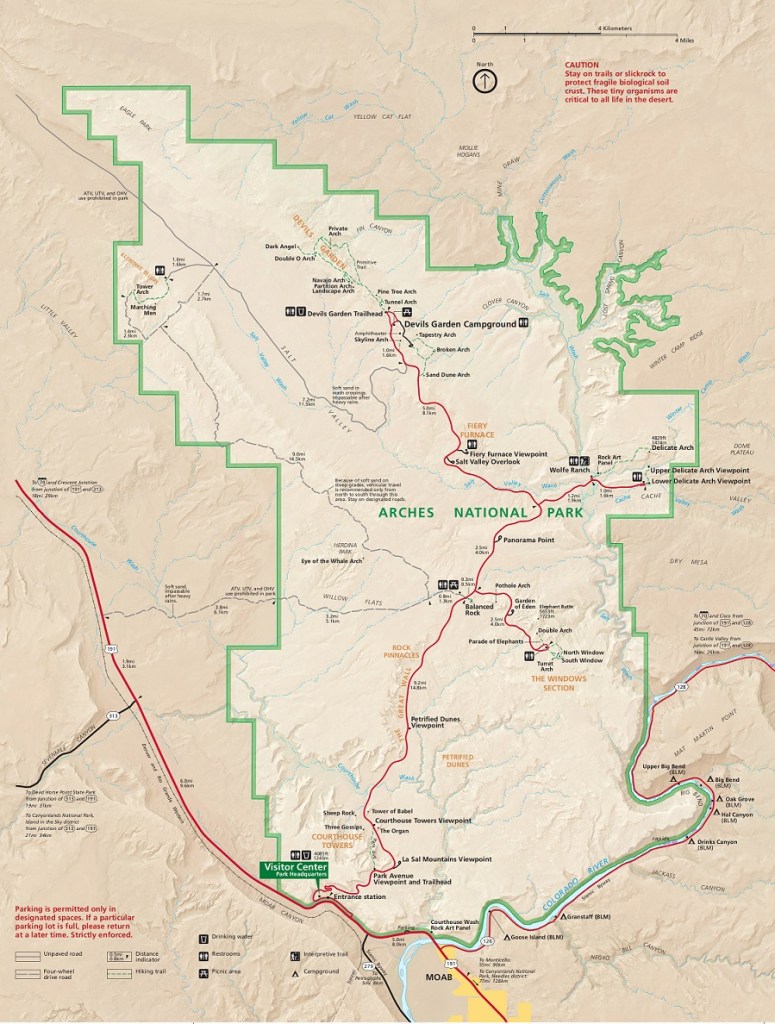
Driving through Arches National Park

You can spend a couple hours or the better part of a day driving the 36 mile (round trip) road through Arches National Park. With plenty of places to stop and snap pictures and panoramic views for miles, you can enjoy the brilliant artistry and majesty of Arches without having to leave your vehicle.

Best places to stop during a drive through Arches National Park

If you’re simply just driving through the park and time is a luxury, making a stop at all the designated view points and points of interest is really the best way to get the most of your experience. If time is of concern, or you really want an abbreviated tour featuring the highlights, we recommend the following itinerary:

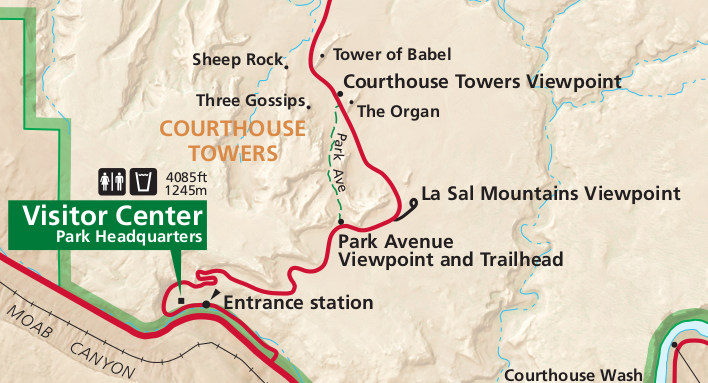
LA SAL MOUNTAINS VIEWPOINT

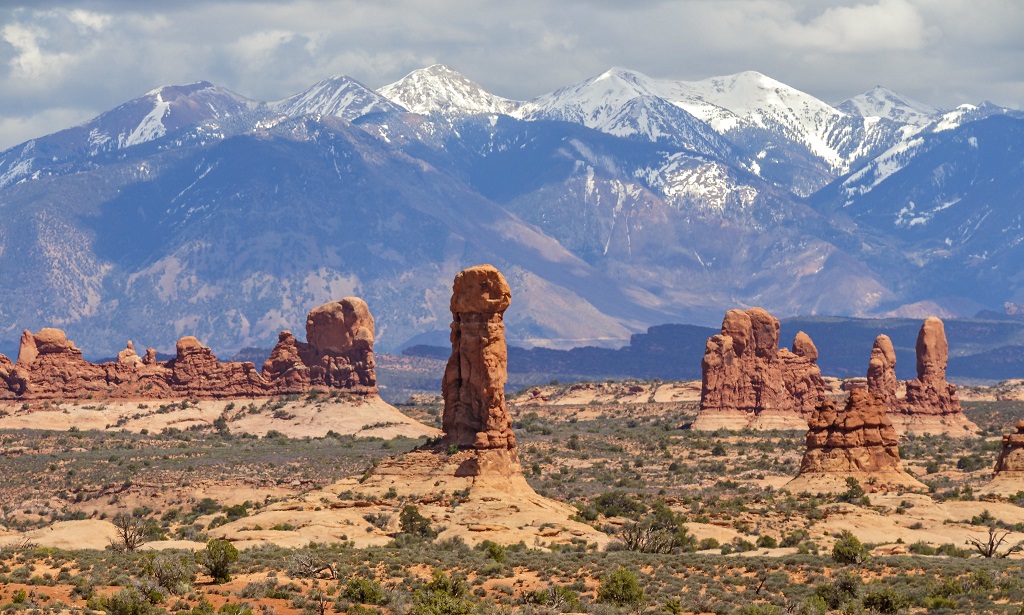
Make your first stop the La Sal Mountains Viewpoint to take in the amazing sight of the La Sal Mountains, Utah’s second highest mountain range, juxtaposed against Arches’ red rock spires.

La Sal Mountains, Panorama Point, Arches National Park

COURTHOUSE TOWERS VIEWPOINT

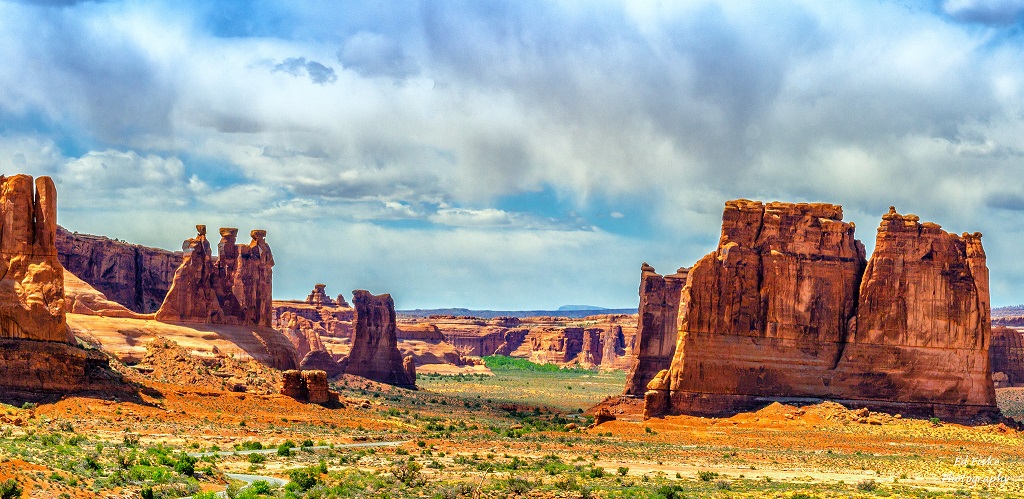
Courthouse Towers Viewpoint should be your next stop to click a quick picture of the towering skyscraper-esque sandstone walls and spires.

The courthouse towers on the right, rise 4800 feet from the desert floor, with the three gossips on the left greets visitors at Arches National Park near Moab Utah


BALANCED ROCK

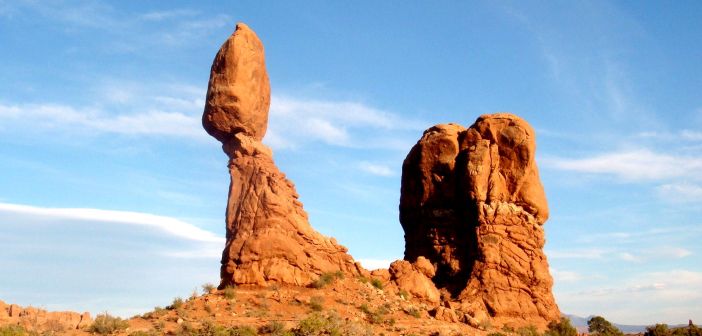
Balanced Rock is arguably one of the most unique formations in the Park and a must see on your tour.

Likewise, Balanced Rock is worth a quick stop. You’ll drive past it numerous times in the park so you may as well park and walk up close once.

THE WINDOWS SECTION

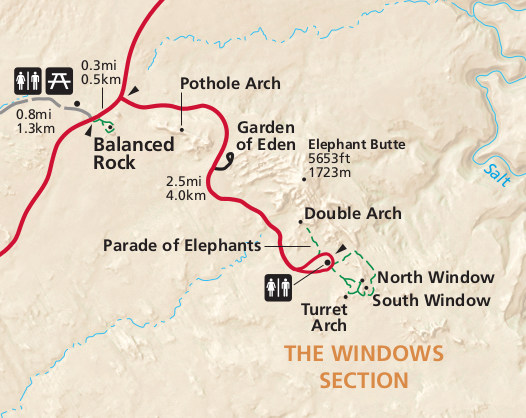
Just past Balanced Rock, take a right and the road will end after a few minutes at the Windows trailhead. Take the trail/sidewalk and you’ll quickly get to the North Window Arch and South Window Arch on your left, or Turret Arch on your right. There’s an option to hike a slightly longer trail (the Primitive Loop) but really you can just stay on the paved trails and see the main arches.

Double Arch

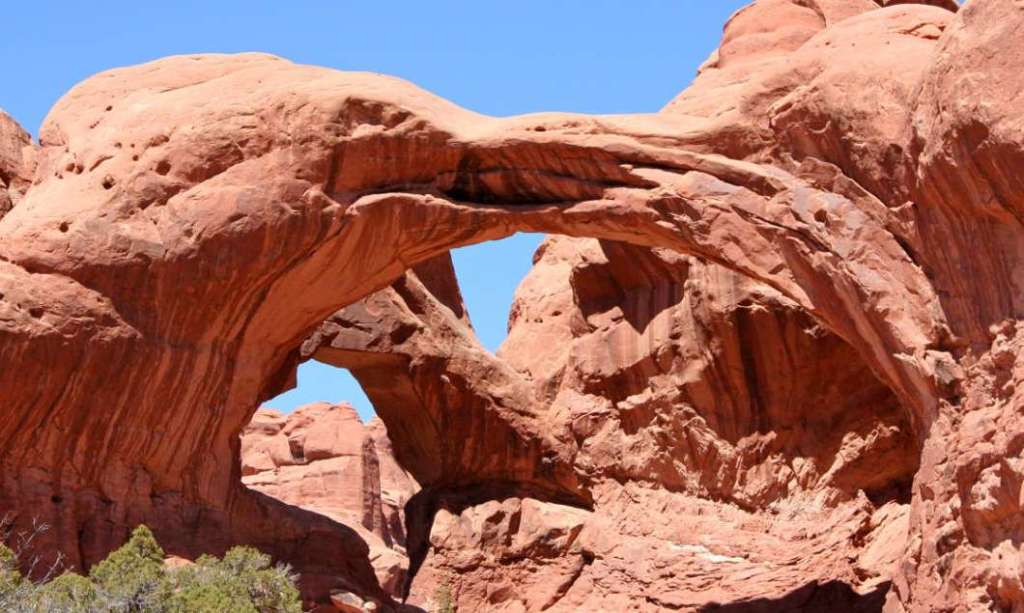
Double Arch is an incredible formation of arches within the Windows area of Arches National Park, an area with the largest concentration of natural arches in the entire world. Double Arch takes its name because of it consists of two arches that share the same stone as a foundation for both of their outer legs. Double Arch was formed by downward water erosion from atop the sandstone, rather than from side-to-side water erosion.

Double Arch is the tallest and second-longest arch in the park. You can view the arch from the parking lot or take a short walk to its base.

It only takes five minutes or so to reach Double Arch from the parking area, on a flat path, and then you can simply enjoy it or you can climb around. Plan for maybe half an hour at Double Arch.

DELICATE ARCH VIEWPOINT

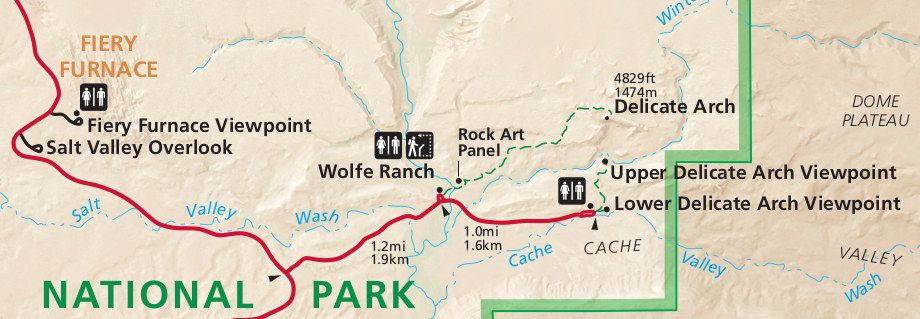
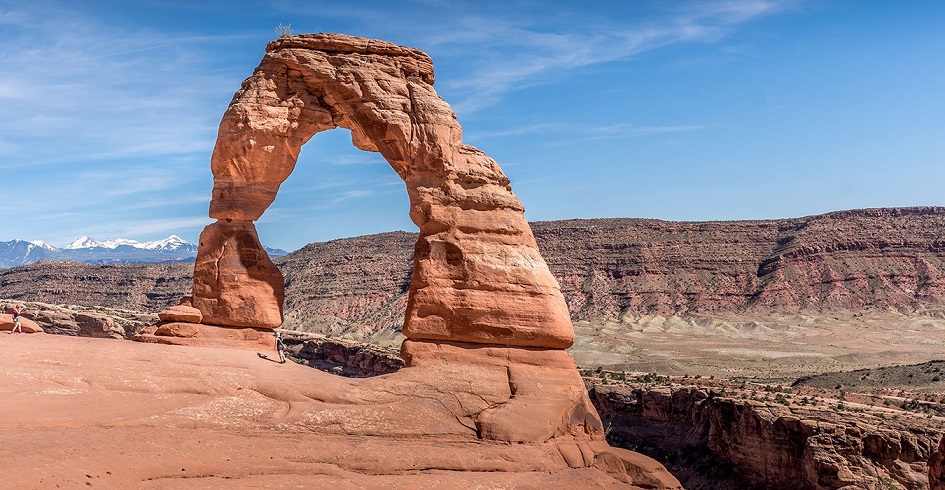
Continue to the Delicate Arch Viewpoint, follow the road all the way until the end. Here, you will need to park your vehicle and take a short walk to get a view of the Arch that is famous across the world.

Other lists start with Delicate Arch as a must-see. It’s the iconic arch in the park, and it’s even on Utah’s license plates. But the hike is moderate and takes 45 minutes to an hour from the parking area (a few minutes down Delicate Arch road from Arches Scenic Drive).

SAND DUNE ARCH

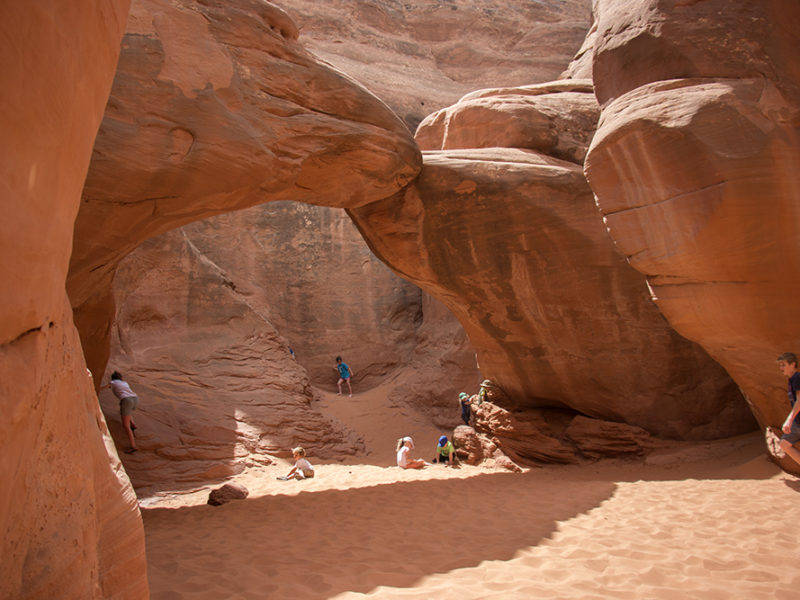
Sand Dune Arch is roughly a half-hour drive from the Visitor’s Center / Entrance Gate. Drive past the two main side roads of the park (the roads to The Windows and to Delicate Arch) and several miles farther on the parking lot for Sand Dune Arch will be on your right and nicely marked. Park and walk just a few minutes along the trail to a narrow canyon which leads to the arch. The sand is thick once you enter the canyon, so I highly recommend taking off your shoes, depending on how much scrambling you’re going to do.

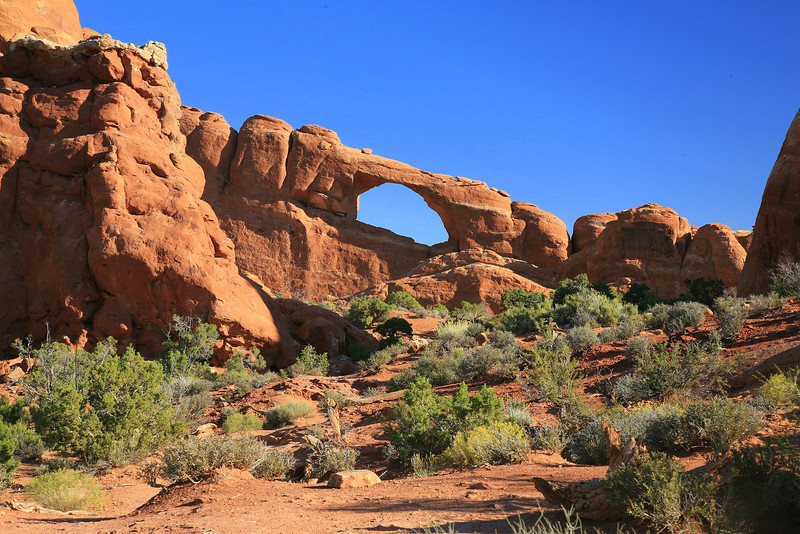
SKYLINE ARCH

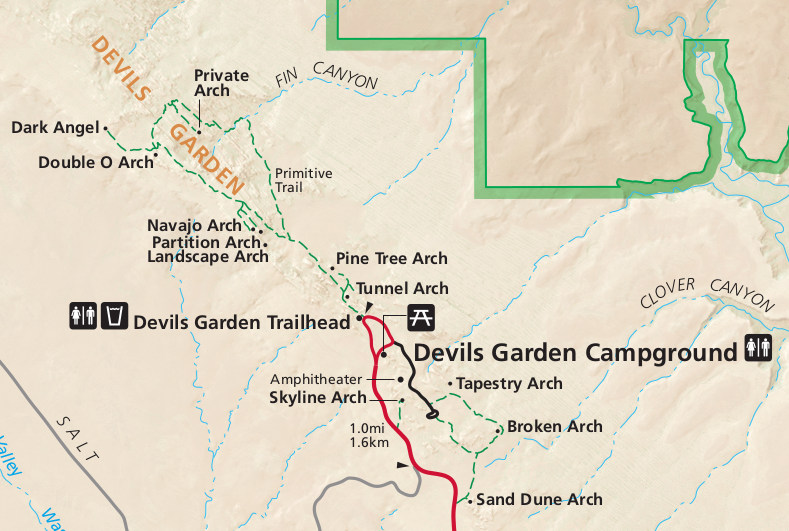
Skyline Arch is an easily accessible and photographable arch and the last recommend stop before reaching the end of the park and making the turn around at Devils Garden.

 This arch is very intriguing, because it doubled in size about 75 years ago when a large chunk of rock tumbled out. The trail under the arch leads to this rubble.

Even if you don’t plan to hike to Skyline Arch, make sure to stop and check out the sign at the trailhead. It shows the arch before it doubled in size, and you get a nice idea of how this slow process can happen quickly. The Arch is beautiful and always framed against the sky, which gives it the name Skyline. In fact, at the end of the trail, the arch is about 75 feet above your head at the top of an unscalable wall.

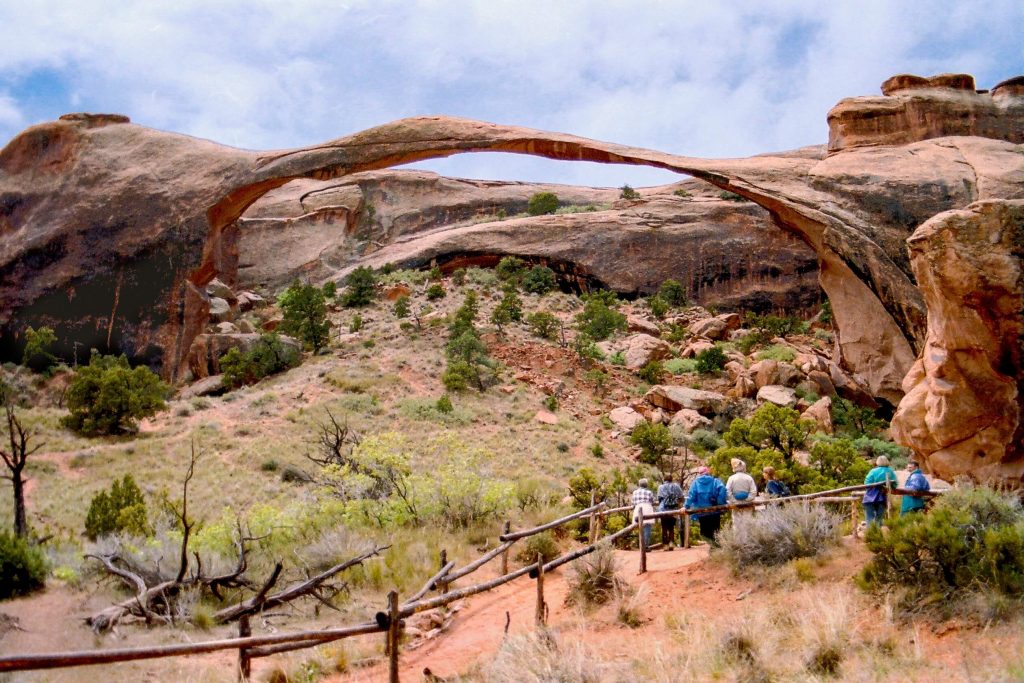
LANDSCAPE ARCH

At the very end of Arches Scenic Drive is the Devil’s Garden Trailhead mostly-flat path to Landscape Arch, stopping to see Tunnel Arch and Pine Tree Arch along the way. .
Landscape Arch is the longest of the many natural rock arches located in the Arches National Park in the U.S. state of Utah. The arch is among many in the area known as Devil’s Garden in the north area of the park. It can be reached by short walk/hike along a maintained trail.
EXIT PATH

You’ll exit the Park via the same road, so if you feel you missed something, you can catch it on the way out.

Design a site like this with WordPress.com
Get started