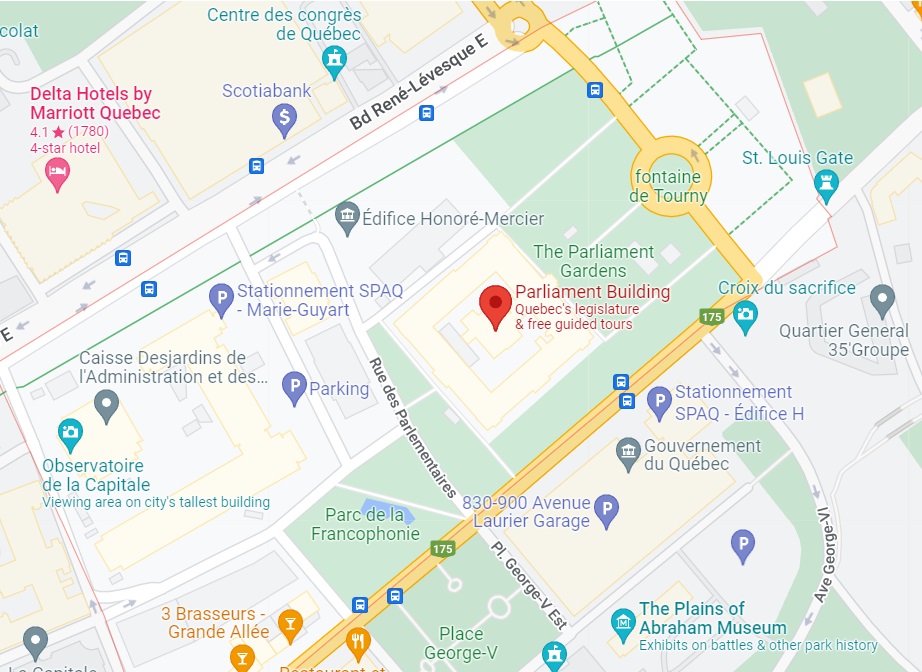
Parliament Hill is located in the Upper Town, just outside the fortifications. It’s home to a number of government buildings, the famous Plains of Abraham, and the festive section of Grande Allée.
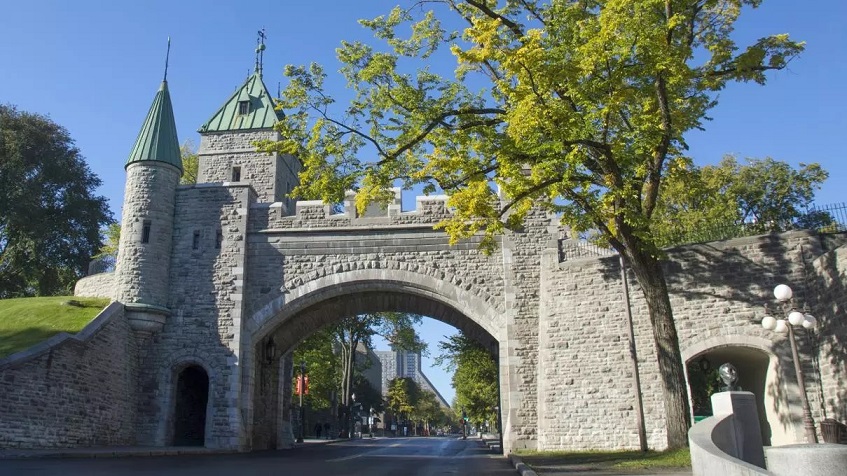
St. Louis Gate
The Saint-Louis Gate is one of the entry points in the fortified walls surrounding Old Québec. On the inside of the walls, rue Saint-Louis stretches from the gate to Château Frontenac, while on the outside can be found the Parliament Building and Grande Allée.
This iconic gate is part of the fortification system comprising bastions, gates and defensive structures that account for Québec City’s renown as a fortified colonial city and the reason Old Québec was named a UNESCO World Heritage Centre. Only three other gates that were part of the original fortifications survive: the Kent, Saint-Jean and Prescott gates.
The history of the Saint-Louis Gate
The first Saint-Louis Gate was in the late 17th century under the French Regime at its present location.
During the British Regime, the army closed the gate doors at night to restrict travel between the city and outlying areas, which disrupted trade and hampered the city’s development. When the British troops left in 1871, the gate doors were removed to permit traffic to flow freely.
Appreciative of the historical value of this architectural treasure, the newly appointed Governor General of Canada, Lord Dufferin, was opposed to having the ramparts and gates torn down. He, along with an Irish architect specializing in the reconstruction of medieval military structures, developed a plan to preserve and enhance these defensive works. The result of their efforts are the fortifications and gates seen today. The current Saint-Louis Gate dates back to 1878 and is both much larger and more esthetically pleasing than the original.
Croix du sacrifice
The Cross of Sacrifice: Thousands of Canadians died in the two great world wars and it is in remembrance of their sacrifice that a cross has been erected next to the entrance to nearby Battlefields Park from the Porte Saint-Louis. Every year, on November 11, Armistice Day, a ceremony to commemorate these historic events takes place here, organized by Branch No. 260 of the Royal Canadian Legion. If the model of the Cross of Sacrifice was inspired by France, the idea, it, comes from Great Britain and is attributed to Lieutenant-Colonel LG Scott who issued it to his colleagues during a meeting of veterans .
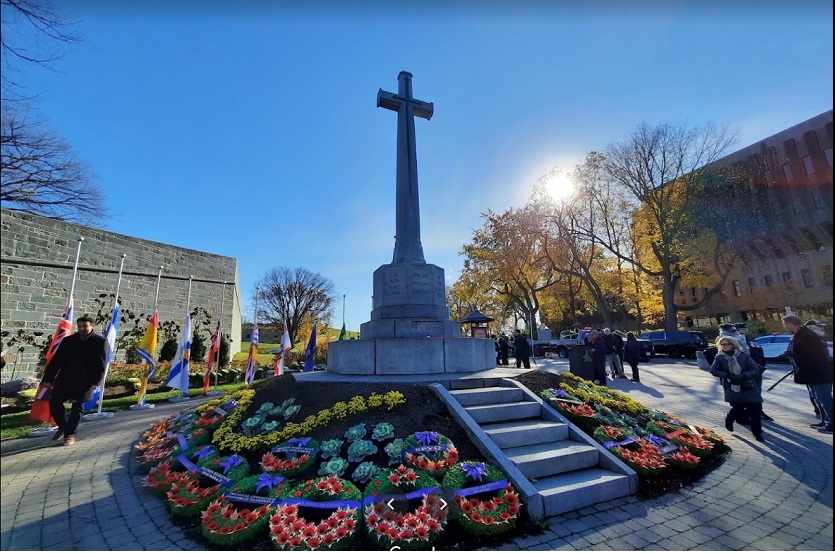
It was around the 1920s. A committee was formed to carry out the project, and a subscription launched in the public, which brought in the amount of $4,000. The monument was unveiled on July 1, 1924 by the Governor General of Canada, Lord Byng of Vimy. This ceremony gave rise to a great patriotic demonstration accompanied by the band of the 22nd Regiment. The Cross of Sacrifice is made of a single stone. The four angles have been knocked down to give the shaft the octagonal shape. The sword occupies almost three quarters of the facade. A copy of the program for the day of July 1, 1924, some newspapers and coins of the time have been deposited in the base of the monument. A second inauguration was to take place in 1947.
It was then that a few handfuls of soil from France were added to the base, an initiative of the “Société Alsace-Lorraine, terre française”. An inscription reads: “To our dead of the great war” with an English translation. In 1947, the memory of the heroes of the 1939-1945 war was joined, symbolized by these words: “A nos glorieux Morts”/“To our glorious dead”. (Reference: The commemorative monuments of Quebec, by GE Marquis.) It should be noted that after the Korean War, in 1953, a sentence was added evoking this other conflict. All these memories are now melting into each other. Monique Duval, Quebecensia, volume 17, no 1, December 1996
Fontaine de Tourny
This majestic fountain, adorned with numerous figures and boasting 43 water jets, stands in front of the Parliament Building.
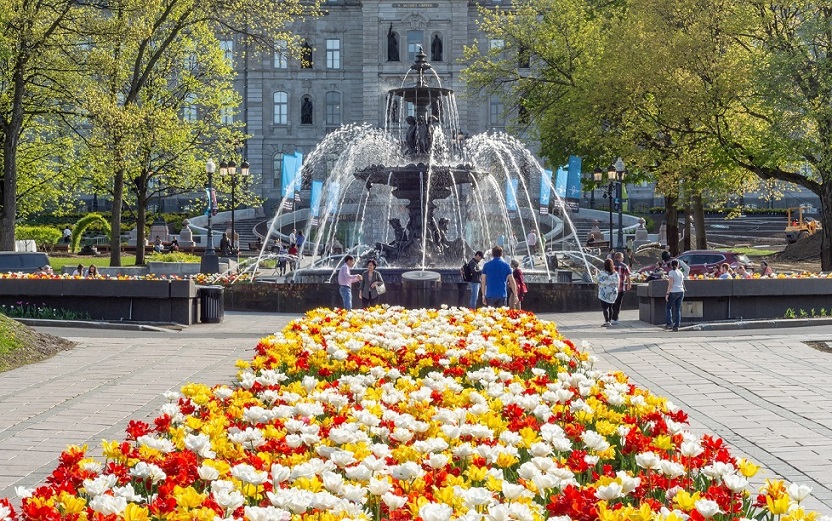
Originally installed in Bordeaux, France, in 1857, and then removed in 1960, the fountain was discovered by chance during a visit to a flea market in Paris by a businessman from Québec City. At the time he was looking for a unique gift to make to the City of Québec for its 400th anniversary. He had the fountain shipped to Québec City, where it was restored before being presented to the city.
History of the Tourny Fountain
Although only recently installed in Québec City, the Tourny Fountain has a fascinating history. Six copies of this work, designed by French sculptor Mathurin Moreau in 1853, were made, and it was exhibited at the 1855 World’s Fair in Paris.
Delighted by the beauty of this work, the mayor of Bordeaux (a twin city of Québec City) acquired two of the six and had them installed in the streets of Tourny in the centre of the city. In 1960, the two were dismantled during the construction of an underground parking lot. One of them later wound up at a Parisian antique dealer.
In the early 2000s, Québec City businessman Peter Simons was mesmerized by the esthetics of the fountain, despite its dilapidated state. Confident in its potential, Simons purchased the fountain and hired a Parisian specialist to restore it. He know that it would complement the architectural style of the Parliament Building perfectly.
The fountain was then shipped to Québec City, restored and presented to the city to celebrate its 400th anniversary. This gesture by the Simons family was an expression of thanks to local residents for contributing to the success of the Simons fashion retail store, located in Old Québec since 1840. The five other copies of the fountain are in Porto, Angers, Soulac, Saint-Quintin and Geneva.
Parliament Building
The Parliament Building was erected between 1877 and 1886. It is an imposing structure whose four wings form a large square. Its architecture, inspired by the Louvre Palace in Paris, makes it one of the only French-style institutional buildings in Québec City. It is Québec’s oldest historic site and the seat of Québec’s government. The building’s main facade boasts 26 bronze statues erected to the memory of key historical figures. It’s a fascinating place full of secrets and surprises.
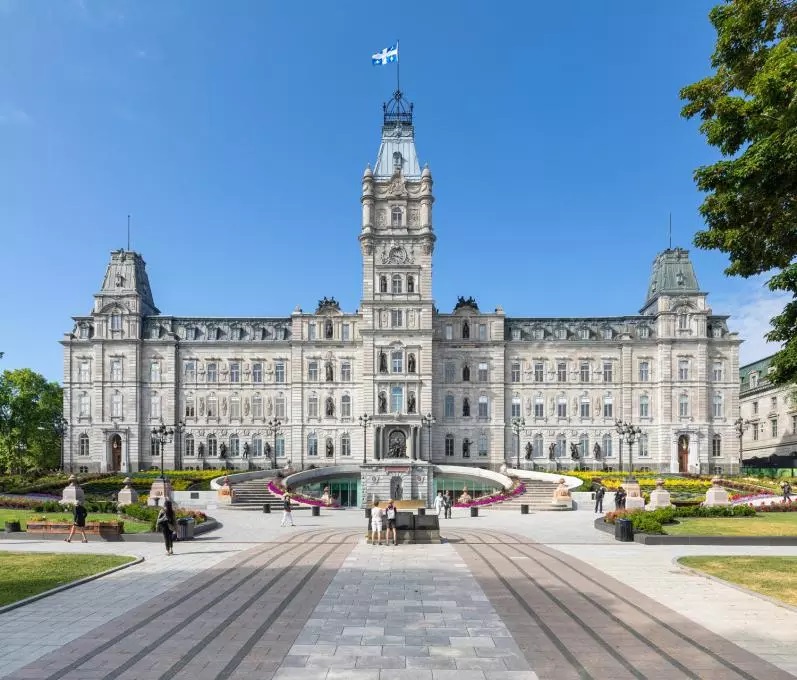
You can take a free guided tour of the Parliament, where the national assembly’s 125 members determine the fate of the province. The tour lasts 60 minutes and delves into the history and workings of Québec’s parliamentary institutions as well as the history of the province itself. Cap off the experience with a meal at Le Parlementaire, a swank restaurant that serves up delicious local products. It’s one of the hill’s best‑kept secrets!
Located in the heart of Québec City, just steps from Old Québec, the National Assembly offers you a unique experience through its free guided tour. Learn about the Parliament of Québec and hear some remarkable stories! This fascinating tour sheds light on Québec’s history as well as its parliamentary institutions and their major contribution to Québec society. The tour features the National Assembly’s beautiful architecture and works of art. Visit one of Québec City’s top tourist attractions!
Opening Hours
Monday to Friday: 8:30 a.m. to 4:30 p.m.
Saturday: 9:30 a.m. to 4:30 p.m.
Sunday: Closed
 Chú Tiểu Đi Hoang